

In The Media
Lilia Shevtsova
{
  "authors": [
    "Lilia Shevtsova"
  ],
  "type": "commentary",
  "centerAffiliationAll": "",
  "centers": [
    "Carnegie Endowment for International Peace",
    "Carnegie Russia Eurasia Center"
  ],
  "collections": [],
  "englishNewsletterAll": "",
  "nonEnglishNewsletterAll": "",
  "primaryCenter": "Carnegie Russia Eurasia Center",
  "programAffiliation": "",
  "programs": [],
  "projects": [],
  "regions": [
    "Russia"
  ],
  "topics": [
    "Political Reform",
    "Foreign Policy"
  ]
}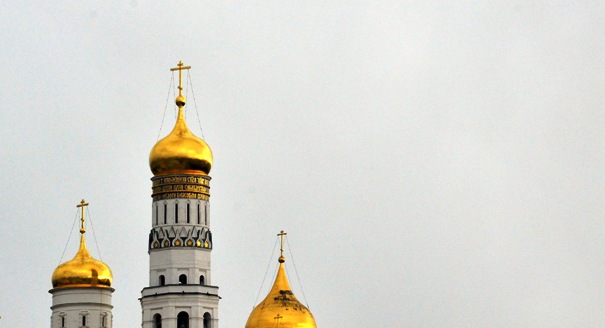
Source: Getty
Russian state and national identity are still based on the search for the enemy. However, the patriotic euphoria that followed Crimea has begun to wear off. As the Kremlin attempts to understand what to do next in Ukraine, it has become clear that Russians are not prepared to pay for it with their lives.
The amazingly successful military-patriotic Kremlin mobilization of the Russian society after the Crimea annexation has confirmed the sad truth: Russian state and national identity is still based on the search for the enemy. During the last two decades of the post-Soviet evolution, Russian society has failed to find another national idea and create a new cohesive social and normative structure. The current political regime has been trying to prevent any popular consolidation on the horizontal level, attempting to liquidate the threat of any anti-regime alternative. The Kremlin’s agenda is clear: to undermine the process of transforming individuals into citizens, and to return the nation toward total submissiveness and the status of “poddanye,” that is, the state slaves.
Meanwhile, the undeclared military conflict in the Ukrainian East has gradually demonstrated its ugly side: dozens of coffins with killed Russian mercenaries are silently brought to their native towns and secretly buried under the watchful eyes of the security services. The authorities, both civilian and the military, turn away from the families of the deceased, saying “We did not send your husband (son) to Ukraine!” This attitude could be easily explained: the Russian population is not ready for a real war and bloodshed, which is why the authorities try hide the truth about casualties. However, the sobering among the population has started. There are signs that the feeling of Post-Crimea euphoria is gone as the uneasy return to reality sets in.
There is no more mass support for annexation of the Ukrainian South-East. Putin is still excluded from criticism. But people’s attitude toward the authorities has returned to the old sour moods: according to recent Levada polls, only 12 percent of respondents believe that the Russian authorities are “honest” and 22 percent think that they are “a good team.” Only 11 percent of respondents believe that the authorities have the same interests that ordinary Russians have.
In the situation when the Kremlin turns to the war policy trying to prove that the State is the only value and has to be defended and obeyed, only 47 percent think that the interests of the state are more important than interests of an individual. And 39 percent of respondents are convinced that the interests of the individual are more important. This means that the military-patriotic drug has started to wear off.
The Kremlin understands its fragile nature and has to deliberate: what to do next? A new battle with the enemy? Growing tension between Moscow and Kiev shows that the Kremlin is playing with another military (or threat of military involvement) solution. But Russians are not ready to pay for it with their lives.
Former Senior Associate, Russian Domestic Politics and Political Institutions Program, Moscow Center
Shevtsova chaired the Russian Domestic Politics and Political Institutions Program at the Carnegie Moscow Center, dividing her time between Carnegie’s offices in Washington, DC, and Moscow. She had been with Carnegie since 1995.
Recent Work
Lilia Shevtsova
Lilia Shevtsova
Carnegie does not take institutional positions on public policy issues; the views represented herein are those of the author(s) and do not necessarily reflect the views of Carnegie, its staff, or its trustees.

Ahead of a tough winter for Ukraine, Donald Trump’s swing back toward Russia bodes ill. But instead of panicking, Kyiv’s European allies are focusing on action.

Rym Momtaz

Funding Ukraine remains a priority for European leaders. As Russia’s war of aggression heads into another winter, two feasible options to mobilize support for Kyiv should be fast-tracked.


Vladyslav Rashkovan, Gregory P. Wilson

While the EU and European governments are embracing the much-lauded middle-power moment, this entails three difficult conundrums.

Richard Youngs

Europe is facing rising populism internally as well as external pressures from Russia, China, Turkey, and the United States.

Dimitar Bechev

A notable degree of participative democracy has firmly arrived in Europe. But to have more far-reaching impact, democratic deliberation needs to move into a radically new phase.
Richard Youngs