

Paper
Yezid Sayigh
{
  "authors": [
    "Yezid Sayigh"
  ],
  "type": "legacyinthemedia",
  "centerAffiliationAll": "dc",
  "centers": [
    "Carnegie Endowment for International Peace",
    "Malcolm H. Kerr Carnegie Middle East Center"
  ],
  "collections": [],
  "englishNewsletterAll": "menaTransitions",
  "nonEnglishNewsletterAll": "",
  "primaryCenter": "Malcolm H. Kerr Carnegie Middle East Center",
  "programAffiliation": "MEP",
  "programs": [
    "Middle East"
  ],
  "projects": [],
  "regions": [
    "Levant",
    "Syria",
    "Middle East"
  ],
  "topics": [
    "Security"
  ]
}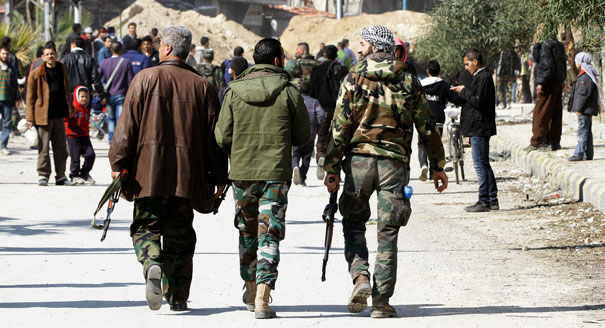
Source: Getty
The failure of the Geneva-II peace talks may have been inevitable but it has also raised the stakes even further for the Assad regime and the opposition, each of which still seeks to gain a decisive advantage on the battlefield.
Source: Al-Hayat
The failure of the first and second rounds of the Geneva-II peace talks to change the dynamics of the Syrian conflict was inevitable, but has raised the stakes even further for the Assad regime and the opposition, each of which still seeks to gain a decisive advantage on the battlefield. Their much-anticipated Spring offensives are already in their opening phases, and the violence will intensify and expand in coming weeks and months, possibly to unprecedented levels. There will be no third round of talks in Geneva.
Serious negotiations are off the table for many months to come, if at all. For the first time since the UN Security Council issued its presidential statement of March 16, 2012, adopting the six-point plan for peace proposed by Special Envoy Kofi Annan, the international community does not have an agreed framework for resolving the Syrian crisis diplomatically. The Annan plan was followed by the Geneva-I communiqué of June 30, the first and second Brahimi missions, and lastly the U.S.-Russian initiative of May 2013 that led to Geneva-II, which has now failed.
In part, this is because the U.S. and Russia, along with their main regional counterparts, remain unwilling to move beyond their basic positions on what a political solution in Syria would entail concretely, despite sharing grave concerns over the jihadist threat and the risks of fragmentation in Syria and spillover for its neighbors. This means that the fundamental incentive structure for the Syrian protagonists will not change, even when most recognize the limitations of relying primarily on altering the military balance.There is a telling historical parallel with the international peace convened in Geneva by the U.S. and Russia’s predecessor, the Soviet Union, following the Arab-Israeli war of 1973. The superpowers agreed on the importance of resolving the conflict that had taken them to the brink of nuclear confrontation, but the talks they launched in December adjourned within weeks without results. More important was U.S. Secretary of State Henry Kissinger’s “shuttle diplomacy,” brokering separate military disengagement agreements on the Egyptian and Syrian fronts with Israel and splitting the Arab war coalition.
The U.S.-USSR statement of October 1977 proposing to reconvene the Geneva conference was their last attempt at joint diplomacy, and was immediately abandoned by the U.S. President Jimmy Carter and then displaced by Egyptian President Anwar Sadat’s surprise visit to Jerusalem. The signing of the Egyptian-Israeli peace treaty in 1979 radically altered the strategic military balance, enabling Israel to expel the Palestine Liberation Organization (PLO) from Lebanon in 1982. The end of the Cold War and the 1991 Gulf war with Iraq allowed the convening of the Madrid peace conference, but this was collective diplomacy only in name, as the U.S. determined the agenda, format, and participant list. When the PLO finally signed the Oslo Accords with Israel in 1993, this was through a bilateral process, in which it accepted terms that had divided it bitterly since 1973.
For Syria, in 2014, the failure of Geneva-II means that Resolution 2139 issued by the UN Security Council on February 22 to ensure humanitarian aid access represents the ceiling for diplomacy from now on. In order to secure Russian (and Chinese) support, the draft was watered down to a point where it relies entirely on good faith for implementation. True, Resolution 2139 threatens to take unspecified “further steps” in the case of non-compliance, but there is nothing to suggest that Russia (or China) will allow in future what it has consistently blocked in the past: meaningful sanctions of even the most modest kind against the Syrian regime.
As the Palestinians have found, non-binding UN resolutions and annual reports reiterating basic principles from bodies such as the Committee on the Exercise of the Inalienable Rights of the Palestinian People are no substitute for forceful diplomacy. A moment for this may come at the end of June if the regime is seriously dragging its feet on completing the elimination of its chemical weapons capability, offering the U.S. an opportunity to revive the cruise missile diplomacy it briefly threatened last August. But the odds are stacked against U.S. military action and getting worse: the reluctance of the Obama administration to set off on a course that may require further escalation is now compounded by the deterioration of relations with Russia over the Ukraine crisis, making Russian acquiescence in punitive action against the Assad regime even less likely.
Here is the catch: the U.S. and other Friends of Syria need Russia to willingly exert enough pressure on the Assad regime to alleviate the humanitarian crisis in Syria, but unless they are willing to raise the price for failing to do so they cannot hope for a shift in the Russian position nor for a chink to open in its political – as well as military and economic – support for the Assad regime. This has been true all along, but the U.S. is running out of opportunities to exercise credible diplomacy. Modest increases in assistance to Syria’s armed rebels will not change the basic equation.
The time has come to recognize the implications for future diplomacy. So far, the U.S. approach has been to reiterate the interpretation of the Geneva communiqué of June 2012 adopted by the Friends of Syria – especially as reaffirmed and expanded in their statement of October 22, 2013 – but nothing on the ground compels Assad, Russia, or Iran to engage on that basis. Quite the contrary, a negotiated peace agreement under present circumstances can only resemble Russian and Iranian preferences, which are closest in substance and format to the cosmetic proposals made by the Syrian regime.
The Friends of Syria are justified in refusing to seek peace on these terms, and in holding on to their own counter-vision for genuine transition in Syria. But they need to be honest that this is tantamount to giving up on effecting meaningful political change anytime soon, leaving Syria trapped in its spiraling, destructive military stalemate.
In all cases, if another joint diplomatic framework appears – not when, as this is no longer certain – it will be very different from Geneva-I/II. One warring side or the other will have made a significant political retreat from its current position, finally recognizing its failure to achieve substantial change on the ground. But there is little prospect of this for the foreseeable future.
This article was originally published in Arabic by Al-Hayat.

Senior Fellow, Malcolm H. Kerr Carnegie Middle East Center
Yezid Sayigh is a senior fellow at the Malcolm H. Kerr Carnegie Middle East Center in Beirut, where he leads the program on Civil-Military Relations in Arab States (CMRAS). His work focuses on the comparative political and economic roles of Arab armed forces, the impact of war on states and societies, the politics of postconflict reconstruction and security sector transformation in Arab transitions, and authoritarian resurgence.
Recent Work
Yezid Sayigh
Yezid Sayigh
Carnegie does not take institutional positions on public policy issues; the views represented herein are those of the author(s) and do not necessarily reflect the views of Carnegie, its staff, or its trustees.

Europe is facing rising populism internally as well as external pressures from Russia, China, Turkey, and the United States.

Dimitar Bechev

The new U.S.–Denmark–Greenland agreement will help Washington exert political, economic, and financial dominance under the guise of security. Yet, it acknowledged Copenhagen’s and Nuuk’s sovereignty on the island.

Marc Pierini

A summer of escalation in the Black Sea has hurt Ukraine economically and is exacerbating world food security. A truce is needed—as is a broader reframing of Europe’s Ukraine strategy.

Thomas de Waal

Are Germany’s economic, industrial, and political struggles becoming a liability for the EU’s ability to rise to the geopolitical moment?

Rym Momtaz, ed.

European states control several Overseas Countries and Territories around the world that carry strategic, economic, and environmental weight. As great powers challenge the rules-based order, defending them is a geopolitical imperative for Europe.
Marc Pierini