

Commentary
Balázs Jarábik
{
  "authors": [
    "Balázs Jarábik"
  ],
  "type": "commentary",
  "centerAffiliationAll": "",
  "centers": [
    "Carnegie Endowment for International Peace",
    "Carnegie Russia Eurasia Center"
  ],
  "collections": [],
  "englishNewsletterAll": "",
  "nonEnglishNewsletterAll": "",
  "primaryCenter": "Carnegie Endowment for International Peace",
  "programAffiliation": "",
  "programs": [],
  "projects": [],
  "regions": [
    "Russia",
    "Eastern Europe",
    "Ukraine"
  ],
  "topics": [
    "Political Reform",
    "Security",
    "Military",
    "Foreign Policy"
  ]
}
Source: Getty
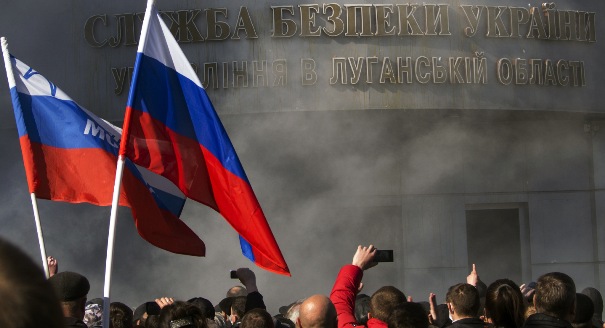
Kyiv’s anti-separatist operation could isolate and limit separatist forces in Eastern Ukraine, while the government attempts to deliver financial and economic assistance to the East, which is vital to Kyiv’s ability to reassert itself in the region.
Days before the Geneva talks—scheduled to take place on April 17 between the EU, Russia, Ukraine and the United States—the actions of pro-Russian separatists in Eastern Ukraine have put the Kyiv government in a no-win situation: to do nothing would risk looking helpless and hapless, while a display of force would escalate the conflict, generate more sympathy for the separatists among the population, and raise the chances of Russian military intervention.
Although there are some doubts whether Russian military personnel are involved in these actions in Eastern Ukraine, there is little doubt that this escalation could have happened without Russia’s consent and assistance. Moscow’s aim appears clearer: disrupting the presidential elections, reducing Ukraine’s new government’s credibility, and shoring up pro-Russian political and paramilitary forces.
The separatist movement seems to be a collection of different groups rather than a homogeneous force. It has in its ranks some organized crime groups, retired military personnel nostalgic for the good old USSR, average citizens frustrated by the government’s multiple failures to deliver on its promises and fearing the loss of what little security they still have, social outcasts, the unemployed and drunkards. Due to the economic hardship their numbers are certain to grow. However, the vast majority of citizens of Eastern Ukraine are mired in apathy.
For the separatist movement to emerge, it needed not just Russian assistance, but local organizers. The speculation—unconfirmed—in the past few weeks has been that the Yanukovych family through its agents has been paying separatist organizers, as well as law enforcement in Eastern Ukraine for inaction. Coincidentally, Viktor Yanukovych gave a press conference just as the takeovers of police stations and government offices got underway. This does not mean that the Yanukovych "family" is controlling the operation, but its rumored activities (for example, bribing local law enforcement) contribute to the erosion of the power and authority of the Kyiv government. If rumors of the Ukrainian oligarchs’ coordinated support for the Maidan are true, Yanukovych could be taking a page out of the oligarchs’ playbook by organizing and supporting separatist actions in Eastern Ukraine.
Eastern Ukraine appears to be following the Transnistrian scenario. The separatist movement there took a long time—three years—to develop because there were not enough pro-Russian forces in the territory, and Russia did not have the military capacity for a full-scale invasion. The newly-declared Russian doctrine of protecting ethnic Russians and even Russian-speakers, combined with the threat to use military force, represents a serious challenge to the dual identity of many residents of Eastern Ukraine. In Donetsk, the overwhelming majority of residents support Ukrainian territorial integrity, even though the break-down of central authority, the growing economic hardships, the promise of Russian pensions for retirees, and the growing number of the unemployed may eventually tip the balance in favor of joining Russia.
In Kyiv, there are growing calls for a general mobilization. This may help the separatists, though. A move by the Ukrainian army into Eastern Ukraine may prompt the local population to look to Russia for protection. But without military backing, Kyiv’s operations to suppress the separatists would be much more difficult to carry out.
However inaction by the Kyiv government would only make Ukraine’s instability worse. The anti-separatist operation could isolate and limit separatist forces, while Kyiv attempts to deliver financial and economic assistance to the East, which is badly needed and vital to Kyiv’s ability to reassert itself in the region. The May 25 presidential election is now more important than ever—not only for the central government’s legitimacy but for the territorial integrity of Ukraine.

Political analyst, former Slovak diplomat, and consultant specializing in Eastern Europe
Recent Work
Balázs Jarábik
Balázs Jarábik
Carnegie does not take institutional positions on public policy issues; the views represented herein are those of the author(s) and do not necessarily reflect the views of Carnegie, its staff, or its trustees.
Amid uncertainty caused by the Iran war, the global drive for nonproliferation has stalled. With Europe diplomatically marginalized and countries reassessing their nuclear options, efforts to curb the spread of nuclear weapons risk becoming irrelevant.

Jane Darby Menton
Between the United States’ market-driven approach and China's state-led industrial strategy, Europe is reckoning with how it can remain competitive in the global economy. But is Europe in danger of becoming a U.S. or China colony?

Noah Barkin, Anu Bradford
Preparing candidate countries for EU membership is no longer enough. As the enlargement process becomes a reality, the union must also prepare its own societies.

Iliriana Gjoni
The full list of humiliations Europe has endured since Donald Trump returned to the White House makes for grim reading. But Washington’s adversarial approach to its allies undermines its own power base.

Rym Momtaz
The closure of the Strait of Hormuz has triggered a global energy crisis, but Europe is stuck in reaction mode. Without more strategic foresight, the EU will remain dependent on fossil fuels and will never be truly secure.


Milo McBride, Pauline Gerard