

In The Media
David Rothkopf
{
  "authors": [
    "David Rothkopf"
  ],
  "type": "legacyinthemedia",
  "centerAffiliationAll": "",
  "centers": [
    "Carnegie Endowment for International Peace"
  ],
  "collections": [],
  "englishNewsletterAll": "",
  "nonEnglishNewsletterAll": "",
  "primaryCenter": "Carnegie Endowment for International Peace",
  "programAffiliation": "",
  "programs": [],
  "projects": [],
  "regions": [
    "North America",
    "United States"
  ],
  "topics": [
    "Political Reform",
    "Economy",
    "Security"
  ]
}
Source: Getty
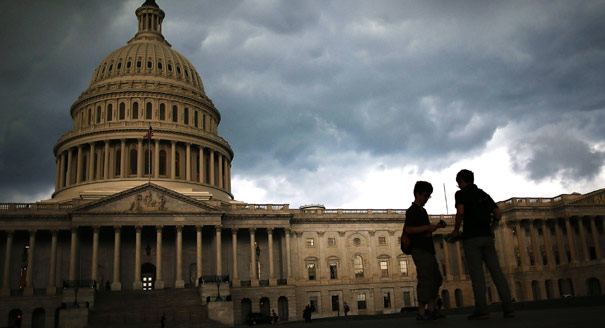
In Washington, strength lies with the opponents rather than the proponents of change.
Source: Foreign Policy
In the seat of American power, power spends most of its time on its seat. That's because, as Henry Kissinger once observed, the greatest force at work in America's capital is inertia.
It handily trumps partisanship and also leaves the more positive drivers of action that one might hope for in a government -- such as leadership, creativity, or moral courage -- coughing and wheezing in the dust.
One clear, compelling illustration of this is on display in this issue of Foreign Policy. Shawn Brimley and Paul Scharre's thoughtful and thought-provoking visual feature, "Ctrl+Alt+Delete: Resetting the U.S. Military," asks the sensible question: What would the military look like if we were to design it today from scratch? Certainly, the piece observes, the military would not include the breathtaking redundancies, efficiency-killing bureaucracy, and obsolete systems of today's bloated defense apparatus. You might disagree with the feature's conclusions about what a right-sized, technologically up-to-date, doctrinally sound military, conceived and prepared to ensure America's safety and worldwide interests, might look like. That's perfectly reasonable. But it is impossible not to conclude that the feature's call to debate what the military should look like and then implement the agreed-upon changes makes sense.It makes economic sense because the United States spends more on defense than all other major powers combined -- even though very nearly all of them are our allies. It makes national security sense because the threats the country faces are changing and because emerging powers are not the slaves to legacy systems that the United States is. It makes political sense because such a reform process is the very essence of good governance and would free up resources for endeavors that could help broader cross-sections of the American population.
Yet the one thing that we know about this idea is that it's never going to happen.
That is because it would require the kind of far-reaching change that the government is terrible at achieving. It would involve confronting moneyed, entrenched interests in the private sector as well as the Pentagon, which kills ideas that threaten its core programs more efficiently than it does any foreign enemy. This is the military-industrial complex that Dwight Eisenhower warned us about as he prepared to leave office -- except today it is bigger and more powerful than it has ever been.
This does not mean, of course, that there are no hugely creative military leaders who have contemplated just the kind of changes that are needed. In Washington, however, strength lies with the opponents rather than the proponents of change. And the opponents possess the ultimate political weapon of mass destruction: They can accuse leaders who want to challenge the status quo of making America weak. So we're left with all the systems the country has accumulated to counter every post-World War II defense challenge: multiple air forces, multiple expeditionary forces, multiple cyber commands.
We can't afford what we have. We don't need much of what we have. The country is misallocating resources in precisely the same way as other nations that have historically made themselves vulnerable, both militarily and economically. Yet any positive, proactive change will exist only on the margins until some crisis demands otherwise, while other supposed "innovations" will in fact just maintain things as they are and have always been. All you need to do is flip back in the magazine and spend a few minutes reading Rosa Brooks's excellent and eye-opening exploration of the Army's regionally aligned forces (RAF) strategy -- convoluted, ill-defined, and dubious -- to see the creative genius of Washington in action. As Brooks concludes, the strategy may be of more value in protecting the Army from budget cuts than in protecting America from future enemies.
Washington's debilitating strain of sleeping sickness affects other parts of the government too.
Indeed, the political system hates action more than nature abhors a vacuum. Both political parties would no doubt agree that the country cannot afford the retirement health-care system it has, even if they have different answers for how to fix the problem. Both parties also have to agree that it is in America's interest to invest in highways and bridges in a meaningful way, which hasn't been done since the Eisenhower era. And both must acknowledge that having half the minority students in inner cities not graduating from high school is a formula for social catastrophe. Yet all these issues remain largely unaddressed.
Even outside government, we have built massive apparatuses designed to assert that some issues are not issues at all, in order to protect the interests of a few. Climate change is one such issue: enormous and indisputable, yet disregarded thanks to political pressure from a well-funded alliance with an affinity for profit and an allergy to science. Inequality rivaling that of the Gilded Age is another issue, as is the country's inability to create jobs for the middle class, because the rich use their influence to prioritize their interests above those of the rest. The U.S. financial system, meanwhile, is corrupt to its core, but its leaders act with impunity -- sometimes with the assistance of members of the government.
With each of these issues, the common sense that keeps a child from touching an open flame or playing in traffic would suggest that actions are urgently needed. But they are not and will not be forthcoming. In no small part, this is because we have given a handful of people disproportionate influence over elections. The Supreme Court's recent McCutcheon decision, like Citizens United before it, enshrines the idea that money is speech -- therefore those with more money now have more say in the country's national affairs. We have also institutionalized the right-left, no-compromise polarization of the political system via gerrymandering and Capitol Hill customs. This has undercut reasoned debate and votes that could produce progress.
But our inertia is caused by something else too. Call it superpower smugness. Or just call it complacency. We don't create, or even really demand, genuine change in America because things seem to be working well enough. America is the world's richest and most powerful nation. When we have crises, we recover from them. The country can make catastrophic errors of judgment in places like Iraq and Afghanistan and absorb the costs and collateral damage to its national image. Furthermore, the private sector, for all its self-interested political behavior, is infused with genius and a stunning capacity to reinvent itself. It has compensated time and again for Washington's sloth and willful ignorance.
So we have been numbed into believing that black is white, that a failing system is functioning, that we, alone among nations, are invulnerable to our own stupidity. If there were ever a flaw in a strategy for national security, this is surely the most pernicious. The only antidote is a healthy dose of courage to act first with good sense and second with a spirit for reform, not just within the military but among average civilians as well.
Former Visiting Scholar
David Rothkopf was a visiting scholar at the Carnegie Endowment as well as the former CEO and editor in chief of the FP Group.
Recent Work
David Rothkopf
David Rothkopf
Carnegie does not take institutional positions on public policy issues; the views represented herein are those of the author(s) and do not necessarily reflect the views of Carnegie, its staff, or its trustees.

Are Germany’s economic, industrial, and political struggles becoming a liability for the EU’s ability to rise to the geopolitical moment?

Rym Momtaz, ed.

European Commission President Ursula von der Leyen is about to give her annual address on the state of the EU. Here’s what she won’t—but should—say.
Rym Momtaz

Radical-right parties are expected to do well in upcoming elections in four of the EU's biggest member states. If successful, they could prevent the union from addressing key challenges ahead.

Stefan Lehne

Canadian Prime Minister Mark Carney has twice inspired praise for standing up to U.S. President Donald Trump: at the 2026 World Economic Forum in Davos and on Canada-U.S. trade negotiations. Is Carney showing a third way better than the EU has in dealing with the Trump administration?
Rym Momtaz, ed.

European states control several Overseas Countries and Territories around the world that carry strategic, economic, and environmental weight. As great powers challenge the rules-based order, defending them is a geopolitical imperative for Europe.

Marc Pierini