

Commentary
Balázs Jarábik
{
  "authors": [
    "Balázs Jarábik"
  ],
  "type": "commentary",
  "centerAffiliationAll": "",
  "centers": [
    "Carnegie Endowment for International Peace",
    "Carnegie Russia Eurasia Center"
  ],
  "collections": [],
  "englishNewsletterAll": "",
  "nonEnglishNewsletterAll": "",
  "primaryCenter": "Carnegie Endowment for International Peace",
  "programAffiliation": "",
  "programs": [],
  "projects": [],
  "regions": [
    "Eastern Europe",
    "Ukraine"
  ],
  "topics": [
    "Political Reform"
  ]
}
Source: Getty
Weeks ago, after heavy fighting in the southern city of Mariupol, local leaders brokered an agreement without the participation of Kyiv-based or regional authorities. Kyiv should move toward a new power-sharing deal or face more Mariupol-type solutions.
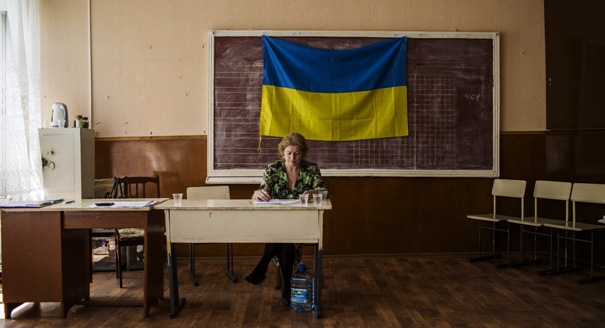
Ukraine demonstrated unity by voting overwhelmingly for Petro Poroshenko in every region as the country’s new president, but, at the same time, two local elections showed a different picture. Under the surface of the unifying outcome of the presidential vote on May 25, Ukraine’s messy yet competitive politics merit close scrutiny.
Consider the results of voting for the Kyiv city council and the Odessa mayoral race, both of which were fiercely contested in (very) different contexts.
In Odessa, exit polls and the actual results turned out to be significantly different. The city’s former mayor, Eduard Gurvitz was defeated by Gennadij Truhanov, a member of the Batkivschina (Fatherland) party with, shall we say, a dubious reputation. Gurvitz is widely believed to have enjoyed support from the Euromaidan movement, but, after the tragic events of May 2 in which dozens died in street clashes and a deadly fire, that support may have cost him a shot at returning to his old job. At the same time, Truhanov’s success suggests that players from pre-Maidan Ukraine such as Batkivschina are willing to go as far as teaming up with (local) “bad boys” to ensure its own survival.
Neither Poroshenko nor Klitschko should see the results in Kyiv as the product of their alliance. Rather, it’s a reflection of the circumstances in which Ukraine and its voters found itself after Viktor Yanukovych fled the country. The historical task for both of them is to build deeper alliances, both at the national and local levels. These local elections demonstrated the importance of holding parliamentary elections—and help explain why scheduling them has proven so difficult. Given the public’s desire to break the monopoly on political life exercised by Yanuvovych-era parties, changing the electoral system to a proportional scheme with open lists and preferential voting—a step advocated by Maidan’s civic enablers—would infuse new blood into Ukraine’s dysfunctional politics. This would also help to address the structural challenges of devolution of central authority and strengthening of self-government. Last but not least, it would let President Poroshenko focus on reform of the key (and weakest) aspect of central government, the law enforcement agencies, a task which fits into his responsibility to handle foreign and defense policy under the current constitution. One suspects that Poroshenko’s actions in this area could easily take on authoritarian trappings, based on his post-Orange track record using his position as head of National Security Council for his own interest.
Ukraine, both East and West, expects Kyiv to pursue further political devolution. Poroshenko is likely to be wary of the phenomenon following the emergence of the so-called Mariupol memorandum on May 16. Just after botched military attempts to take on separatists in the city, local stakeholders, including businesses, law enforcement, and some of the separatists themselves, signed an agreement that allowed peace to return to the city. Remarkably, neither the central authorities nor the region’s governor were among the signatories.
Kyiv will either lead a devolution of its power to regional authorities or its authority will continue to erode in the face of locally generated solutions.

Political analyst, former Slovak diplomat, and consultant specializing in Eastern Europe
Recent Work
Balázs Jarábik
Balázs Jarábik
Carnegie does not take institutional positions on public policy issues; the views represented herein are those of the author(s) and do not necessarily reflect the views of Carnegie, its staff, or its trustees.

The domestic impacts of how long it is taking to end the war in Ukraine have pushed the French electorate to the political extremes and compromised the country’s diplomatic capacity.

Rym Momtaz

Before the next wave of EU enlargement takes place, the union needs to grapple with thorny questions of how power is distributed among its members.


Emil Sondaj Hansen, Ditte Brasso Sørensen

A summer of escalation in the Black Sea has hurt Ukraine economically and is exacerbating world food security. A truce is needed—as is a broader reframing of Europe’s Ukraine strategy.

Thomas de Waal

European Commission President Ursula von der Leyen is about to give her annual address on the state of the EU. Here’s what she won’t—but should—say.
Rym Momtaz

As we close out another season of Strategic Europe, it is worth taking stock of the deep shifts underway.
Rym Momtaz