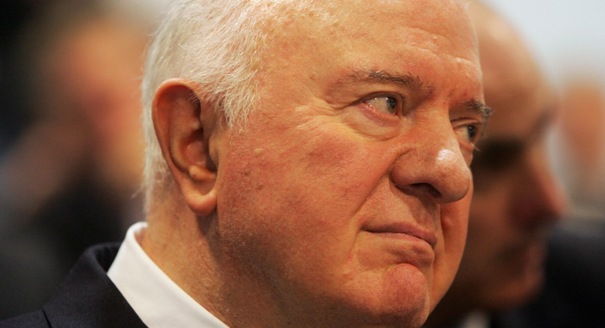
In losing a mentor, a person who introduced me to the art of diplomacy and the essence of foreign policy-making of sovereign Georgia, my first thoughts go the family of Eduard Shevardnadze. As a Georgian, I can only humbly pay my respects to a man who proved to be an “independent variable” in the creation of the modern Georgian State. He was a leader that managed to present his choices as preordained; he lived in an era with no roadmaps, paving the way as he went, creating options for the rest of us, who are now in a position to choose amongst “best practices.” Alas, President Shevardnadze—or “Babu” (Grandpa in Georgian) for his immediate inner circle and “Shev” to the outside world—passed away in a humble guesthouse rather than a grandiose villa: for better or worse, he toiled for Georgia, not for his personal benefit.
Beyond his myth, he was human, with great tenacity, energy, drive, patriotism, courage and a sense of self-reflective humor, or “dry wit” as our friends often recall. I should know, as I was introduced half-jokingly to his foreign interlocutors as his “National Insecurity Advisor,” having in mind a typical Hobbesean momentum that we witnessed when he returned back to Georgia in 1992: everybody against everybody—chaos, a civil war, clashes in South Ossetia and Abkhazia, a collapse of the state…
Shevardnadze also had weaknesses but he had them because he was a doer, going through the unknown terrain of building a Georgian state, a democratic state, anew, laying down its institutional foundation virtually brick by brick. And he was as great as he was, not despite, but because of these weaknesses. His weaknesses are well known. At times, he was known not to fit the small shoes of the Caucasus reality. He did practice dramatic politics with an unflappable façade and spoke in passionate hyperboles. He was very Georgian this way. But that should not be confused with groundless and counterproductive idealism. His utopias were a drive, not a state of mind; he was known for shrewd, dispassionate thinking, dry wit, toiling to transcend reality rather than daydreaming. He was a strategist with a vision, not delusions.
At the helm of the Georgian Soviet Republic, he fought corruption, motivated farmers and fought against organized crime, which of course officially “did not exist” under communism. Later on, he stood by the right side of history, supporting Perestroika and Glasnost, warning everyone against the inevitable reaction of the establishment. And he did what had to be done to end a bloody dead-end conflict in Afghanistan and facilitated the bloodless coming down of the Berlin Wall. At his moment of truth, at the helm of Soviet Foreign Policy, Shevardnadze did what had to be done to take the world a few steps away from the threat of nuclear annihilation.
When he did assume Georgia’s national leadership, the state was an “an idea” rather than a fact. A civil war was going on and the rule by law—let alone of law—was questionable. He did not allow, however, these hard realities to cloud his foresight. Shevardnadze took his distance from Russia, without forgetting where Georgia is located; he did not make Georgia part of the problem in the North Caucasus.
In dealing with his neighbors, he did not take “equal distances,” instead labeling Georgia as “an option” for all parties involved, be it “a gateway” or “a transit land.” Early on, he saw our region as a boat, in which we stay afloat or sink together. “Shev” was always a visionary, sometimes strategically placing regional interests above the national ones. That happened during those Caspian energy projects when he cared more for regional cooperation, including how to find a place for Russia in that so called “Western route” along with Azerbaijan’s President Heydar Aliyev. By the way, with that strategic decision President Shevardnadze not only offered to his Western partners Georgia as a transit gateway to the energy markets but also succeeded in identifying Georgia's strategic function and value in the global affairs.
Under his rule, the first seeds of a Georgian national economy, currency, free mass media and civil society were sown; and when his rule was challenged, he stepped aside leaving room for the next chapter in Georgia’s nation-building. Even in his relinquishing of power, he transcended reality with foresighted vision.
Many today, with the privilege of retroactive assessment, may doubt the effectiveness of his policies. But few can doubt that he did not shy away from almost superhuman responsibility, opening roads for both Europe and Georgia that will for generations define them both. And so his personal moment of reckoning becomes the moment of reckoning for a generation. Because of Eduard Shevardnadze, we have a set of options today, being in a position that in no way resembles the reality a generation ago. His successes and failures are those of a generation, marked by those who distinguished themselves, first and foremost Shevardnadze himself. After all, he was only a mere mortal, which makes his mark all the more significant.