

Article
Frederic Wehrey, Charles H. Johnson
{
  "authors": [
    "Frederic Wehrey"
  ],
  "type": "legacyinthemedia",
  "centerAffiliationAll": "dc",
  "centers": [
    "Carnegie Endowment for International Peace",
    "Malcolm H. Kerr Carnegie Middle East Center"
  ],
  "collections": [],
  "englishNewsletterAll": "menaTransitions",
  "nonEnglishNewsletterAll": "",
  "primaryCenter": "Malcolm H. Kerr Carnegie Middle East Center",
  "programAffiliation": "MEP",
  "programs": [
    "Middle East"
  ],
  "projects": [],
  "regions": [
    "North Africa",
    "Libya",
    "Maghreb"
  ],
  "topics": [
    "Political Reform",
    "Security"
  ]
}
Source: Getty
To avoid throwing the country into further chaos, Libyans must focus on forging a consensus government, build security institutions, and recommit itself to a broad-based national reconciliation and the drafting of an equitable constitution.
Source: International New York Times
Two days before she was murdered in Benghazi on June 25, the Libyan human rights activist Salwa Bugaighis walked into a Tripoli hotel guarded by Islamist militias wearing three-inch heels and no veil.
She had little patience for such gunmen and their political backers, whom she accused of terrorizing Libya and derailing the country’s struggling democracy: “We have five courthouses in Benghazi and they are all shut down,” she told me. “If these Islamists say they are committed to defending the state, they should defend the state’s institutions.”
Ms. Bugaighis was at the vanguard of the 2011 revolution and had recently been appointed the deputy head of a national dialogue commission. She had criticized the United States for inflating the stature of Islamist figures like the ex-jihadist Abdelhakim Belhaj and the grand mufti, whose religious edicts had stymied her fight for women’s rights.Her murder shocked a country facing two divergent paths toward security: repression or reconciliation.
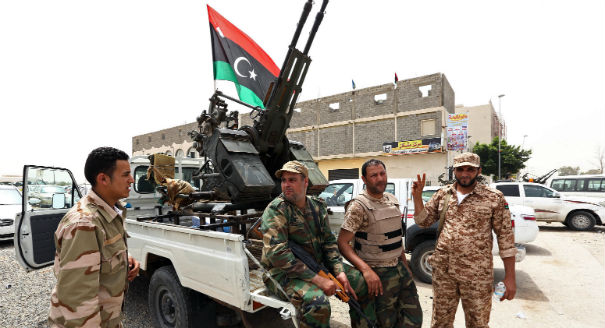
When she was killed, I was in eastern Libya meeting with Gen. Khalifa Hifter, who, for the past month, has been leading a military campaign against Islamist militias in Benghazi and other eastern cities.
General Hifter, a septuagenarian mustachioed man in a crisply starched uniform with golden epaulets, could not be a stronger counterpoint to Ms. Bugaighis.
He received me at a sprawling military base littered with rusting T-72 tanks, after I was ushered through an extraordinary security gauntlet that involved an invasive pat-down by men with assault rifles. I was not allowed to take my own pen and paper into the meeting.
The general’s military campaign is called “Operation Dignity” and his self-styled “Libyan National Army” taps support from tribes, civil society, defected army units and militias to the west of Tripoli, who were fed up with the spate of daily assassinations in Benghazi and other eastern cities. It burst onto the scene with relentless artillery strikes and aerial bombardment of Islamist militia bases in and around Benghazi and other cities; the Islamists have responded with rocket attacks of their own.
General Hifter is unsanctioned by the Libyan government and his Libyan National Army is, quite frankly, just another militia outside the official military chain of command. Most alarmingly, his operation was aimed at the country’s elected legislature, whose Islamist members he accuses of backing the militias and blocking the rebuilding of the country’s army and police.
All of this has left Libya deeply divided. For some — as for millions of Egyptians who opened their arms to a familiar form of autocracy — General Hifter is a savior delivering long-sought stability. Others recoil at the shades of Muammar el-Qaddafi, seeing a strongman subverting democracy in the name of fighting a loosely defined threat of “terrorism.”
In person, and like Egypt’s new president, Abdel Fattah el-Sisi, General Hifter is utterly convinced of his popular mandate. His language is grandiose and messianic. “Libya will be the graveyard of global terrorism,” he told me. He dismissed recent mediation efforts in Benghazi by tribal elders as producing nothing but “emotional language.” There could be no negotiations, he insisted, citing an ambush of his forces and the killing of Ms. Bugaighis; his foes could only expect one of three outcomes: prison, death or expulsion from the country.
He was frustrated that Libya’s allies, including America, had not given him more support in the form of drones and Apache helicopters. “We are fighting the world’s enemies,” he declared, “and the world should help us.”
Amid Libya’s worsening violence and polarization, room for dialogue and consensus is shrinking. Bridge builders like Ms. Bugaighis have been forced to take sides. In our last conversation before her death, she seemed to have chosen among evils: She maintained that, despite his faults, General Hifter had broken the taboo of calling out extremists and had taken action. She argued that since he couldn’t be stopped, the Libyan government should bring him into the fold and legitimate him, in the hopes of somehow limiting and controlling him.
But there is a stark danger — for Libyans and their friends abroad — in backing a military strongman whose vague definition of terrorism includes nonviolent Islamist political groups like the Muslim Brotherhood. General Hifter denies the right of peaceful Islamist groups to shape the future of the post-Qaddafi state, even though they fought in the revolution, too, and played a greater role than he did. Many Libyans draw a distinction between these groups and Ansar al-Sharia. The danger is that by lumping them all in the same basket the general will radicalize the moderates.
Even more worrisome for Libya is the general’s claim that he is defending democracy while threatening the country’s main elected body with military force. Whether he can be tamed by being “brought into the fold” seems unlikely: History is littered with examples of such appeasement of strongmen gone horribly awry.
Supporting General Hifter would be a Faustian bargain with far-reaching negative consequences for Libya’s future. To avoid throwing the country into further chaos or sending it down an authoritarian path, Libyans must focus on forging a consensus government that addresses grievances in the east. It must build security institutions overseen by elected authorities. And it should recommit itself to a broad-based national reconciliation and the drafting of an equitable constitution.
For their part, outside powers like the United States should make clear that they will not tolerate upending the rule of law in the interest of fighting General Hifter’s ill-defined “terrorist” threat that includes political opponents.
Ms. Bugaighis paid the ultimate price in her quest for dignity, but General Hifter may be extracting an even higher one from Libya’s future.
This article was originally published in the International New York Times.

Senior Fellow, Middle East Program
Frederic Wehrey is a senior fellow in the Middle East Program at the Carnegie Endowment for International Peace, where his research focuses on governance, conflict, and security in Libya, North Africa, and the Persian Gulf.
Recent Work
Frederic Wehrey, Charles H. Johnson
Frederic Wehrey, Charles H. Johnson
Carnegie does not take institutional positions on public policy issues; the views represented herein are those of the author(s) and do not necessarily reflect the views of Carnegie, its staff, or its trustees.

With its public finances in shambles, the far right polling at 35 percent ahead of the 2027 presidential election, and a growing protest movement, is France’s crisis a threat to the EU’s geopolitical awakening?

Rym Momtaz, ed.

Europe is facing rising populism internally as well as external pressures from Russia, China, Turkey, and the United States.

Dimitar Bechev

A notable degree of participative democracy has firmly arrived in Europe. But to have more far-reaching impact, democratic deliberation needs to move into a radically new phase.

Richard Youngs

Before the next wave of EU enlargement takes place, the union needs to grapple with thorny questions of how power is distributed among its members.


Emil Sondaj Hansen, Ditte Brasso Sørensen

The new U.S.–Denmark–Greenland agreement will help Washington exert political, economic, and financial dominance under the guise of security. Yet, it acknowledged Copenhagen’s and Nuuk’s sovereignty on the island.

Marc Pierini