

In The Media
Vikram Nehru
{
  "authors": [
    "Vikram Nehru"
  ],
  "type": "legacyinthemedia",
  "centerAffiliationAll": "dc",
  "centers": [
    "Carnegie Endowment for International Peace"
  ],
  "collections": [],
  "englishNewsletterAll": "asia",
  "nonEnglishNewsletterAll": "",
  "primaryCenter": "Carnegie Endowment for International Peace",
  "programAffiliation": "AP",
  "programs": [
    "Asia"
  ],
  "projects": [],
  "regions": [
    "United States",
    "China",
    "Southeast Asia"
  ],
  "topics": [
    "Economy",
    "Foreign Policy"
  ]
}
Source: Getty
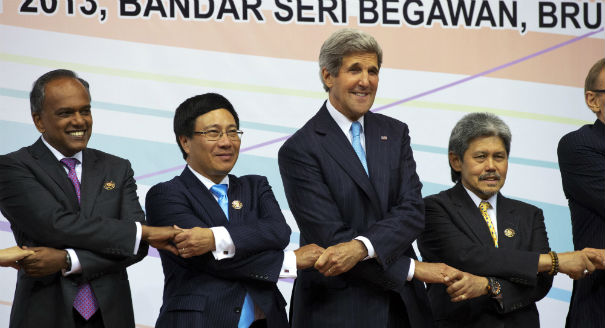
U.S. Secretary of State John Kerry will attend several summits in Southeast Asia in a bid to ease regional tensions with China. However, expectations on any breakthrough should be tempered.
Source: Deutsche Welle
Kerry will be leaving on Friday, August 8, on a six-day trip to Myanmar, Australia, the Solomon Islands and Hawaii. The top US diplomat plans to spend three days attending the ASEAN Regional Forum, the East Asia Summit ministerial, US-ASEAN, and the Lower Mekong Initiative meetings. He will also meet with Myanmar government officials and hold several bilateral meetings on the side. His final stop in Asia will be at Honiara, the capital of the Solomon Islands, for World War II commemoration ceremonies at Guadalcanal.
A priority for Kerry will be to lower tensions as his visit comes at a time where several Southeast Asian countries are involved in disputes with Beijing over parts of the South China Sea. Although China's recent withdrawal of an oil rig from waters also contested by Vietnam has helped reduce tensions, there are still many unanswered questions about Beijing's long-term strategy in the region. China claims 90 percent of the South China Sea, which is believed to contain oil and gas deposits.
During the ASEAN Forum, the Philippines - a close ally of the United States - is expected to propose a three-part plan to freeze all activity that raises tension over disputed waters. But Vikram Nehru, an expert on Southeast Asia at the Carnegie Endowment for International Peace, says in a DW interview that the plan has no chance of success as Beijing has rejected not only a freeze on construction activities in the South China Sea, but also the application of international arbitration.
Vikram Nehru: Kerry's main objective will be to underscore US commitment to the region and engage Asia's multilateral institutions to demonstrate the positive role the United States can play in supporting peace, prosperity, and stability in the region.
These meetings will likely focus on a host of issues including measures needed to reduce tensions in the South China Sea; US support of the region's development initiatives; Thailand's military coup; progress in establishing the ASEAN Economic Community scheduled for end-2015; and policy issues affecting US business interests in the region.The Secretary of State's bilateral meeting with the Myanmar authorities will cover the country's political and economic reforms, as well as such sensitive issues as the continued persecution of the Rohingya community and the imprisonment of five journalists for ten years each.
Kerry will then go on to Sydney, where he will be joined by US Defense Secretary Chuck Hagel and high ranking US military officials to participate in the annual Australia-United States Ministerial consultations.
Here the focus will be on security cooperation, although other regional issues will no doubt also be discussed, especially relations with China and the future of the Trans Pacific Partnership, which has run into some heavy weather in Washington. His final stop in Asia will be on August 13 at Honiara, the capital of the Solomon Islands, for World War II commemoration ceremonies at Guadalcanal.
A key goal for Kerry in all his meetings will be to find common ground among meeting participants on what actions can be taken to reduce tensions in the South China Sea. This is a tall order and one should temper any expectations of a breakthrough.
For example, Kerry is likely to propose a freeze on any "provocative" actions in the South China Sea - leaving it to the claimant states to decide what actions are considered provocative. But China has already rejected such an approach, arguing that this would interfere with ongoing discussions on a code of conduct for the South China Sea and indicating its intention to continue with construction activities.
Moreover, ASEAN itself is divided on what stance to take with regard to the South China Sea. There are some - such as Vietnam and the Philippines, both claimant states with a direct interest in the South China Sea - that, like the United States, are actively seeking voluntary, confidence-building measures to de-escalate the situation and promote stability. But there are others, such as Laos and Cambodia, and to a lesser extent Thailand and Malaysia - even though the latter has overlapping claims with China in the South China Sea - , that are unlikely to support any proposals that may antagonize China.
The main Southeast Asian claimant states would be willing to consider a freeze on any actions that may change the status quo in the South China Sea. Such a proposed freeze would cover any new seizure of territory, construction of buildings, ports, airstrips, radar or other military facilities, reclamation of land, and establishment of military or civilian outposts.
But such a freeze has already been rejected by China, and its reiteration at the Myanmar meetings will not change that position. Yi Xianlang, Deputy Director General of the Chinese Foreign Ministry's Department of Boundary and Ocean Affairs, stated recently that "the Spratly Islands are China's intrinsic territory, and what China does or doesn't do is up to the Chinese government."
It should be noted here that at the end of June 2014, China published an official map that showed most of the South China Sea, bounded by a new ten-dash line, as part of China. China has also explicitly rejected the involvement of the United States in the South China Sea issue, arguing that this issue could be resolved by the countries directly involved.
The plan refers to actions that could be taken immediately, followed by actions in the intermediate period, and then actions that would finally settle the underlying cause of the dispute - namely the disputants' overlapping claims in the South China Sea.
It suggests an immediate moratorium on all activities that may change the status quo in the South China Sea and a more concrete definition and strict adherence of paragraph 5 in the Declaration of the Code of Conduct. In the intermediate period the plan calls for an expeditious approval of a final code of conduct that would govern interstate relations in the South China Sea; and in the last stage, it aims at a resolution of the underlying cause of the dispute through international arbitration within the framework of the United Nations Convention on the Law of the Sea (UNCLOS).
The triple action plan has a snowball's chance in hell of success.
China has not only rejected a freeze on construction activities in the South China Sea, it has, for a long time, rejected the application of arbitration on the grounds that its claims are not in dispute and that any discussions should be held bilaterally with the other countries directly involved.
China has also not been in any hurry to finalize the Code of Conduct in the South China Sea, arguing that it should be the result of consensus while keeping "the comfort of all parties in mind." Beijing also does not wish to see any "interference" from outside parties, referring indirectly to the United States, and has condemned previous US efforts to raise the issue in ASEAN meetings.
Former Nonresident Senior Fellow, Asia Program
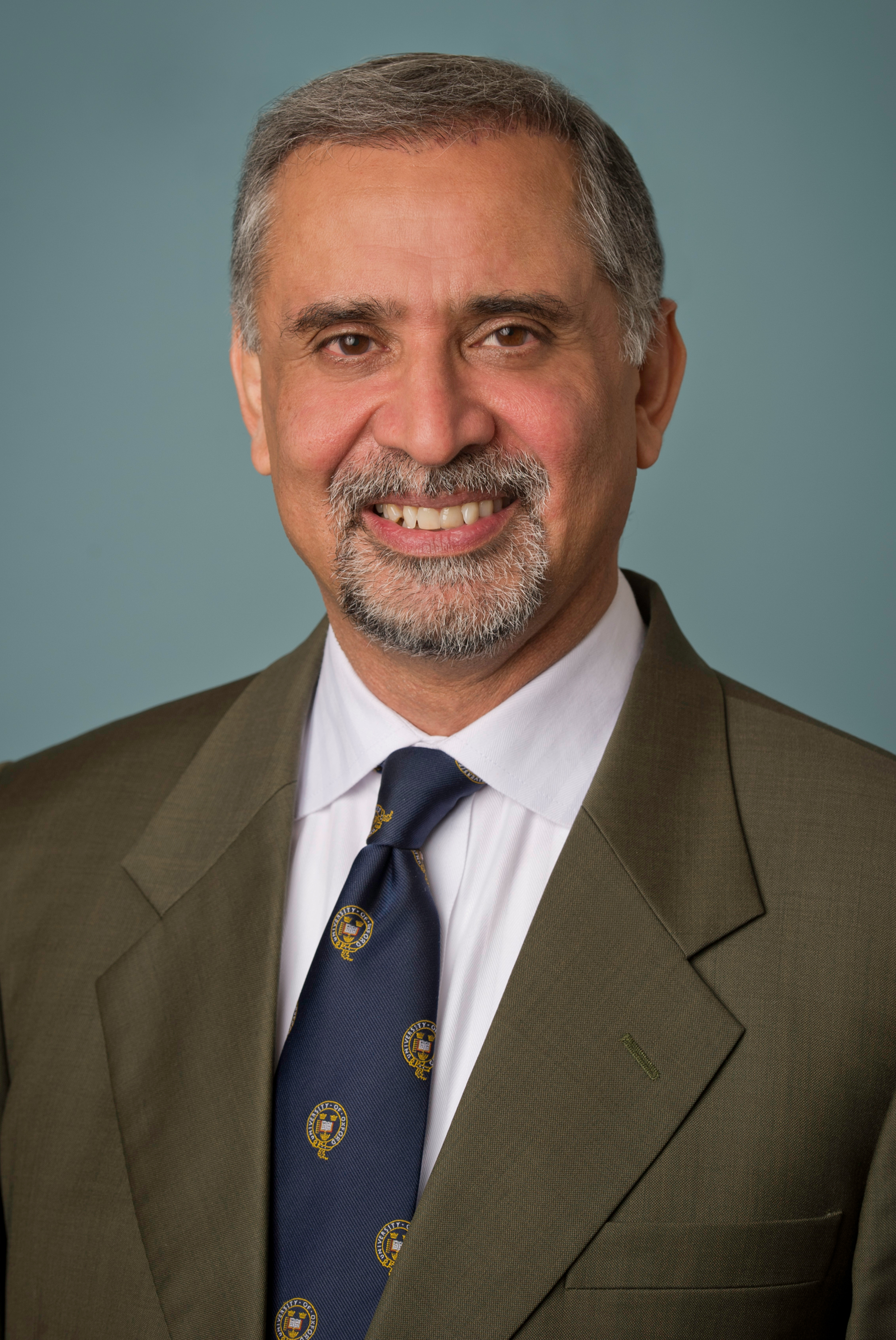
Nehru was a nonresident senior fellow in the Carnegie Asia Program. An expert on development economics, growth, poverty reduction, debt sustainability, governance, and the performance and prospects of East Asia, his research focuses on the economic, political, and strategic issues confronting Asia, particularly Southeast Asia.
Recent Work
Vikram Nehru
Vikram Nehru
Carnegie does not take institutional positions on public policy issues; the views represented herein are those of the author(s) and do not necessarily reflect the views of Carnegie, its staff, or its trustees.

The aftermath of the Ceuta crisis shows Europe has drawn the wrong lessons. Rather than doubling down on failed migration policies, the EU needs to address the underlying roots of such episodes.

Richard Youngs

Canadian Prime Minister Mark Carney has twice inspired praise for standing up to U.S. President Donald Trump: at the 2026 World Economic Forum in Davos and on Canada-U.S. trade negotiations. Is Carney showing a third way better than the EU has in dealing with the Trump administration?

Rym Momtaz, ed.

The EU’s responses to two recent incidents expose the gulf between European perceptions and capabilities. Unless the union can bridge that gap, it will never become a real geostrategic power.
Rym Momtaz

European states control several Overseas Countries and Territories around the world that carry strategic, economic, and environmental weight. As great powers challenge the rules-based order, defending them is a geopolitical imperative for Europe.

Marc Pierini

In supporting Europe’s far-right, MAGA and Russia both want the same thing: a weaker EU. Europe must defend itself without abandoning the openness these forces exploit.

Armida van Rij