

Article
Thomas de Waal
{
  "authors": [
    "Thomas de Waal"
  ],
  "type": "commentary",
  "centerAffiliationAll": "",
  "centers": [
    "Carnegie Endowment for International Peace",
    "Carnegie Europe",
    "Carnegie Russia Eurasia Center"
  ],
  "collections": [],
  "englishNewsletterAll": "",
  "nonEnglishNewsletterAll": "",
  "primaryCenter": "Carnegie Europe",
  "programAffiliation": "",
  "programs": [],
  "projects": [],
  "regions": [
    "Caucasus",
    "Russia"
  ],
  "topics": [
    "Political Reform"
  ]
}
Source: Getty
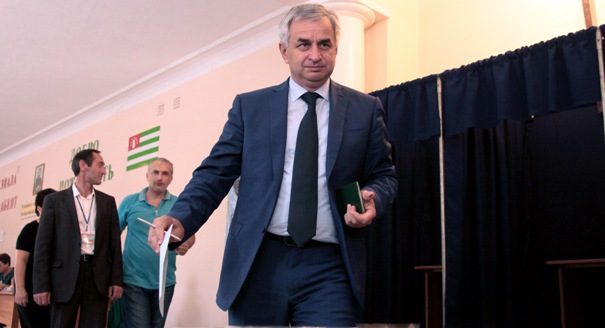
Raul Khajimba has attained the position of Abkhazian president at the fourth attempt, but he knows it's a far from enviable job.
Who would want to be president of Abkhazia? Raul Khajimba has attained that position at the fourth attempt, but he knows it's a far from enviable job.
Declared the victor in the first round of the election of August 24 by the slenderest of argins—50.57 percent of the vote—Khajimba received basically only one telegram of congratulation, from Russian president Vladimir Putin. Interestingly, the telegram was timed before even the official Abkhaz news agency Apsny Press announced the result.
The European Union and United States duly followed the lead of Tbilisi, as they have done in previous Abkhaz elections and declared the ballot illegitimate. That means Khajimba will effectively be under a travel ban to Western countries. It also lessens the leverage of those countries in Abkhazia. (It would surely be better to go half-way and acknowledge the election of the leader of the “Abkhaz community” as they do with the Turkish leader of northern Cyprus).
The fairly long list of issues that divides the two governments was spelled out in a revealing interview to Radio Liberty by the Russian ambassador in Abkhazia. In return for the millions it has invested in Abkhazia, Moscow wants to see Russians given the right to acquire property there and it will expect Khajimba to be a more compliant leader than his predecessors. But the Abkhaz elite fears that this would be the beginning of the end of its economic control over its own republic.
In domestic politics, Khajimba will have to balance the claims of the elite, who are preoccupied with issues like this one, and the claims of ordinary people, who want to see the economy improve and are disappointed that recognition by Russia has not delivered them more tangible benefits, such as the re-opening of Sukhumi airport.
The population data this election provided shows how weak and damaged Abkhazia still is, 20 years after the end of the war with Tbilisi. Almost exactly 100,000 people voted, which is about the same number as in the past two elections. Even though this omits the Georgian-majority Gali region (which voted the last two times but not on this occasion) it still suggests that the overall population of Abkhazia cannot be much more than 200,000.
This small number compares to a 1989 census tally of 525,000, of whom 240,000 were Georgians. In other words, Abkhazia is not just missing most of its Georgian population who were forced to flee in 1992-3, but still has a smaller non-Georgian population (of Abkhaz, Armenians, Russians and others) than it did in 1989.
Khajimba comes across as a modest man, more consensual than his rather autocratic predecessor Alexander Ankvab, who was forced from office in May. He has already spoken of the need for national unity and will probably try to form a coalition government.
But he cannot avoid another volatile issue, that of the Georgians of Gali region, almost none of whom voted in the election—and whose non-participation helped ensure Khajimba's victory in a first round. The campaign against the right of these people, who cross back and forth into western Georgia, to hold Abkhaz passports was one that Khajimba used to challenge Ankvab.
Now that he is elected leader of Abkhazia, Khajimba will have to decide whether to continue to appeal to his "base" (to use American terminology) and risk a confrontation or to try and appeal to the disaffected Gali Georgians.
All this would be a daunting to-do list even if Khajimba had the benefit of having his election recognized by the world at large.

Senior Fellow, Carnegie Europe
Thomas de Waal is a senior fellow at Carnegie Europe, specializing in Eastern Europe and the Caucasus.
Recent Work
Thomas de Waal
Thomas de Waal
Carnegie does not take institutional positions on public policy issues; the views represented herein are those of the author(s) and do not necessarily reflect the views of Carnegie, its staff, or its trustees.
As we close out another season of Strategic Europe, it is worth taking stock of the deep shifts underway.

Rym Momtaz
The hybrid warfare landscape is evolving rapidly, leaving policymakers without clear strategies. To better inform their work in addressing emerging challenges, governments must dig deeper into the underlying dynamics at play.

Raluca Csernatoni, Alicia Wanless
The EU had to compromise to adopt a twenty-first sanctions package against Russia, exposing growing cracks in the union’s resolve. Is this latest, weaker round worth it to keep pressure on Moscow?
Rym Momtaz, ed.

Trump is distracted and Ukraine wants Europe to step up. The continent’s leaders must find their voice and assert it in talks with Russia.

Alissa de Carbonnel

Mounting economic strain and battlefield losses will not necessarily make the Kremlin less dangerous. They could instead push Moscow toward a more aggressive hybrid campaign designed to test NATO’s Eastern flank, exploit allied hesitation, and fracture European resolve.

Maksym Beznosiuk