

Commentary
As we close out another season of Strategic Europe, it is worth taking stock of the deep shifts underway.
Rym Momtaz
{
  "authors": [
    "Alexey Arbatov"
  ],
  "type": "commentary",
  "centerAffiliationAll": "",
  "centers": [
    "Carnegie Endowment for International Peace",
    "Carnegie Russia Eurasia Center"
  ],
  "collections": [],
  "englishNewsletterAll": "",
  "nonEnglishNewsletterAll": "",
  "primaryCenter": "Carnegie Endowment for International Peace",
  "programAffiliation": "",
  "programs": [],
  "projects": [],
  "regions": [
    "North America",
    "United States",
    "Russia",
    "Eastern Europe",
    "Ukraine"
  ],
  "topics": [
    "Foreign Policy",
    "Civil Society"
  ]
}
Source: Getty
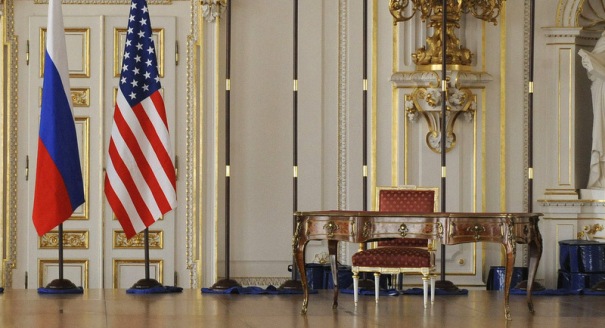
The growing hostility between the Russian and American societies accompanies the tensions in state bilateral relations.
A lot is being said about the current return to the Cold War, but, in some respects, Russia and the United States are even worse off now than they were back in that period of global confrontation. There have been numerous conflicts in U.S.-Russia relations in the past seven decades; some of them (the 1961 Berlin and 1962 Caribbean crises) put the world on the brink of a head-to-head military confrontation which could have possibly ended in a global nuclear war. Fortunately, up to now the Ukrainian crisis has not escalated to such an extent.
But there is another cause for concern: the growing hostility between the Russian and American societies that accompanies the tensions in state bilateral relations. Both Russians and Americans were initially euphoric following the end of the Cold War era. Americans were ready to embrace their Russian brethren that freed themselves of the “communist yoke,” expecting them to rejoin the big “Euro-Atlantic family.” For their part, Russians idealized Americans, distrusting the image created by the Soviet propaganda machine and imagining the United States to be a “Promised Land” of sorts.
We have now entered the third stage characterized by increasing alienation, mutual resentment, and even hatred. Russians feel that Americans injured their pride and seek to take revenge for a quarter of a century of Russia’s humiliations and concessions. They also tend to blame American evil designs for their failures at home and abroad. Russians hoped for equal and respectful relations; instead, they saw Americans arrogantly exploiting Russia’s weakness and refusing to accept Russia as an equal partner. Russians stereotypically perceive Americans as superficial and blunt people that respect no one, abuse their power across the globe, bomb whomever they please, and recognize no other views or interests but their own…
Meanwhile, Americans were drawing their own conclusions. They don’t see why they can respect Russians if, in a quarter of century, Russians have been unable to take advantage of their country’s enormous natural resources, its culture, and science to ensure prosperity for themselves. After all, German and Japanese post-World War II rebuilding efforts took much less time. Americans believe that Russia could have progressed almost as much as the United States has. Instead, Russians are still living off oil and gas sales (like Saudis or Venezuelans), corruption is running rampant, and many of Russia’s social and economic indicators put the country on par with developing countries—and not the highest-ranking ones to boot. But Russians do not rush to improve their lives, choosing to compete with the United States on using force overseas and expanding their country’s geopolitical influence. Besides, they keep praising their moral superiority, but fail to appear in church on Sunday or swear on the Bible in court…
Americans now think that despite looking deceptively European, Russians have some genetic predisposition for the traditionalist paradigm. Yet again, the Russian state seeks to bring society under its control: its leader makes all the decisions on his own, Russia again has a pocket parliament and obedient press, and the Russian people are called upon to serve their country and sacrifice their well-being for the sake of grand schemes beyond the country’s borders. Americans cannot quite grasp that. They were brought up in a state whose public servants actually serve the people and are constantly held accountable to it; their patriotism stems from the feeling that their country lives better and more freely than others.
The communist ideology of the early 20th century came from the top and was injected into Russia’s uneducated masses, and the West responded with anti-communism. But today’s attitudes of the two societies toward each other are not as much the function of propaganda, however biased and unbridled it might be. The matters appear worse—these attitudes come from within the societies themselves, reflecting some elements of the actual state of affairs, although, of course, in less exaggerated terms.
Therefore, even the peaceful end to the Ukrainian saga will do little to change these attitudes, and they will be having serious effect on the words and deeds of political leaders for a long time to come. It is especially true in light of the fact that, just like their American counterparts, Russian politicians now closely monitor opinion polls and check their ratings on a daily basis.

Alexey Arbatov
Alexey Arbatov is the head of the Center for International Security at the Primakov National Research Institute of World Economy and International Relations.
Carnegie does not take institutional positions on public policy issues; the views represented herein are those of the author(s) and do not necessarily reflect the views of Carnegie, its staff, or its trustees.

As we close out another season of Strategic Europe, it is worth taking stock of the deep shifts underway.

Rym Momtaz

The hybrid warfare landscape is evolving rapidly, leaving policymakers without clear strategies. To better inform their work in addressing emerging challenges, governments must dig deeper into the underlying dynamics at play.


Raluca Csernatoni, Alicia Wanless
The EU had to compromise to adopt a twenty-first sanctions package against Russia, exposing growing cracks in the union’s resolve. Is this latest, weaker round worth it to keep pressure on Moscow?
Rym Momtaz, ed.

Trump is distracted and Ukraine wants Europe to step up. The continent’s leaders must find their voice and assert it in talks with Russia.

Alissa de Carbonnel

Mounting economic strain and battlefield losses will not necessarily make the Kremlin less dangerous. They could instead push Moscow toward a more aggressive hybrid campaign designed to test NATO’s Eastern flank, exploit allied hesitation, and fracture European resolve.

Maksym Beznosiuk