

Article
Dalia Ghanem
{
  "authors": [
    "Dalia Ghanem"
  ],
  "type": "legacyinthemedia",
  "centerAffiliationAll": "dc",
  "centers": [
    "Carnegie Endowment for International Peace",
    "Malcolm H. Kerr Carnegie Middle East Center"
  ],
  "collections": [],
  "englishNewsletterAll": "menaTransitions",
  "nonEnglishNewsletterAll": "",
  "primaryCenter": "Malcolm H. Kerr Carnegie Middle East Center",
  "programAffiliation": "MEP",
  "programs": [
    "Middle East"
  ],
  "projects": [],
  "regions": [
    "Maghreb",
    "Algeria",
    "North Africa"
  ],
  "topics": [
    "Political Reform",
    "Security"
  ]
}
Source: Getty
The latest act of violence in Algeria may be part of a pattern of opportunism for the leader of Jund El Khalifa rather than an indication of Islamic State presence.
Source: openDemocracy
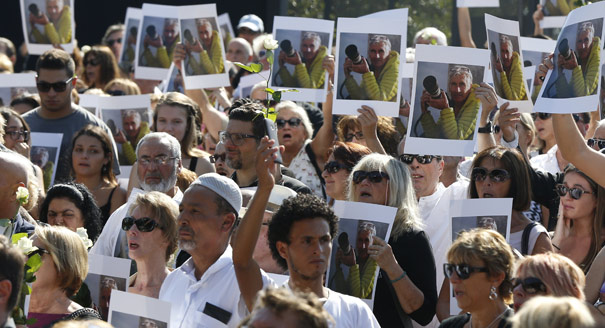
On Sunday, September 21, a group claiming affiliation with the Islamic State kidnapped French national Hervé Gourdel in the high altitudes of Djurdjuran (Kabylia). The man was beheaded three days later.
The group, called Jund El Khalifa, released the scene on YouTube in a video titled ‘Message of blood’; in it, they explain that their reasons for doing this were mainly tied to French involvement in the coalition against IS in Iraq. Should we consequently worry for Algeria? Is the Islamic State a serious threat to the country?
It is important to remember that this new group Jund El Khalifa is a splinter cell of AQIM (Al Qaeda in the Islamic Maghreb), consisting of nearly a dozen fighters. Its leader Abdelmalek Gouri, dubbed Abu Slimane, aged 37, is a veteran of the GIA (Groupe Islamique Armé) and the GSPC (Groupe Salafiste pour la Prédication et le Combat), which he first joined in 1997.A native of Boudahr (Si Mustapha), a small town in Boumerdes, Gouri is known for his fiery temperament, his radicalism, and his intransigence. He quickly proved himself to the GSPC (later renamed AQIM in 2007), and ascended the hierarchy.
Indeed, AQIM leader Abdelmalek Droudkel even entrusted him with the group Katibet El Akram, which plagued the center, and south of Boumerdes. El Akram is thought to be responsible for dozens of attacks against the security forces between 2007 and 2011.
This latest act of allegiance to IS – declared and demonstrated through the beheading of a national of a member of the coalition – is nothing but a means for Gouri to become head of his own organization, and to take advantage of this sudden visibility.
Gouri wanted to prove that he was worthy of El Baghdadi, and has made a name for himself through this act. The media coverage of the decapitation heightens the efficiency of the attack: gore is a mode of communication, and Gouri knows this well.
As was seen during Algeria’s ‘black decade,’ fighters had to intensify their level of violence in order to achieve positions of responsibility within jihadist organizations. Ultra-violence was the means by which they established a reputation and allegiances.
Djamel Zitouni, who climbed the ranks of the GIA to become the ‘National Emir’ between 1994-1996, notably did this; his successor Antar Zouabri, Emir from 1996 to 2002, followed the same tactic. These two men doubled their cruelty and made ultra-violence their trademark.
Once at the top of the hierarchy, in order to maintain their reputation and that of their group, to prevent defections, and more importantly to preserve their monopoly over jihadism in Algeria (in the face of competition from armed groups such as l’Armée Islamique du Salut): first Zitouni then Zouabri sank to extreme violence and perpetrated massacres of entire populations beginning summer 1997. Their ultra-violence was ultimately a strategy to restore the organic solidarity of the group and re-establish its reputation.
The situation today is no different: Gouri knew that ultra-violence was the means by which he would be noticed. He is an opportunist who is riding the ‘Da’eshist’ wave and utilizing the insecurity in the Kabylie region to organize his operation. Indeed, Kabylie is the former ‘Zone 2’ of the GIA and the headquarters of Hassan Hattab, the “emir” of the GSPC.
The region is a major handicap for the ‘war against terror’: The topography of the area with its mountains (Djurdjuran, Agawa), thick forests (Ait Ouabane, Tigounatine, Guerrouche), parks (Djurdjuran and Taza), gorges, and wadis (Wadi Sahel-Summam and Sebaou) makes it ideal for the development and concealment of armed groups.
Still, all things considered, the security situation in Algeria is far from what it was between 1990 and 2000. While the country is prone to sporadic jihadist attacks, it must be noted that they are highly localized. In addition, the ANP is equipped with over ten years of experience in anti-terrorism operations. Overall, Jund El Khalifa’s capacity for action is constrained, and their ability to inflict any harm is overmatched by an army with proven capabilities.
Hence, the possibility that the IS could infiltrate Algeria remains slim. We will probably see the formation of satellite cells such as Jund El Khalifa, but these will have to face a well-experienced army, as well as competition from AQIM.
Indeed, it is farfetched to believe that Abdelmalek Droukdel – the emir of AQIM in Algeria – would accept the transformation of his well-established organization into a mere branch of IS.
What may happen instead is the outbreak of a war between AQIM members and those of the IS for monopoly over jihad in Algeria. The result could be similar to those of the 1990s, when the GIA launched a campaign to purge its rivals: in other words, there could be a fragmentation of the armed movement and a reduction of its capacity to inflict harm.
Former Senior Resident Scholar, Malcolm H. Kerr Carnegie Middle East Center
Dalia Ghanem was a senior resident scholar at the Malcolm H. Kerr Carnegie Middle East Center in Beirut, where her research focuses on Algeria’s political, economic, social, and security developments. Her research also examines political violence, radicalization, civil-military relationships, transborder dynamics, and gender.
Recent Work
Dalia Ghanem


Frances Z. Brown, Judy Dempsey, Dalia Ghanem, …
Carnegie does not take institutional positions on public policy issues; the views represented herein are those of the author(s) and do not necessarily reflect the views of Carnegie, its staff, or its trustees.

With its public finances in shambles, the far right polling at 35 percent ahead of the 2027 presidential election, and a growing protest movement, is France’s crisis a threat to the EU’s geopolitical awakening?

Rym Momtaz, ed.

Europe is facing rising populism internally as well as external pressures from Russia, China, Turkey, and the United States.

Dimitar Bechev

A notable degree of participative democracy has firmly arrived in Europe. But to have more far-reaching impact, democratic deliberation needs to move into a radically new phase.

Richard Youngs

Before the next wave of EU enlargement takes place, the union needs to grapple with thorny questions of how power is distributed among its members.


Emil Sondaj Hansen, Ditte Brasso Sørensen

The new U.S.–Denmark–Greenland agreement will help Washington exert political, economic, and financial dominance under the guise of security. Yet, it acknowledged Copenhagen’s and Nuuk’s sovereignty on the island.

Marc Pierini