

Research
- +10
Rosa Balfour, Frances Z. Brown, Yasmine Farouk, …
{
  "authors": [
    "Moisés Naím"
  ],
  "type": "legacyinthemedia",
  "centerAffiliationAll": "dc",
  "centers": [
    "Carnegie Endowment for International Peace"
  ],
  "collections": [],
  "englishNewsletterAll": "americanStatecraft",
  "nonEnglishNewsletterAll": "",
  "primaryCenter": "Carnegie Endowment for International Peace",
  "programAffiliation": "ASP",
  "programs": [
    "American Statecraft"
  ],
  "projects": [],
  "regions": [
    "North America"
  ],
  "topics": [
    "Economy",
    "Trade"
  ]
}
Source: Getty
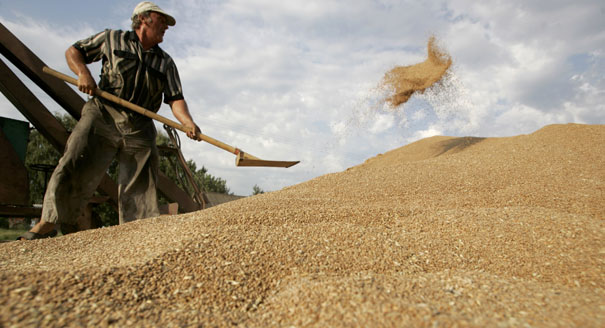
Agricultural production is at record levels—and that could make the planet less stable.
Source: Atlantic
Apple sold over 10 million iPhone 6s in a single weekend—a record. Google is under pressure from European authorities on two fronts: concerns over anti-competitive practices and privacy violations, following an EU court ruling recognizing citizens’ “right to be forgotten” by the web. Amazon is embroiled in a commercial dispute with Hachette and retaliated by discriminating against writers working with the publisher. In reaction, many prominent authors have signed an open letter denouncing Amazon’s behavior.
Information-technology and Internet companies are magnets for media attention. But we hear far less about the companies that produce the food we eat—especially those involved in agriculture. And yet agricultural activity is breaking records in ways that will have huge consequences for hundreds of millions of people. Did you know that worldwide wheat production is the highest it’s ever been? And that despite growing consumption, farms and granaries are overflowing with excess production?
The International Grains Council estimates that inventories of soy, wheat, barley, and corn are reaching their highest volume in 30 years. In the United States, this year’s corn harvest is expected to top last year’s, which was also unprecedented. Europe is setting records with its wheat and corn harvests, and Canada is doing the same with wheat, barley, and oats. “The new abundance will have broad effects, weakening incomes of farmers and companies that supply them, fattening profit margins at food and biofuel companies and—eventually—slowing food price inflation for consumers in rich and poor countries alike,” writes Gregory Meyer of the Financial Times.
And what has caused this explosion in grain supplies? Prices. They’ve been unusually high in recent years and have encouraged farmers to pour money into boosting production. According to the Food and Agriculture Organization of the United Nations, from 2005 to 2013 the land used to cultivate wheat, soy, and corn grew by 11 percent globally. Never before has such a large swath of the earth been tilled.
There are four main factors behind these rising prices: world population growth; increased food consumption in poor countries (in large part due to rising middle classes and their disposable income); the use of grains in the production of fuels like ethanol; and the greater frequency of extreme climatic occurrences that have the potential to destroy harvests or limit farm yields. High prices served as an enormous incentive to invest in agriculture and more investment propelled production to unprecedented levels, which in turn is now pushing prices down.
Today’s lower prices could discourage investment and reduce future production, ushering in another period of higher prices. This cycle is nothing new, but in recent years it has been shaped by new drivers (climate change, demographic change, volatile global economic conditions) that make the swings more frequent and the range of variation more extreme.
The problem with these developments is that greater food-related volatility will bring about social and geopolitical instability. Nearly 20 percent of the world population is directly involved in agriculture, meaning that one out of five people on the planet would be affected by such flux. (By contrast, the consumer-electronics manufacturing industry only employs 2.3 million people, or 0.03 percent of the world population.) The boom-and-bust cycle of agricultural prices has severe effects on poor farming populations that lack the savings and other cushions to buffer the impact of prices suddenly plummeting. And even if agriculture ranks low on the global scale of economic activity (it accounts for only 2.8 percent of overall income), it remains very important for poor countries. In India, for example, agriculture represents 18 percent of the economy and generates 54 percent of employment.
Both the demand for and supply of agricultural goods have experienced abrupt changes in the past 50 years. One of the most notable is the concentration of production in several countries. According to a study by Julian Alston and Philip Pardey, 42 percent of the world’s farmed land is clustered in five countries (India, the United States, Russia, China, and Brazil). By comparison, the 100 countries with the least agricultural activity account for a mere 0.78 percent of harvested land. The authors write that Brazil, China, and India “have among the largest total numbers of farmers and the ‘food-poor,’ whose lives can be very substantially improved through agricultural innovation leading to more abundant and cheaper food.” And yet the experts also draw attention to the rapid drop over the past 50 years in public and private investment in agricultural research and development, particularly in wealthy countries where agriculture is a relatively insignificant part of the economy. Given the geopolitical stakes, however, we would all benefit if the brains at Apple, Google, and other titans of modernity applied their creativity to disrupting and improving the oldest economic activity in the world.
This article was originally published in the Atlantic.

Distinguished Fellow
Moisés Naím is a distinguished fellow at the Carnegie Endowment for International Peace, a best-selling author, and an internationally syndicated columnist.
Recent Work



Rosa Balfour, Frances Z. Brown, Yasmine Farouk, …
Moisés Naím
Carnegie does not take institutional positions on public policy issues; the views represented herein are those of the author(s) and do not necessarily reflect the views of Carnegie, its staff, or its trustees.

The European Commissioner for Trade is headed to China. But after President Xi’s bridge-building visit to Washington, can a more isolated EU overcome Beijing’s stranglehold on critical raw materials? Who will blink first?

Rym Momtaz, ed.

The domestic impacts of how long it is taking to end the war in Ukraine have pushed the French electorate to the political extremes and compromised the country’s diplomatic capacity.
Rym Momtaz

A summer of escalation in the Black Sea has hurt Ukraine economically and is exacerbating world food security. A truce is needed—as is a broader reframing of Europe’s Ukraine strategy.

Thomas de Waal

Canadian Prime Minister Mark Carney has twice inspired praise for standing up to U.S. President Donald Trump: at the 2026 World Economic Forum in Davos and on Canada-U.S. trade negotiations. Is Carney showing a third way better than the EU has in dealing with the Trump administration?
Rym Momtaz, ed.
Europe’s industrial supply chains leave it vulnerable to global shocks. The EU needs a pragmatic green industrial strategy that balances durable partnerships and bolsters homegrown clean tech without sacrificing low-carbon ambition.


Milo McBride, Pauline Gerard