

Article
C. Raja Mohan, Darshana M. Baruah
{
  "authors": [
    "C. Raja Mohan"
  ],
  "type": "legacyinthemedia",
  "centerAffiliationAll": "dc",
  "centers": [
    "Carnegie Endowment for International Peace",
    "Carnegie India"
  ],
  "collections": [],
  "englishNewsletterAll": "ctw",
  "nonEnglishNewsletterAll": "",
  "primaryCenter": "Carnegie India",
  "programAffiliation": "SAP",
  "programs": [
    "South Asia"
  ],
  "projects": [],
  "regions": [
    "Asia",
    "South Asia",
    "India",
    "East Asia",
    "Southeast Asia"
  ],
  "topics": [
    "Foreign Policy"
  ]
}
Source: Getty
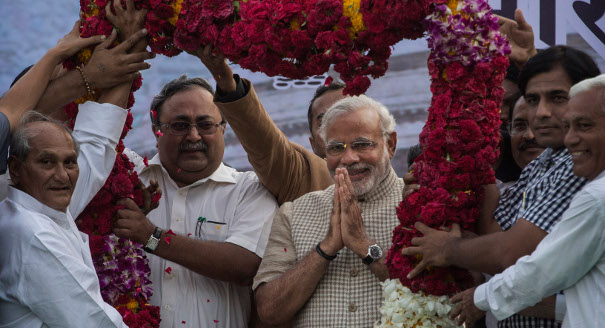
As Prime Minister Narendra Modi surprised the world with his passion for foreign policy, Asia has inevitably taken center stage in the conduct of his government’s diplomacy.
Source: Saudi Gazette
As Prime Minister Narendra Modi surprised the world with his passion for foreign policy, Asia has inevitably taken the centerstage in the conduct of his government’s diplomacy. It was widely expected that the emphasis of Modi, when he became the Prime Minister of India at the end of May 2014, would be on reviving India’s economic growth that had slowed down in the first years of this decade. For Modi though diplomacy and economic development are deeply interconnected.
Summing up the government’s expansive diplomatic activism in the second half of 2014, the External Affairs Minister Sushma Swaraj told the parliament at the end of the year that the “Prime Minister has consistently advocated a proactive and innovative approach to foreign policy that is aligned with our government’s primary goal of accelerating national economic development. India needs access to capital, technology, resources, energy, markets and skills, a secure environment, a peaceful neighbourhood and a stable global trading system.”
Once Indian diplomacy was put at the service of India’s development, Asia with its economic dynamism has become a major priority presented for the Foreign Office. In the early 1990s, Prime Minister Narasimha Rao unveiled the Look East Policy to reconnect with Asia as part of India’s economic globalization. Nearly quarter of a century later, Modi has again turned to Asia to improve India’s economic fortunes. The policy of ‘Acting East’ is about injecting new vigor and purpose into India’s Asia policy.In the intervening decades India’s economic engagement with the region has grown considerably and Delhi is very much part of the regional institutions led by the ASEAN (the Association of South East Asian Nations). Yet there was no denying the sense that India had not realized the full potential of its partnerships with the Asian nations.
Modi was in a good position to change this, given his personal interest in the region. As the chief minister of Gujarat for more than a decade, Modi had traveled the region extensively. His destinations included China, Japan, Singapore and Australia, where he had actively sought investments from the region into Gujarat. Leading businesses in the region were impressed by the level of development and the ease of doing business in the state. The region therefore was quick to welcome the arrival of the Modi government and embrace its agenda for economic development.
During his visit to Japan, Prime Minister Shinzo Abe, promised to mobilize nearly $35 billion of aid and investment into India in the next five years. The Chinese President Xi Jinping during his visit to India set an investment target of about $20 billion in the coming years. As the business and economic environment improves under Modi, more investments are likely from across East Asia, including Korea, Australia and the South East Asian nations. A significant part of these investments, Delhi hopes, will be directed at the modernization of India’s physical infrastructure.
Modi has tapped into the interest in both Japan and China in the development of high speed railways in India. Tokyo and Beijing have ambitious plans to build trans-border transport corridors between India and East Asia. China is pressing for the Indian participation in the development of the so-called BCIM corridor that will connect China’s south western province of Yunnan with Myanmar, Bangladesh and India. Tokyo has promised to modernize road networks in the northeastern provinces and contribute to the development of maritime corridors between peninsular India and South East Asia. Connectivity — over land and sea — is also a major priority for the new government in its engagement with the ASEAN.
Modi has also significantly expanded the geographic scope of India’s Look East policy. He has become the first prime minister in 28 years to visit Australia that has emerged as a major partner for India. Modi also became the first Indian PM in 33 years to travel to Fiji, which has a sizable population of Indian origin. Modi also took the opportunity to host a meeting in Fiji with all the leaders of the Pacific Islands Forum.
Modi and Swaraj have put a special emphasis on promoting India’s soft power in the region — through a vigorous engagement with the Diaspora and a strong commitment to build on shared civilizational bonds. For the new government renewing cultural and spiritual connectivity with Asia are as important as physical connectivity.
The Modi government is also fully engaged with the emerging political challenges in East Asia. Modi has reaffirmed the centrality of ASEAN in building a stable and prosperous order in East Asia and the Pacific. He cautioned the region, where territorial disputes are threatening peace, against the expansionist concepts of the 19th century and sustain the focus on development. On the territorial disputes in the South China Sea, Modi was firm in stating India’s deep interests in the freedom of navigation in sea and air. He underlined the importance of all parties abiding by the principles of the United Nations Convention on the Law of the Seas.
Under the previous governments, Delhi’s Look East Policy did recognize the centrality of maritime security and the need to expand India’s defense partnerships with Asia. The Modi government’s Act East Policy is pursuing these objectives with a new sense of urgency. Amid a historic power shift in the region and the increasing uncertainty in the relations among the major powers, including the US, China and Japan, there has been a growing demand for a larger Indian security role in the region.
In the last few months, India has begun to deepen defense ties with the United States, Japan, Australia and Vietnam. Delhi does not however, view its defense diplomacy in the region as part of an alignment with one great power against another. The objective of India is to engage all powers, strengthen the regional institutions and contribute effectively to maintenance of a stable balance of power in Asia and its waters.
Former Nonresident Senior Fellow, Carnegie India
A leading analyst of India’s foreign policy, Mohan is also an expert on South Asian security, great-power relations in Asia, and arms control.
Recent Work

C. Raja Mohan, Darshana M. Baruah


Alexander Gabuev, Paul Haenle, C. Raja Mohan, …
Carnegie does not take institutional positions on public policy issues; the views represented herein are those of the author(s) and do not necessarily reflect the views of Carnegie, its staff, or its trustees.

As we close out another season of Strategic Europe, it is worth taking stock of the deep shifts underway.

Rym Momtaz
The EU had to compromise to adopt a twenty-first sanctions package against Russia, exposing growing cracks in the union’s resolve. Is this latest, weaker round worth it to keep pressure on Moscow?
Rym Momtaz, ed.

Trump is distracted and Ukraine wants Europe to step up. The continent’s leaders must find their voice and assert it in talks with Russia.

Alissa de Carbonnel

Mounting economic strain and battlefield losses will not necessarily make the Kremlin less dangerous. They could instead push Moscow toward a more aggressive hybrid campaign designed to test NATO’s Eastern flank, exploit allied hesitation, and fracture European resolve.

Maksym Beznosiuk

Over the past ten years, NATO has held almost as many summits as it did during the entirety of the Cold War. Are they still useful, or is it time to stop holding annual meetings?
Rym Momtaz, ed.