

Paper
Raphaël Lefèvre
{
  "authors": [
    "Raphaël Lefèvre"
  ],
  "type": "other",
  "centerAffiliationAll": "dc",
  "centers": [
    "Carnegie Endowment for International Peace",
    "Malcolm H. Kerr Carnegie Middle East Center"
  ],
  "collections": [],
  "englishNewsletterAll": "menaTransitions",
  "nonEnglishNewsletterAll": "",
  "primaryCenter": "Malcolm H. Kerr Carnegie Middle East Center",
  "programAffiliation": "MEP",
  "programs": [
    "Middle East"
  ],
  "projects": [],
  "regions": [
    "Levant",
    "Lebanon",
    "Syria",
    "Middle East"
  ],
  "topics": [
    "Political Reform",
    "Security"
  ]
}
Source: Getty
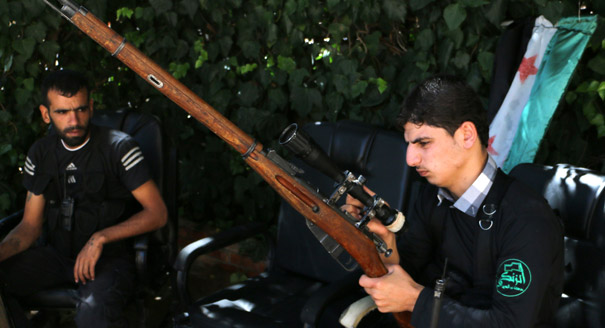
The Syrian Muslim Brotherhood had been in exile for a long time, so it had to work very hard to gain a measure of influence on the Syrian uprisings.
Source: Project on Middle East Political Science
Speaking with George Washington University’s Marc Lynch, director of the Project on Middle East Political Science, Carnegie’s Raphaël Lefèvre discussed the Syrian Muslim Brotherhood, the Syrian civil war, and Lebanon. When asked about the role the Muslim Brotherhood played in the Syrian uprising, Lefèvre explained that the group had been in exile for a long time, so it had to work very hard to gain a measure of influence on the Syrian uprisings.
It did so through various different ways, continued Lefèvre: “At first, it took a leading role in the Syrian opposition—first the Syrian National Council and then the National Coalition. It tried to do some work on-the-ground inside Syria in rebel-held areas, doing some humanitarian work. It started a series of militias as well, trying to gain influence on the Syrian rebel scene, but that was, unfortunately for them, very unsuccessful because at that point in time...the extremists in Syria were on the rise and posed a serious challenge to the Syrian Muslim Brotherhood.”
This interview was originally published by the Project on Middle East Political Science (POMEPS).
Former Nonresident Scholar, Middle East Center
Raphaël Lefèvre was a nonresident scholar at the Carnegie Middle East Center, where his research focuses on Sunni Islamist movements in Lebanon.
Recent Work
Raphaël Lefèvre
Raphaël Lefèvre
Carnegie does not take institutional positions on public policy issues; the views represented herein are those of the author(s) and do not necessarily reflect the views of Carnegie, its staff, or its trustees.

With its public finances in shambles, the far right polling at 35 percent ahead of the 2027 presidential election, and a growing protest movement, is France’s crisis a threat to the EU’s geopolitical awakening?

Rym Momtaz, ed.

Europe is facing rising populism internally as well as external pressures from Russia, China, Turkey, and the United States.

Dimitar Bechev

A notable degree of participative democracy has firmly arrived in Europe. But to have more far-reaching impact, democratic deliberation needs to move into a radically new phase.

Richard Youngs

Before the next wave of EU enlargement takes place, the union needs to grapple with thorny questions of how power is distributed among its members.


Emil Sondaj Hansen, Ditte Brasso Sørensen

The new U.S.–Denmark–Greenland agreement will help Washington exert political, economic, and financial dominance under the guise of security. Yet, it acknowledged Copenhagen’s and Nuuk’s sovereignty on the island.

Marc Pierini