

Paper
Renad Mansour, Faleh A. Jabar
{
  "authors": [
    "Renad Mansour"
  ],
  "type": "legacyinthemedia",
  "centerAffiliationAll": "dc",
  "centers": [
    "Carnegie Endowment for International Peace",
    "Malcolm H. Kerr Carnegie Middle East Center"
  ],
  "collections": [],
  "englishNewsletterAll": "menaTransitions",
  "nonEnglishNewsletterAll": "",
  "primaryCenter": "Malcolm H. Kerr Carnegie Middle East Center",
  "programAffiliation": "MEP",
  "programs": [
    "Middle East"
  ],
  "projects": [],
  "regions": [
    "Gulf",
    "Iraq",
    "Middle East"
  ],
  "topics": [
    "Political Reform",
    "Security"
  ]
}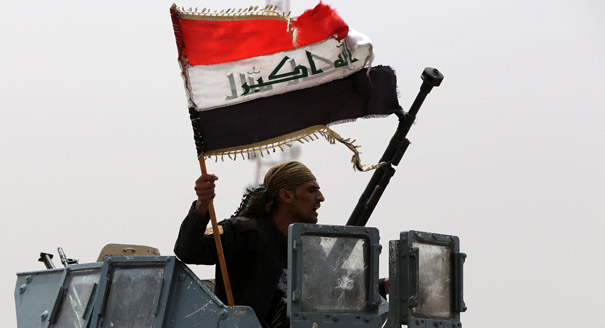
Source: Getty
The solution to Iraq’s woes must involve strong political leadership.
Source: Deutsche Welle
United Nations Secretary-General Ban Ki-moon met with Iraqi government officials during a visit to the capital, Baghdad, on Monday. During the talks, Ban expressed concern about the millions of Iraqis who have been forced to flee their homes to escape the terror group "Islamic State" (IS), saying "additional resources are urgently needed to save lives."
Earlier in March, the UN Office of the High Commissioner for Human Rights released a report saying that IS militants may have committed war crimes, crimes against humanity and genocide in Iraq. The report also said Iraqi forces and allied militias fighting IS may too have committed war crimes, and "carried out extrajudicial killings, torture, abductions and forcibly displaced a large number of people, often with impunity."
Iraqi forces are battling to retake the strategic city of Tikrit as part of the government's largest military operation yet against the jihadist group.
The Iraqi government has always been pressing for more support. As the winter was approaching, the biggest issue was what they referred to as Winterization, with the issue being how these displaced people would be able to live. It's hard to see how much more the UN can really do. A lot of UN member states are contributing to the humanitarian effort in their own capacities. The Iraqi government, as well as the Kurdish regional government, will continue to press for more humanitarian support to help develop camps, to give equipment and supplies for the displaced, as well as to also give a sense of hope to the displaced - that this is a very temporary solution and that they will return home at some point. For Iraqis who are displaced, having the United Nations come might, at least for them, suggest that the international community is very well aware of their plight, and they're not being ignored as such.
I tend to share a more realistic expectation of the UN's role in these types of conflicts - you're not going to have the UN peacekeepers or a military force move into Iraq at any point. The main area the UN can help with is humanitarian need, and of course they can do more on that front and try to convince more of their member states to contribute. And perhaps they can begin to facilitate some form of international negotiations or political dialogue between the different groups in Iraq. However, at the end of the day, the main solution will have to be some form of compromise with the local Iraqi actors. The groups that represent the Shiites, Sunnis and the Kurds - and most likely some external actors like Iran, the US and Turkey - will be the ones that are really facilitating these negotiations. What we've seen in the past ten-to-fifteen years is that the UN will play more of an auxiliary role.
Very. One of the biggest issues that we have in Iraq at the moment is that, even if Iraq takes back Tikrit, and even if it takes back Mosul, Iraq's democratization - and creating a secure country - is not going to come from a military solution. It's very much going to come from a socio-political solution, which is going to have to include trust between the different parties. When you have Shia militias performing these gruesome acts of violence and crimes against humanity, that hurts the trust Sunni groups have in the Shia militias, which at the moment are seen by [Sunni groups] as part of the government. This is where I think we can take a lesson from the previous Sunni awakening which actually managed to get rid of, at that time [between 2005 and 2007, the eds.], al Qaeda in Iraq and bring the Sunnis back into the political equation. Today we need much more of that, much more of a recognition that both sides are at fault, and I think that's the key for reconciliation.
Former El-Erian Fellow, Middle East Center
Mansour was an El-Erian fellow at the Carnegie Middle East Center, where his research focuses on Iraq, Iran, and Kurdish affairs.
Recent Work
Renad Mansour, Faleh A. Jabar
Renad Mansour
Carnegie does not take institutional positions on public policy issues; the views represented herein are those of the author(s) and do not necessarily reflect the views of Carnegie, its staff, or its trustees.

Europe is facing rising populism internally as well as external pressures from Russia, China, Turkey, and the United States.

Dimitar Bechev

A notable degree of participative democracy has firmly arrived in Europe. But to have more far-reaching impact, democratic deliberation needs to move into a radically new phase.

Richard Youngs

Before the next wave of EU enlargement takes place, the union needs to grapple with thorny questions of how power is distributed among its members.


Emil Sondaj Hansen, Ditte Brasso Sørensen

The new U.S.–Denmark–Greenland agreement will help Washington exert political, economic, and financial dominance under the guise of security. Yet, it acknowledged Copenhagen’s and Nuuk’s sovereignty on the island.

Marc Pierini

A summer of escalation in the Black Sea has hurt Ukraine economically and is exacerbating world food security. A truce is needed—as is a broader reframing of Europe’s Ukraine strategy.

Thomas de Waal