

In The Media
Lina Khatib
{
  "authors": [
    "Lina Khatib"
  ],
  "type": "legacyinthemedia",
  "centerAffiliationAll": "dc",
  "centers": [
    "Carnegie Endowment for International Peace",
    "Malcolm H. Kerr Carnegie Middle East Center"
  ],
  "collections": [],
  "englishNewsletterAll": "menaTransitions",
  "nonEnglishNewsletterAll": "",
  "primaryCenter": "Malcolm H. Kerr Carnegie Middle East Center",
  "programAffiliation": "MEP",
  "programs": [
    "Middle East"
  ],
  "projects": [],
  "regions": [
    "Levant",
    "Syria",
    "Middle East"
  ],
  "topics": [
    "Political Reform",
    "Security"
  ]
}
Source: Getty
While the fall of Idlib is a clear loss for the regime of embattled Syrian President Bashar al-Assad, the takeover of Yarmouk by the self-proclaimed Islamic State is a regime-blessed tactic, if not necessarily a successful one.
Source: CNN
The past two weeks have witnessed two significant advances for rebel groups—and for ISIS—in Syria.
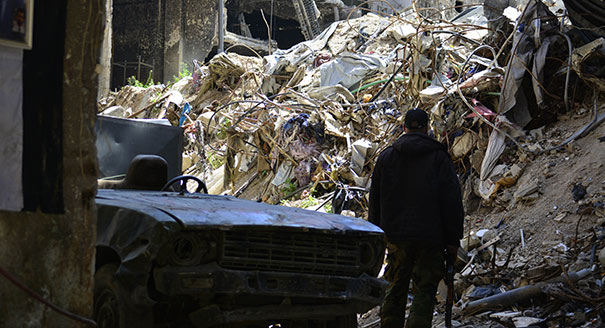
ISIS recently took over most of the Yarmouk Palestinian refugee camp near Damascus. A week before that, a rebel coalition calling itself Jaysh al-Fateh—mainly composed of ISIS rivals Ahrar al-Sham and Jabhat al-Nusra—took over the northern city of Idlib, making it the second urban center lost by the Syrian regime after Raqqa, where ISIS is headquartered.
But the two advances are wildly different: While the fall of Idlib is a clear loss for the regime of embattled Syrian President Bashar al-Assad, the ISIS takeover of Yarmouk is a regime-blessed tactic, if not necessarily a successful one. And they are both signs that the position of the Syrian regime is not as solid as it used to be.The regime, following the loss of Idlib, is now concerned it could also lose the southern city of Daraa, where more moderate Free Syrian Army (FSA) rebels have been making significant gains. The regime has started to move its administrative bureaus out of the area as it did just before Idlib’s fall.
Yarmouk is only 100 kilometers away from Daraa. If ISIS, now in control of the camp, uses it as a base to attack the FSA in Daraa, it would save the Syrian regime from having to fight that battle itself.
This tactic is not new. ISIS has been attempting to gain a foothold in FSA-controlled southern Syria for several months, relying on local recruitment of Syrians and Palestinians to have a presence in an area. Throughout this time, the Syrian regime has also been indirectly enabling ISIS access to the south because this serves the regime’s aim of crushing the moderate opposition in the area.
But the Yarmouk scenario is also about countering the gains of al-Nusra in Idlib. Unable to overwhelm al-Nusra militarily, the Syrian regime tried to indirectly use Yarmouk as a way to discredit al-Nusra through facilitating the access of ISIS to the camp.
After ISIS was provoked by a Palestinian brigade in the Yarmouk camp, Aknaf Bayt al-Maqdis—a group which had threated ISIS after accusing it of murdering one of its leaders—the regime did not stand in the way of ISIS fighters who raided the camp. The regime had already besieged Yarmouk for several months and starved its residents, so it was no regime stronghold. Allowing ISIS to take over the camp was only a small sacrifice for Assad.
In return, the regime calculated that ISIS’ takeover of the camp would achieve a much bigger gain: sparking a rift within al-Nusra.
Although the group is officially an enemy of ISIS—the latter has declared al-Nusra an apostate—some al-Nusra brigades in southern Syria have personal connections with ISIS leaders.
The ISIS advance in Yarmouk pushed the al-Nusra brigades that are sympathetic to ISIS to help it on the ground. The attack also forced the al-Nusra brigades opposed to ISIS to stay out of the battle so as not to spark a hot war between the two groups that would detract them from achieving their objectives (establishing a caliphate in the case of ISIS, and fighting the regime in the case of al-Nusra).
The regime’s calculation was that this contradiction between the actions of some al-Nusra brigades and the “neutrality” of others would embarrass the leaders of al-Nusra and hurt the group’s credibility.
Indeed, public criticisms of al-Nusra’s apparent flip-flopping in Yarmouk have already begun to emerge—and rival groups see in the Yarmouk scenario an opportunity to reassert themselves in the face of al-Nusra.
Damaging Jabhat al-Nusra’s credibility is crucial for Assad. Unlike ISIS, which has largely refrained from attacking the regime as it concentrates on building its state-within-a-state, al-Nusra in particular has always had fighting Assad its sole raison d’être.
In Idlib, Jaysh al-Fateh—which again, is partly comprised of al-Nusra—is now working on creating a joint civilian-military administration similar to the model offered by the FSA in the south. This model is more acceptable to the local population than an Islamist mode of governance, and is a way for al-Nusra as well as the FSA to demonstrate that they can offer a better alternative to the regime. Any further growth of al-Nusra therefore means a growing concrete threat to the Syrian regime.
The takeover of the Yarmouk camp has therefore been a wily and tactical maneuver by the Syrian regime. But its success remains to be seen. So far, al-Nusra has released a statement distancing itself from the events in Yarmouk, and has handed over control of the main crossing on the Syrian-Jordanian border near Daraa to the FSA. Whether this indicates that the Islamist Jaysh al-Fateh and the moderate FSA are exploring a pragmatic formula to increase their cooperation in the future is an open question.
As the developments in Yarmouk, Idlib, and Daraa show, in the Syrian conflict, the line between friends and enemies is often blurry. But they also signal that the regime is facing graver challenges in the north and the south than ever—threats that it cannot counter on its own.
Former Director, Middle East Center
Khatib was director of the Carnegie Middle East Center in Beirut. Previously, she was the co-founding head of the Program on Arab Reform and Democracy at Stanford University’s Center on Democracy, Development, and the Rule of Law.
Recent Work
Lina Khatib
Lina Khatib
Carnegie does not take institutional positions on public policy issues; the views represented herein are those of the author(s) and do not necessarily reflect the views of Carnegie, its staff, or its trustees.

With its public finances in shambles, the far right polling at 35 percent ahead of the 2027 presidential election, and a growing protest movement, is France’s crisis a threat to the EU’s geopolitical awakening?

Rym Momtaz, ed.

Europe is facing rising populism internally as well as external pressures from Russia, China, Turkey, and the United States.

Dimitar Bechev

A notable degree of participative democracy has firmly arrived in Europe. But to have more far-reaching impact, democratic deliberation needs to move into a radically new phase.

Richard Youngs

Before the next wave of EU enlargement takes place, the union needs to grapple with thorny questions of how power is distributed among its members.


Emil Sondaj Hansen, Ditte Brasso Sørensen

The new U.S.–Denmark–Greenland agreement will help Washington exert political, economic, and financial dominance under the guise of security. Yet, it acknowledged Copenhagen’s and Nuuk’s sovereignty on the island.

Marc Pierini