

Article
Dalia Ghanem
{
  "authors": [
    "Dalia Ghanem"
  ],
  "type": "legacyinthemedia",
  "centerAffiliationAll": "dc",
  "centers": [
    "Carnegie Endowment for International Peace",
    "Malcolm H. Kerr Carnegie Middle East Center"
  ],
  "collections": [],
  "englishNewsletterAll": "menaTransitions",
  "nonEnglishNewsletterAll": "",
  "primaryCenter": "Malcolm H. Kerr Carnegie Middle East Center",
  "programAffiliation": "MEP",
  "programs": [
    "Middle East"
  ],
  "projects": [],
  "regions": [
    "Maghreb",
    "Algeria",
    "North Africa"
  ],
  "topics": [
    "Political Reform"
  ]
}
Source: Getty
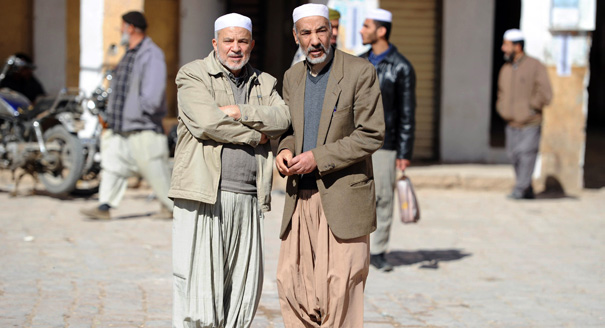
The immediate causes of Algeria’s Ghardaia conflict between ethnic Arabs and Berbers are more political, social, and economic in nature.
Source: World Politics Review
Last week, at least 22 Algerians died in clashes between ethnic Arabs and Berbers in the oasis city of Ghardaia, where tensions have grown for the last two years between the two communities over jobs, housing and land. In an email interview, Dalia Ghanem-Yazbeck, a research analyst at the Carnegie Middle East Center, discussed ethnic violence in Algeria.
Dalia Ghanem-Yazbeck: The conflict between the Arabs and Berbers in Algeria dates back to 1975, when clashes broke out between the two communities for unknown reasons. Clashes broke out again a decade later in 1985 and have since become a regular occurrence. There were clashes in 1991 in Berriane, in 2004 in Beni Isguene, in 2008 and 2009 in Ghardaia, and sporadically during 2014 and more recently in July 2015. Some claim that the reasons for the conflict are confessional—the Mozabite Berbers are Ibadi Muslims, and the Chaamba Arabs follow the Maliki school of Sunni Islam. Others say the conflicts are caused by ethnic tensions between Berbers and Arabs. However, these two communities have been coexisting for centuries in peace.
The immediate causes of the conflict are more political, social, and economic in nature. Unemployment is very high in the region, and the majority of youth have no future job prospects, despite the region’s wealth of natural resources, including gas, shale gas, and oil. The clashes are also linked to land and housing. In 2013 riots broke out following the allocation of state-subsidized housing, in which both camps felt the other was given preferential treatment.Fundamentally, the two communities do not trust each other, and each feels it is marginalized by the other. The Berbers accuse the Arabs of benefiting from preferential treatment by the government, including obtaining better jobs and places to live, because they are Arabs. Meanwhile, the Arabs accuse the Berbers, who are generally perceived to be wealthier, of hindering poorer Arabs’ integration into their exclusive social structures.
Ghanem-Yazbeck: Since clashes in 2014 that left 12 people dead and hundreds injured, the government has only sought to contain the crisis locally in the hopes that it would just go away, without implementing long-term solutions. The government also protected the local security forces and political authorities, refusing to examine their role in the management of the crisis. It offered compensation for the families of victims of the 2014 clashes and proposed building 30,000 dwellings to increase local development.
Obviously, this was not enough, as the recent clashes have left at least 22 people dead. In response, the government deployed 8,000 troops to protect Ghardaia and its residents. This response does not address the underlying social, political and economic problems of the M’zab region. Instead, the government is claiming that the violence is the result of a “foreign hand” that is “trying to destabilize Algeria.”
Ghanem-Yazbeck: There is a high potential for the violence to spread, as there are terrorist groups operating in the region and the Sahel that will take advantage of the situation in the M’zab for recruiting purposes. One has to keep in mind that Mokhtar Belmokhtar, the former head of al-Qaida in the Islamic Maghreb and the mastermind behind the attack on the gas complex in Ain Amenas in January 2013, is from Ghardaia. He was a smuggler between Mali and Niger and an important member of the Salafist Group for Preaching and Combat (GSPC). In addition, the region is a major stop in the Saharan drug-trafficking routes from Morocco to Europe. As such, it is very important for the informal economy that is the source of financing for all extremist groups in the region.
This interview was originally published by World Politics Review.
Former Senior Resident Scholar, Malcolm H. Kerr Carnegie Middle East Center
Dalia Ghanem was a senior resident scholar at the Malcolm H. Kerr Carnegie Middle East Center in Beirut, where her research focuses on Algeria’s political, economic, social, and security developments. Her research also examines political violence, radicalization, civil-military relationships, transborder dynamics, and gender.
Recent Work
Dalia Ghanem


Frances Z. Brown, Judy Dempsey, Dalia Ghanem, …
Carnegie does not take institutional positions on public policy issues; the views represented herein are those of the author(s) and do not necessarily reflect the views of Carnegie, its staff, or its trustees.

As the EU confronts profound challenges, several leaders have called for fundamental reform to the union’s model—but only modest, superficial changes have resulted. What if Europe really could be reimagined from zero today: What should such a redesigned European order look like?

Richard Youngs, ed.
The EU’s new migration policy is not suited to today’s realities. With climate change increasingly becoming a driver of displacement, Europe needs to rethink its deterrence-focused approach.

Shana Tabak
Preparing candidate countries for EU membership is no longer enough. As the enlargement process becomes a reality, the union must also prepare its own societies.

Iliriana Gjoni
Countries face several hurdles in joining the EU, including the final stage of ratifying their accession treaties. Procedural reforms and substantive adjustments could help move the process forward.

Stefan Lehne
Europe has an interest in supporting Armenian leader Nikol Pashinyan as he tries to make peace with neighbors and loosen ties with Russia. But it is depersonalized support in the long term, not quickfire flash, that will win the day.

Thomas de Waal