

Paper
Douglas H. Paal
{
  "authors": [
    "Douglas H. Paal"
  ],
  "type": "legacyinthemedia",
  "centerAffiliationAll": "dc",
  "centers": [
    "Carnegie Endowment for International Peace",
    "Carnegie China"
  ],
  "collections": [],
  "englishNewsletterAll": "asia",
  "nonEnglishNewsletterAll": "",
  "primaryCenter": "Carnegie China",
  "programAffiliation": "AP",
  "programs": [
    "Asia"
  ],
  "projects": [],
  "regions": [
    "North America",
    "United States",
    "East Asia",
    "China"
  ],
  "topics": [
    "Foreign Policy"
  ]
}
Source: Getty
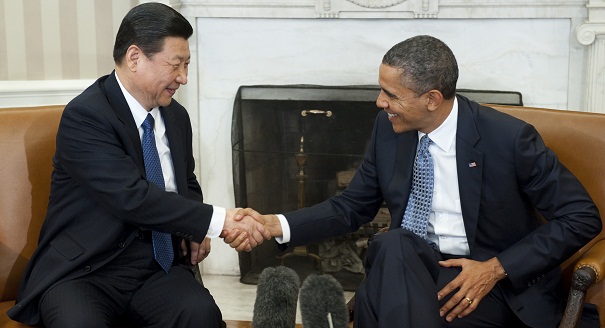
Instead of focusing on Chinese activities in the South China Sea, cyberspace, and the currency markets during the upcoming state visit of President Xi Jinping to the United States, the leaders should discuss the health of the global economy.
Source: China Daily
If Americans focus on Chinese activities in the South China Sea, cyberspace, and the currency markets during the upcoming state visit of President Xi Jinping to the United States, they will be mistaking the urgent for the important. This summit should be about what is important: the health of the global economy and successful management of the inevitable frictions between the two largest economies.
The Barack Obama administration is perceived as weak in its response to developments in the South China Sea (and elsewhere) over the past few years. Officials have complained endlessly, but done little. This has created the false impression that the tiny islands there are at the center of U.S.-China relations, whereas they are just one among many arenas in the Asia-Pacific region where China's growing capabilities are bumping up against a security framework that has never had to accommodate Chinese interests before.
The real challenge for Washington is to find a way to engage Beijing while building on the success of the alliance arrangements that have prevailed in the region since World War II. These have largely brought peace and prosperity to the region, including to China, while avoiding crippling arms races among Asia's heterogeneous nations.China's losses to imperialism and its self-imposed isolation are over, as exemplified by the military parade marking the end of WWII in Beijing on September 3, and its security needs will have to be channeled in constructive directions by a new regional security vision. The leaders need to talk candidly about the responsibilities of both capitals to achieve that.
Cyberspace poses vexing issues, both of policy comprehension and management. The revelations by former National Security Agency operative Edward Snowden and Wikileaks have undercut Obama's efforts to distinguish between legitimate intelligence collection and off-limits commercial theft. Americans felt the intrusion into their personnel files and accounting data very personally and want their government to protect them.
China and the United States have had a late and feeble start to consultations on what to do about managing the rules of cyberspace. China has been blamed for alleged massive intrusions, as at the Office of Personnel Management, but not given credit for cooperating in identifying the Democratic People's Republic of Korea perpetrators of the Sony hack. A risk management mechanism is needed, one that involves industry representatives. Talk of sanctions against China may feel good in the United States, but the word resonates unconstructively in Chinese public opinion. At their summit, Obama and Xi both should acknowledge there is a problem and give a joint call for a positive program, for reining in behavior that both can identify as criminal.
Turbulence in China's stock markets and efforts to delink the renminbi from the dollar have some American politicians talking about China trying to use its currency to take jobs from American workers. Cataclysmic projections of declining Chinese growth and mounting debt should be left to the opinion columns. Predictions of American failure and Chinese triumph need to be reassessed.
The leaders need to climb to the summit and reassure markets, not alarm them. There are positive stories to tell. China is shifting from investment-led to consumption-and services-led growth. As a result, GDP growth will decline. China's stock markets were overheated and needed correction. The renminbi needs to be more market based and less centrally orchestrated. The United States has lowered unemployment, reduced the cost of energy, and sustained demand as the European Union and emerging markets deal with reduced consumption and deleveraging.
In surveying the globe, the two leaders have accomplishments to applaud and challenges to address. The Iran nuclear agreement was achieved with considerable Chinese assistance; Beijing needs also to make clear that it is serious about the consequences if Teheran reneges. Tensions between China and Japan have abated, but not been resolved. Elections in Taiwan in January may require closer consultation. The Islamic State is a threat to both countries' interests. The list of topics is long.
If Obama and Xi can demonstrate verbally and symbolically that they are seriously engaged in the business of delivering global prosperity and maintenance of peace, they will have done well with the last Chinese state visit of the Obama era. They can lay a foundation of stability under what will be two years of fraught politics and challenging frictions as the United States transitions to a new administration.

Distinguished Fellow, Asia Program
Paal previously served as vice chairman of JPMorgan Chase International and as unofficial U.S. representative to Taiwan as director of the American Institute in Taiwan.
Recent Work
Douglas H. Paal


Douglas H. Paal, Tong Zhao, Chen Qi, …
Carnegie does not take institutional positions on public policy issues; the views represented herein are those of the author(s) and do not necessarily reflect the views of Carnegie, its staff, or its trustees.

The new U.S.–Denmark–Greenland agreement will help Washington exert political, economic, and financial dominance under the guise of security. Yet, it acknowledged Copenhagen’s and Nuuk’s sovereignty on the island.

Marc Pierini

A summer of escalation in the Black Sea has hurt Ukraine economically and is exacerbating world food security. A truce is needed—as is a broader reframing of Europe’s Ukraine strategy.

Thomas de Waal

Are Germany’s economic, industrial, and political struggles becoming a liability for the EU’s ability to rise to the geopolitical moment?

Rym Momtaz, ed.

European Commission President Ursula von der Leyen is about to give her annual address on the state of the EU. Here’s what she won’t—but should—say.
Rym Momtaz

Radical-right parties are expected to do well in upcoming elections in four of the EU's biggest member states. If successful, they could prevent the union from addressing key challenges ahead.

Stefan Lehne