

Commentary
Alexander Gabuev
{
  "authors": [
    "Alexander Gabuev"
  ],
  "type": "legacyinthemedia",
  "centerAffiliationAll": "",
  "centers": [
    "Carnegie Endowment for International Peace",
    "Carnegie Russia Eurasia Center"
  ],
  "collections": [],
  "englishNewsletterAll": "",
  "nonEnglishNewsletterAll": "",
  "primaryCenter": "Carnegie Endowment for International Peace",
  "programAffiliation": "",
  "programs": [],
  "projects": [],
  "regions": [
    "East Asia",
    "China",
    "Russia"
  ],
  "topics": [
    "Political Reform",
    "Foreign Policy"
  ]
}
Source: Getty
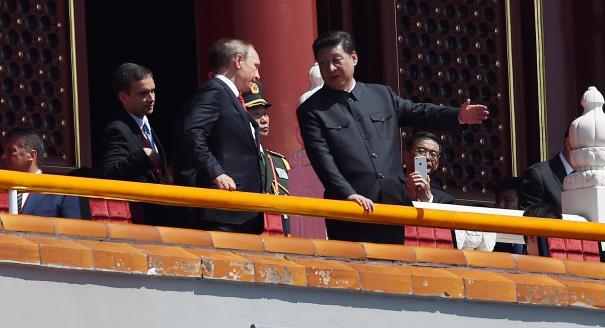
The symbolic affinity between Xi Jinping and Vladimir Putin represents not only a shared outlook on the current world, but also a shared view of history.
Source: Global Times
Chinese President Xi Jinping watched the military parade Thursday at Tiananmen Square to commemorate China's contribution to WWII and Chinese losses in the war. Xi was joined by 30 heads of state, with Russian President Vladimir Putin standing next to him. This was a repeat of the May 9 Victory Day parade on Moscow's Red Square, where Xi was Putin's guest of honor. The symbolic affinity between the two leaders represents not only a shared outlook on the current world, but also a shared view of history.
WWII plays an important role in national psyches of both Russia and China. For China, the war first started in 1937 - before the 1939 invasion of Poland that begun the war's European theater - and ended last. The country has lost tens of millions of lives. For the Soviet Union, the war claimed about 27 million lives - more than 13.7 percent of the population.
Large parts of both countries were invaded, and local populations were engaged in guerilla resistance. The war touched nearly every family in both Russia and China. That is why the memory of victory in WWII and of the sacrifices made in the course of war is still remembered after 70 years. This anniversary may be the last one for surviving veterans, which only adds to the significance.Both states have made the memory of WWII a part of "patriotic education campaigns" over the last seven decades, aimed at boosting social cohesion. Many of current leaders in both countries were brought up to hold respect toward WWII, making V-Day one of the most important days in their respective national calendars.
This reality is very different from many former Allies nations, where the memories of WWII are still important, but don't play that foundational role. For example, WWII was no less an important experience for Great Britain, France and the US. This partially explains why these Western leaders skipped celebrations in Moscow and Beijing so easily this year due to current political disagreements with China and Russia over territorial disputes in the South China Sea or the war in Ukraine.
Sometimes this attitude makes many Russians and Chinese feel not credited enough for what both nations contributed to the common victory.
It is not only the astonishingly high number of casualties which bring Russia and China together on this day. Chinese resistance played a vital role in immobilizing the Japanese army and preventing an attack on the USSR from the East. Without China, both the Soviet Union and the US would have a very different situation vis-a-vis Nazi Germany and Imperial Japan.
The present is also important.
Russia is under international sanctions over its actions in Crimea and its role in Donbass war. For Putin, a special relationship with China and Xi, who is perhaps the closest person to him among all current global leaders, is very important. China is facing its own international difficulties because of intensified territorial conflicts in the South China Sea and over the Diaoyu Islands. Another layer of tensions was added by the US plan to introduce sanctions against selected Chinese companies charged with cyber theft.
In this environment, it is also important for Beijing to show that it has some friends in the BRICS and SCO countries. Russia is, of course, a very important player in both groups.
With mutual trade falling by 30 percent this year due to low commodities prices and economic downturn in Russia, the symbolic dimension is playing an increasingly important role for both Moscow and Beijing.

Director, Carnegie Russia Eurasia Center
Alexander Gabuev is director of the Carnegie Russia Eurasia Center. Gabuev’s research is focused on Russian foreign policy with particular focus on the impact of the war in Ukraine and the Sino-Russia relationship. Since joining Carnegie in 2015, Gabuev has contributed commentary and analysis to a wide range of publications, including the Financial Times, the New York Times, the Wall Street Journal, and the Economist.
Recent Work
Alexander Gabuev
Alexander Gabuev
Carnegie does not take institutional positions on public policy issues; the views represented herein are those of the author(s) and do not necessarily reflect the views of Carnegie, its staff, or its trustees.

Before the next wave of EU enlargement takes place, the union needs to grapple with thorny questions of how power is distributed among its members.


Emil Sondaj Hansen, Ditte Brasso Sørensen

The new U.S.–Denmark–Greenland agreement will help Washington exert political, economic, and financial dominance under the guise of security. Yet, it acknowledged Copenhagen’s and Nuuk’s sovereignty on the island.

Marc Pierini

A summer of escalation in the Black Sea has hurt Ukraine economically and is exacerbating world food security. A truce is needed—as is a broader reframing of Europe’s Ukraine strategy.

Thomas de Waal

Are Germany’s economic, industrial, and political struggles becoming a liability for the EU’s ability to rise to the geopolitical moment?

Rym Momtaz, ed.

European Commission President Ursula von der Leyen is about to give her annual address on the state of the EU. Here’s what she won’t—but should—say.
Rym Momtaz