

In The Media
David Rothkopf
{
  "authors": [
    "David Rothkopf"
  ],
  "type": "legacyinthemedia",
  "centerAffiliationAll": "",
  "centers": [
    "Carnegie Endowment for International Peace",
    "Malcolm H. Kerr Carnegie Middle East Center"
  ],
  "collections": [
    "Iranian Proliferation"
  ],
  "englishNewsletterAll": "",
  "nonEnglishNewsletterAll": "",
  "primaryCenter": "Carnegie Endowment for International Peace",
  "programAffiliation": "",
  "programs": [],
  "projects": [],
  "regions": [
    "United States",
    "Middle East",
    "Iran"
  ],
  "topics": [
    "Political Reform",
    "Foreign Policy",
    "Nuclear Policy",
    "Arms Control"
  ]
}
Source: Getty
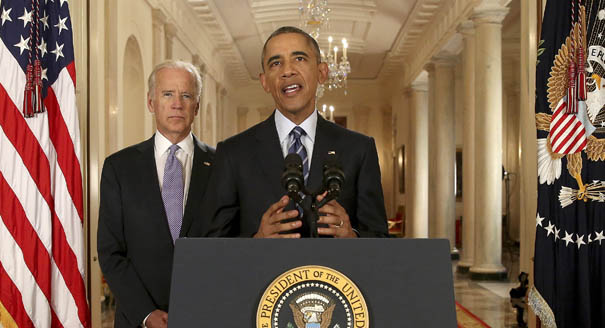
This podcast examines the key parts of the Iran deal and President Barack Obama’s foreign policy strategy in the Middle East.
Source: Foreign Policy
On the the heels of the advancement of the Iran deal, FP Group CEO and Editor David Rothkopf sits down at the Editor’s Roundtable (The E.R.) with Foreign Policy columnists Rosa Brooks and Kori Schake, and historian and FP contributor Robert Kagan. The conversation breaks down the key parts of the Iran deal and President Barack Obama’s foreign policy strategy in the Middle East. What are U.S. interests in the region? What’s ahead in terms of the Iran deal and how it will affect surrounding countries? This episode of The E.R. explores these pressing issues that are rocking today’s news headlines and political conversations.
Rosa Brooks teaches international law, national security, and constitutional law at Georgetown University. Follow her on Twitter: @brooks_rosa.
Kori Schake is a research fellow at the Hoover Institution where she focuses on military history. She is a former foreign policy adviser to Sen. John McCain. Follow her on Twitter: @KoriSchake.
David Rothkopf is the CEO and editor of FP Group. Follow him on Twitter: @djrothkopf.
Former Visiting Scholar
David Rothkopf was a visiting scholar at the Carnegie Endowment as well as the former CEO and editor in chief of the FP Group.
Recent Work
David Rothkopf
David Rothkopf
Carnegie does not take institutional positions on public policy issues; the views represented herein are those of the author(s) and do not necessarily reflect the views of Carnegie, its staff, or its trustees.

The European Commissioner for Trade is headed to China. But after President Xi’s bridge-building visit to Washington, can a more isolated EU overcome Beijing’s stranglehold on critical raw materials? Who will blink first?

Rym Momtaz, ed.

European NATO countries are wrestling with the possibility of U.S. disengagement from the alliance. With the continent’s security increasingly uncertain, governments must restore the credibility of their collective defense.



Hans-Dieter Lucas, Adam Thomson, Pierre Vimont

Before the next wave of EU enlargement takes place, the union needs to grapple with thorny questions of how power is distributed among its members.


Emil Sondaj Hansen, Ditte Brasso Sørensen

The new U.S.–Denmark–Greenland agreement will help Washington exert political, economic, and financial dominance under the guise of security. Yet, it acknowledged Copenhagen’s and Nuuk’s sovereignty on the island.

Marc Pierini

A summer of escalation in the Black Sea has hurt Ukraine economically and is exacerbating world food security. A truce is needed—as is a broader reframing of Europe’s Ukraine strategy.

Thomas de Waal