

Paper
James M. Acton, Ankit Panda
{
  "authors": [
    "James M. Acton"
  ],
  "type": "other",
  "centerAffiliationAll": "dc",
  "centers": [
    "Carnegie Endowment for International Peace"
  ],
  "collections": [
    "Hypersonic Weapons"
  ],
  "englishNewsletterAll": "ctw",
  "nonEnglishNewsletterAll": "",
  "primaryCenter": "Carnegie Endowment for International Peace",
  "programAffiliation": "NPP",
  "programs": [
    "Nuclear Policy"
  ],
  "projects": [],
  "regions": [],
  "topics": [
    "Security",
    "Military",
    "Nuclear Policy"
  ]
}
Source: Getty
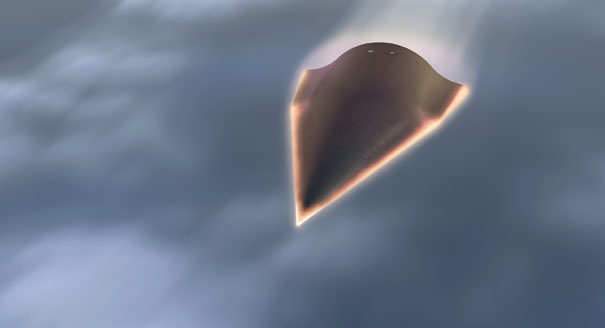
How do boost-glide weapons work? How effective will they be from a military standpoint?
Source: Science & Global Security
The United States, Russia and China are developing hypersonic boost-glide vehicles. A simple model of their trajectory is developed by assuming that the vehicle does not oscillate during the transition to equilibrium gliding. This model is used to analyze U.S. Department of Defense data on test flights for the Hypersonic Technology Vehicle-2. This glider's lift-to-drag ratio—a key performance parameter—is estimated to be 2.6. The model is also used to calculate the tactical warning time that a boost-glide attack would afford an adversary. Other aspects of boost-glide weapons’ military effectiveness are explored. Approximate calculations suggest that, compared to existing non-nuclear weapons, boost-glide weapons could penetrate more deeply but would be less effective at destroying silos. The distance at which a boost-glide weapon armed with a particle dispersion warhead could destroy a mobile missile is also calculated; it is expected to be significantly larger than for an explosive warhead....
This article was originally published in Science & Global Security. A supplement to the article can be found here.

Jessica T. Mathews Chair, Co-director, Nuclear Policy Program
Acton holds the Jessica T. Mathews Chair and is co-director of the Nuclear Policy Program at the Carnegie Endowment for International Peace.
Recent Work

James M. Acton, Ankit Panda
James M. Acton
Carnegie does not take institutional positions on public policy issues; the views represented herein are those of the author(s) and do not necessarily reflect the views of Carnegie, its staff, or its trustees.

Europe is facing rising populism internally as well as external pressures from Russia, China, Turkey, and the United States.

Dimitar Bechev

The new U.S.–Denmark–Greenland agreement will help Washington exert political, economic, and financial dominance under the guise of security. Yet, it acknowledged Copenhagen’s and Nuuk’s sovereignty on the island.

Marc Pierini

A summer of escalation in the Black Sea has hurt Ukraine economically and is exacerbating world food security. A truce is needed—as is a broader reframing of Europe’s Ukraine strategy.

Thomas de Waal

Are Germany’s economic, industrial, and political struggles becoming a liability for the EU’s ability to rise to the geopolitical moment?

Rym Momtaz, ed.

European states control several Overseas Countries and Territories around the world that carry strategic, economic, and environmental weight. As great powers challenge the rules-based order, defending them is a geopolitical imperative for Europe.
Marc Pierini