

Commentary
Funding Ukraine remains a priority for European leaders. As Russia’s war of aggression heads into another winter, two feasible options to mobilize support for Kyiv should be fast-tracked.
Vladyslav Rashkovan, Gregory P. Wilson
{
  "authors": [
    "Thomas de Waal",
    "Eugene Rumer",
    "Andrew S. Weiss"
  ],
  "type": "legacyinthemedia",
  "centerAffiliationAll": "dc",
  "centers": [
    "Carnegie Endowment for International Peace",
    "Carnegie Europe",
    "Malcolm H. Kerr Carnegie Middle East Center"
  ],
  "collections": [
    "Europe’s Eastern Neighborhood"
  ],
  "englishNewsletterAll": "ctw",
  "nonEnglishNewsletterAll": "",
  "primaryCenter": "Carnegie Endowment for International Peace",
  "programAffiliation": "EP",
  "programs": [
    "Europe"
  ],
  "projects": [],
  "regions": [
    "Middle East",
    "Russia",
    "Levant",
    "Syria",
    "Iran",
    "Caucasus",
    "Eastern Europe"
  ],
  "topics": [
    "Foreign Policy",
    "Political Reform",
    "Security"
  ]
}
Source: Getty
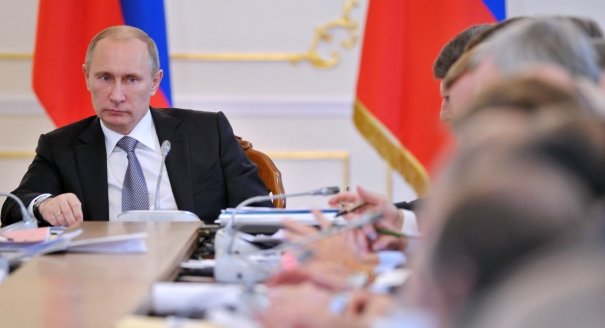
Russia may be using the pretense of combating the self-proclaimed Islamic State to justify its air strikes in Syria, but its true objectives are up for debate.
Source: POLITICO Magazine
People around the world give Putin way too much credit as a master strategist. He’s an improviser and an opportunist of the highest order. It’s true that he’s trying to fill some of the vacuum in the Middle East and Syria as the United States scales back our military involvement in the region. At the same time, I doubt very much that Putin is thinking two or three moves ahead. The war in Syria is about to get a lot worse and he’s plunging Russia right into the middle of it. It’s also only a matter of time before we see surge of jihadist activity targeting Russians, both inside Syria and, I fear, on the streets of Moscow. Russia’s move is going to embolden the Assad regime and motivate the forces of global jihadism.
We’ve seen this pattern already: Putin’s aggression against Ukraine has by all accounts been a debacle. The Syria adventure has all the makings of a similar tragedy and tells us a great deal about the impulsive and erratic nature of the Kremlin’s decision-making efforts on national security. I’m also concerned that Putin has plowed ahead and started engaging in so-called kinetic activity in the very complicated battlefield that is Syria without having a serious conversation about de-confliction with the Pentagon or other members of the US-led anti-ISIL coalition. The de-confliction effort is still in its infancy. He’s courting danger and unintended contact between his military and others operating there.
Vladimir Putin has as many reasons for wanting to get involved in Syria as Barack Obama does for staying out.
The current Russian regime sees in Assad’s Syria its truest friend in the Middle East and its own reflection, a secular one-party autocracy fighting domestic dissent and Sunni extremism. Active support for Assad reinforces two of Putin’s long-held credos: the need to pursue with extreme force the “war on terror” (an idea he cherished before George W. Bush) and an anathema of regime change. So the operation both recalls Putin’s beginning as Russian president, propelled by the 1999 war in Chechnya, and reveals his fear of an end.
Putin’s Russia is also an “information-based dictatorship,” which draws its legitimacy from the support of the television-watching public. As intervention in Ukraine has deteriorated into a nasty intractable mess, “The War on ISIL” is meant to be a new popular TV series in which Russia again bravely fights terrorists and outwits the West. As ever with Putin, this looks more like short-term showmanship than long-term strategy.
By launching his own bombing campaign in Syria, Mr. Putin has proved that Russia too can do its part to contribute to havoc in the Middle East. Other than that, he is probably pursuing several goals, none of them mutually exclusive: support for Assad by destroying his enemies—various oppositon groups and maybe even ISIL; some of these groups reportedly include fighters from Russia, which provides Mr. Putin with a collateral benefit. He has successfully redirected the conversation from his aggression in Ukraine—another side benefit of involvement in Syria. He has positioned himself as a power broker in the Syrian war—he can’t deliver a solution there, but nobody can do it now without him either. He has asserted himself at the expense of the United States, as U.S. officals complain, but the United States can do little about Russian airstikes targeting U.S.-backed militias opposed to Assad.
He has once again proven the pundits wrong when they said he was crippled by Western sanctions and falling oil prices. Where does Mr. Putin go from here? He probably doesn’t know yet. He’ll adapt his tactics to the situation as it changes. It is not clear there is a strategy behind it. To paraphrase the late Yogi Berra, if he doesn’t know where he is going, he’ll end up someplace else.

Senior Fellow, Carnegie Europe
Thomas de Waal is a senior fellow at Carnegie Europe, specializing in Eastern Europe and the Caucasus.
Director and Senior Fellow, Russia and Eurasia Program
Rumer, a former national intelligence officer for Russia and Eurasia at the U.S. National Intelligence Council, is a senior fellow and the director of Carnegie’s Russia and Eurasia Program.
James Family Chair, Vice President for Studies
Andrew S. Weiss is the James Family Chair and vice president for studies at the Carnegie Endowment for International Peace, where he oversees research on Russia, Ukraine, and Eurasia. His graphic novel biography of Vladimir Putin, Accidental Czar: the Life and Lies of Vladimir Putin, was published by First Second/Macmillan in 2022.
Carnegie does not take institutional positions on public policy issues; the views represented herein are those of the author(s) and do not necessarily reflect the views of Carnegie, its staff, or its trustees.

Funding Ukraine remains a priority for European leaders. As Russia’s war of aggression heads into another winter, two feasible options to mobilize support for Kyiv should be fast-tracked.


Vladyslav Rashkovan, Gregory P. Wilson

While the EU and European governments are embracing the much-lauded middle-power moment, this entails three difficult conundrums.

Richard Youngs

Europe is facing rising populism internally as well as external pressures from Russia, China, Turkey, and the United States.

Dimitar Bechev

A notable degree of participative democracy has firmly arrived in Europe. But to have more far-reaching impact, democratic deliberation needs to move into a radically new phase.
Richard Youngs

Much has been said of the changes Brussels is trying to make to the EU enlargement process. Here’s why gradual integration might—or might not—be the answer.
Dimitar Bechev