
The war in Ukraine is costing Russia its leverage overseas. Across the South Caucasus and Middle East, this presents an opportunity for Europe to pick up the pieces and claim its own sphere of influence.
William Dixon, Maksym Beznosiuk
{
"authors": [
"Marc Lynch",
"Christian Koch",
"Ellie Geranmayeh"
],
"type": "legacyinthemedia",
"centerAffiliationAll": "dc",
"centers": [
"Carnegie Endowment for International Peace",
"Malcolm H. Kerr Carnegie Middle East Center"
],
"collections": [],
"englishNewsletterAll": "menaTransitions",
"nonEnglishNewsletterAll": "",
"primaryCenter": "Carnegie Endowment for International Peace",
"programAffiliation": "MEP",
"programs": [
"Middle East"
],
"projects": [],
"regions": [
"Middle East",
"Iran",
"Saudi Arabia",
"Gulf"
],
"topics": [
"Political Reform",
"Security"
]
}Source: Getty
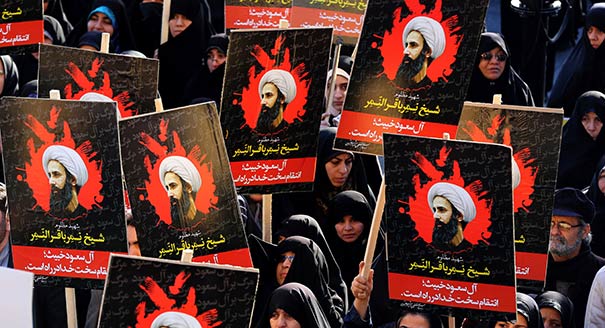
The recent Saudi execution of a prominent Shia cleric and the subsequent attack on their embassy in Iran has heightened tensions across the Gulf.
Source: European Council on Foreign Relations
Saudi Arabia’s execution of Nimr al-Nimr has further stoked regional sectarian discord. However, the attack on the Saudi embassy in Tehran has spoiled much of the political capital that Iran built with the nuclear agreement. Carnegie’s Marc Lynch joined a discussion of the regional and international implications of recent events in the region on ECFR’s World in 30 Minutes.
This podcast originally appeared at the European Council on Foreign Relations.
Former Nonresident Senior Fellow, Middle East Program
Marc Lynch was a nonresident senior fellow in Carnegie’s Middle East Program where his work focuses on the politics of the Arab world.
Christian Koch
Ellie Geranmayeh
Senior policy fellow and deputy head of the Middle East and North Africa programme at the European Council on Foreign Relations.
Ellie Geranmayeh is a senior policy fellow and deputy head of the Middle East and North Africa programme at the European Council on Foreign Relations. She focuses on European policy in relation to Iran, particularly on the nuclear and regional dossiers and sanctions policy.
Carnegie does not take institutional positions on public policy issues; the views represented herein are those of the author(s) and do not necessarily reflect the views of Carnegie, its staff, or its trustees.
The war in Ukraine is costing Russia its leverage overseas. Across the South Caucasus and Middle East, this presents an opportunity for Europe to pick up the pieces and claim its own sphere of influence.
William Dixon, Maksym Beznosiuk
The war in Iran proves the United States is now a destabilizing actor for Europe and the Arab Gulf. From protect their economies and energy supplies to safeguarding their territorial integrity, both regions have much to gain from forming a new kind of partnership together.
Rym Momtaz
French President Emmanuel Macron has unveiled his country’s new nuclear doctrine. Are the changes he has made enough to reassure France’s European partners in the current geopolitical context?
Rym Momtaz, ed.
The drone strike on the British air base in Akrotiri brings Europe’s proximity to the conflict in Iran into sharp relief. In the fog of war, old tensions in the Eastern Mediterranean risk being reignited, and regional stakeholders must avoid escalation.
Marc Pierini
European reactions to the war in Iran have lost sight of wider political dynamics. The EU must position itself for the next phase of the crisis without giving up on its principles.
Richard Youngs