

Commentary
European Commission President Ursula von der Leyen is about to give her annual address on the state of the EU. Here’s what she won’t—but should—say.
Rym Momtaz
{
  "authors": [
    "C. Raja Mohan",
    "R. Shashank Reddy"
  ],
  "type": "other",
  "centerAffiliationAll": "dc",
  "centers": [
    "Carnegie Endowment for International Peace",
    "Carnegie India"
  ],
  "collections": [],
  "englishNewsletterAll": "ctw",
  "nonEnglishNewsletterAll": "",
  "primaryCenter": "Carnegie India",
  "programAffiliation": "SAP",
  "programs": [
    "South Asia"
  ],
  "projects": [],
  "regions": [
    "South Asia",
    "Pakistan",
    "India"
  ],
  "topics": [
    "Foreign Policy"
  ]
}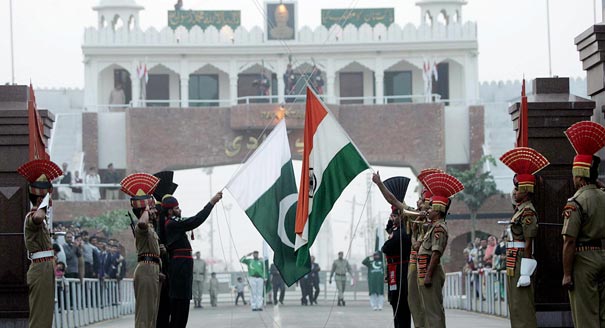
Source: Getty
As New Delhi prepares to resume a comprehensive bilateral dialogue with Islamabad, there is much that India could learn from its past engagement with Pakistan.
Source: Event Reflection
As New Delhi prepares to resume a comprehensive bilateral dialogue with Islamabad, there is much that India could learn from its past engagement with Pakistan. Although the past weighs heavily on India’s current outreach to Pakistan, there has been little effort to draw upon India’s vast negotiating experience with Pakistan over the last several decades. A number of former Indian officials, who had negotiated with Pakistan since the early 1980s, shared their experiences at a roundtable organized by Carnegie India, in collaboration with the India International Centre, on February 15, 2016. Their collective self-reflection offered a five-fold framework to the current negotiators.
The first relates to the importance of a sustained engagement with Pakistan, despite some persistent doubts about the utility of negotiating with Islamabad. The present government in New Delhi and its recent predecessors have all come under criticism for frequent flip-flops toward Pakistan. All of them have often suspended talks in response to major acts of terror or other concerns. The disengagement had not helped India better address the concerns cited for the suspension of the dialogue. All prime ministers, of different political hues over the last quarter of a century, have also found it necessary to resume the dialogue with Pakistan not too long after suspending it. A prolonged period of disengagement has inevitably led to intensification of domestic and external demands on India to return to the negotiating table. The political costs of reengagement have always been high. India has a big stake in normalizing relations with all of its neighbors, including Pakistan. This important interest alone should discourage any future interruption of the dialogue with Islamabad.Second, while sustained engagement is important, the past suggests India should temper its expectations. The recent past has seen significant progress in the negotiations on a number of issues ranging from the disputes over Siachen and Sir Creek to trade normalization, cross-border energy trade, and visa liberalization. Yet agreements that seemed so close at hand often turned out to be difficult to clinch at the eleventh hour. It is also important to remember that agreements, once put in place, have survived much conflict and tension over the decades. On balance, the fact that negotiators had traversed some very difficult path to arrive at potential solutions to issues that have dogged them over the decades provides reason for optimism. After all, the back-channel talks between Prime Minister Manmohan Singh and General Pervez Musharraf from 2004 to 2007 had produced a broad framework for addressing the Kashmir question without violating the essential red lines on either side. The challenge, then, is less about looking for big ideas to resolve difficult issues, but of finding ways to create the enabling environment for moving forward on pathways already traversed.
The third set of issues relate to the structural problems in the dialogue. The weakness of the civilian leaders in Pakistan to deliver on key understandings with India, the army’s veto over Islamabad’s national security and its support for cross-border terrorism are among these factors. It was not difficult to negotiate with Pakistan when the army was directly ruling the country. Prime ministers Indira Gandhi and Rajiv Gandhi did engage with General Zia ul-Haq and so did Atal Bihari Vajpayee and Manmohan Singh with General Pervez Musharraf. It was rather hard, however, to engage with the Pakistan Army when the civilian leadership was formally in charge. Finding a credible mechanism of negotiation with the Pakistan Army is critical for any sustainable dialogue with Islamabad. The Bangkok Mechanism—the current instrument for dialogue between Ajit Doval, India’s national security adviser and his counterpart, General Naseer Janjua (retired)—promises to facilitate communication with the leadership of the Pakistan Army as well as address the most important issue from the Indian perspective—cross border terrorism. New Delhi must nurture this new mechanism.
The fourth set of issues relates to the role of the external third parties. Indian diplomacy since 1971 has largely succeeded in making India’s engagement with Pakistan a strictly bilateral one. But there is no doubt that the interest of the international community in India’s relations with Pakistan has significantly increased since the introduction of nuclear weapons into the subcontinent at the turn of the 1990s. Through the 1990s, India successfully fended off efforts by the United States and others to inject themselves into the India-Pakistan disputes. More broadly, as the balance of power shifts in New Delhi’s favor, an increasing number of countries, including many traditional allies of Islamabad, are treating the India-Pakistan relationship in an even-handed manner or seeking a closer relationship with India. New Delhi must leverage these changing external conditions to encourage Pakistan to stop using terrorism as an instrument of regional policy and expand the areas of cooperation with India. A policy of sustained engagement would help India focus international attention on Pakistan’s ambivalence towards the sources of terrorism on its soil.
The fifth and most important set of issues relate to the domestic management of the dialogue with Pakistan. The deep scars from the partition of the subcontinent and the unending tensions with Pakistan since then have lent an intense emotional dimension to New Delhi’s engagement with Islamabad. Although the Bharatiya Janata Party (BJP) and the Congress Party have recognized the imperatives of continuous dialogue with Pakistan when they were in power, they have not hesitated to attack the other for doing the same when the reins of power switch hands in New Delhi. Meanwhile, India’s electronic media has whipped up public passion and made it increasingly difficult to negotiate calmly with Pakistan. Generation of a broad consensus among the political parties and better management of the public perceptions have increasingly become preconditions for a successful engagement with Pakistan.
Although the difficulties of negotiating with Pakistan are real, New Delhi must bet that patient engagement that can seize upon occasional moments of opportunity can help chip away at entrenched hostility across the border, diminish resistance at home, and mobilize substantive international support for India’s regional objectives. New Delhi must avoid being too deterministic in its understanding of Pakistan. Indian diplomacy must be sensitive to the prospects of change in Pakistan’s internal politics and external orientation. Above all, New Delhi must recognize the strength of its own agency in shaping the long-term evolution of Pakistan while coping with the inevitable near-term frustrations in dealing with Islamabad.
R. Shashank Reddy is a research assistant at Carnegie India.
Former Nonresident Senior Fellow, Carnegie India
A leading analyst of India’s foreign policy, Mohan is also an expert on South Asian security, great-power relations in Asia, and arms control.
R. Shashank Reddy
Former Research Analyst
R. Shashank Reddy was a research analyst at Carnegie India. His research focuses on the implications of emerging technologies and their governance for international and Indian security.
Carnegie does not take institutional positions on public policy issues; the views represented herein are those of the author(s) and do not necessarily reflect the views of Carnegie, its staff, or its trustees.

European Commission President Ursula von der Leyen is about to give her annual address on the state of the EU. Here’s what she won’t—but should—say.

Rym Momtaz

The aftermath of the Ceuta crisis shows Europe has drawn the wrong lessons. Rather than doubling down on failed migration policies, the EU needs to address the underlying roots of such episodes.

Richard Youngs

Canadian Prime Minister Mark Carney has twice inspired praise for standing up to U.S. President Donald Trump: at the 2026 World Economic Forum in Davos and on Canada-U.S. trade negotiations. Is Carney showing a third way better than the EU has in dealing with the Trump administration?
Rym Momtaz, ed.

The EU’s responses to two recent incidents expose the gulf between European perceptions and capabilities. Unless the union can bridge that gap, it will never become a real geostrategic power.
Rym Momtaz

European states control several Overseas Countries and Territories around the world that carry strategic, economic, and environmental weight. As great powers challenge the rules-based order, defending them is a geopolitical imperative for Europe.

Marc Pierini