

Commentary
The new U.S.–Denmark–Greenland agreement will help Washington exert political, economic, and financial dominance under the guise of security. Yet, it acknowledged Copenhagen’s and Nuuk’s sovereignty on the island.
Marc Pierini
{
  "authors": [
    "Nikolay Kozhanov"
  ],
  "type": "legacyinthemedia",
  "centerAffiliationAll": "",
  "centers": [
    "Carnegie Endowment for International Peace",
    "Carnegie Russia Eurasia Center"
  ],
  "collections": [],
  "englishNewsletterAll": "",
  "nonEnglishNewsletterAll": "",
  "primaryCenter": "Carnegie Russia Eurasia Center",
  "programAffiliation": "",
  "programs": [],
  "projects": [],
  "regions": [
    "Middle East",
    "Russia"
  ],
  "topics": [
    "Foreign Policy"
  ]
}
Source: Getty
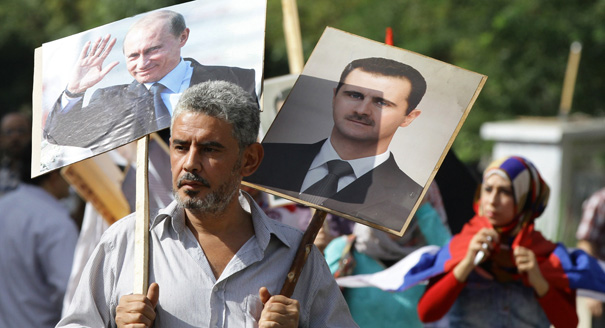
By intensifying its current activities in the Middle East, the Kremlin is pursuing three goals: economic, political, and security.
Source: Cipher Brief
Since 2012, there has been a period of diplomatic activity by the Kremlin in the Middle East which is unprecedented since the fall of the USSR. Existing records of diplomatic and political contacts show an increased exchange of multilevel delegations between Russia and Middle Eastern countries. Moscow is attempting to cultivate deeper involvement in regional issues and to establish contacts with those forces in the region which the Kremlin considers as legitimate. If before 2012 the Kremlin’s diplomacy in the Middle East could be characterized as inconsistent and shaped by the opportunism of the Russian authorities, the growing confrontation with the West became the factor which impelled Moscow to intensify its activities in the Middle East. All in all, by intensifying its current activities in the region, the Kremlin is pursuing the following three goals:
This article was originally published on The Cipher Brief website.

Nikolay Kozhanov
Former nonresident scholar, Foreign and Security Policy Program, Moscow Center
Kozhanov is a former nonresident scholar at the Carnegie Moscow Center and a contributing expert to the Moscow-based Institute of the Middle East.
Carnegie does not take institutional positions on public policy issues; the views represented herein are those of the author(s) and do not necessarily reflect the views of Carnegie, its staff, or its trustees.

The new U.S.–Denmark–Greenland agreement will help Washington exert political, economic, and financial dominance under the guise of security. Yet, it acknowledged Copenhagen’s and Nuuk’s sovereignty on the island.

Marc Pierini

A summer of escalation in the Black Sea has hurt Ukraine economically and is exacerbating world food security. A truce is needed—as is a broader reframing of Europe’s Ukraine strategy.

Thomas de Waal

Are Germany’s economic, industrial, and political struggles becoming a liability for the EU’s ability to rise to the geopolitical moment?

Rym Momtaz, ed.

European Commission President Ursula von der Leyen is about to give her annual address on the state of the EU. Here’s what she won’t—but should—say.
Rym Momtaz

The aftermath of the Ceuta crisis shows Europe has drawn the wrong lessons. Rather than doubling down on failed migration policies, the EU needs to address the underlying roots of such episodes.

Richard Youngs