

Article
Dalia Ghanem
{
  "authors": [
    "Dalia Ghanem"
  ],
  "type": "legacyinthemedia",
  "centerAffiliationAll": "dc",
  "centers": [
    "Carnegie Endowment for International Peace",
    "Malcolm H. Kerr Carnegie Middle East Center"
  ],
  "collections": [],
  "englishNewsletterAll": "menaTransitions",
  "nonEnglishNewsletterAll": "",
  "primaryCenter": "Malcolm H. Kerr Carnegie Middle East Center",
  "programAffiliation": "MEP",
  "programs": [
    "Middle East"
  ],
  "projects": [],
  "regions": [
    "Maghreb",
    "Algeria",
    "North Africa"
  ],
  "topics": [
    "Political Reform"
  ]
}
Source: Getty
Extremist groups offer their supporters simple answers to complex questions through a variety of ideologies.
Source: The New Arab
How do otherwise "normal" and "sane" individuals such as the attackers in Brussels and Paris convince themselves that killing their own kind is the right thing to do? And how do thousands of fighters in IS-held territories act on a daily basis to persuade themselves that the killings and massacres they are perpetrating are right, and necessary?
I spent seven years studying jihadist groups such as the Armed Islamic Group of Algeria (GIA), one of the most prominent and most dangerous groups in Algeria in the 1990s. In studying the radicalisation process, I examined how young, "sane" Algerians were enticed into violent careers, and the reasons behind such acts.
In answering these complex questions, it is worth remembering the historian Christopher Browning's observation that "explaining is not excusing. Understanding is not forgiving".How do otherwise "normal" and "sane" individuals such as the attackers in Brussels and Paris convince themselves that killing their own kind is the right thing to do? And how do thousands of fighters in IS-held territories act on a daily basis to persuade themselves that the killings and massacres they are perpetrating are right, and necessary?The salafi-jihadi ideology is the first element to shed some light on these questions. Since its inception in June 2014, the Islamic State group has been calling for "the Ummah of Muhammad to wake up from its sleep, remove the garments of dishonour, and shake off the dust of humiliation and disgrace… The sun of jihad has risen" (Dabiq, n°1, p8).
Through this ideology, IS offers its followers simple answers to complex problems. It proposes a binary view that helps its followers make sense of our complicated world: "O Ummah of Islam, indeed the world today has been divided into two camps and two trenches, with no third camp present. The camp of Islam and faith, and the camp of kufr [disbelief] and hypocrisy - the camp of the Muslims and the mujahidin everywhere, and the camp of the Jews, the crusaders, the allies, and with them the rest of the nations and religions of kufr, all being led by America and Russia, and being mobilized by the Jews" (Dabiq, n°1, p.11, bold in original).
This process of "othering", sets up an "us vs them" approach, attempting to rationalise the group through the identification of its enemies. It also provides instructions on behaving favourably towards the in-group and fighting against the out-group.
The scriptures are referred to repeatedly, with distorted interpretations that turn the other into the enemy, because s/he is "impious", "a hypocrite", "apostate", "infidel" or "a supporter of infidels".
To encourage violence against the out-group, salafi-jihadist ideology often uses the imagery of revenge
Supporters rationalise their representations of the victims in order to justify their actions. This allows them to overcome the natural repugnance for killing, and reduces any internal tensions once on the ground or while preparing their attacks, and is referred to by Leon Festinger as "cognitive dissonance".
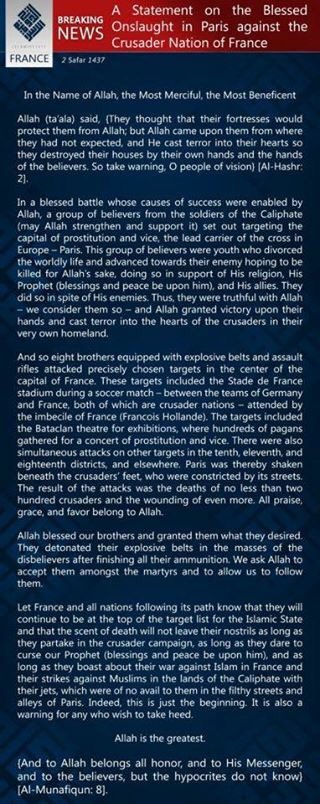
For jihadists, not only is the eradication of the other both perfectly natural and necessary, it is a righteous defence of their religion, as stated in an official IS press release issued after the Paris attack: "This group of believers… [were] hoping to be killed for Allah's sake, doing so in support of His religion, His prophet and His allies."
Jihadists - presented as "brave knights of the Caliphate" - act in the name of God who has sent them "to wage war in the homelands of the wicked crusaders".
To encourage violence against the out-group, salafi-jihadist ideology often uses the imagery of revenge. The November attack in Paris - "the capital of abominations and perversion" - is presented as an act of revenge against France "blinded by hubris, thinking that its geographical distance from the lands of the Khilafah would protect it from the justice of the mujahidin".
"It also did not grasp that its mockery of the Messenger would not be left unavenged… and so revenge was exacted upon those who felt safe in the cockpits of their jets… yes, by Allah, the Khilafah will take revenge for any aggression against its religion and people" (Dabiq, n°12, p2-3).
The power of the group to enthrall is such that its belief system is unconditionally accepted as being the norm and the only truth
This easy-access ideology - disseminated through a powerful communication strategy - can draw people in from afar, including those who are not in IS-held territories, and encourage them to take action against the out-group.
The idea of denying the "other", the "impious" and the "apostate" is no longer sufficient; they must be eradicated.
Once on the ground, and even more so once they have acted, this ideology takes over the mindset of perpetrators who are excited to kill. The other becomes dehumanised and seen as the source of all problems. The power of guns or bombs and a feeling of impunity contribute to a sense of omnipotence.
Even in cases of "lone wolves", jihadists usually operate in a network of cohesive cells, which are, in most cases, interdependent on each other's operational roles. In the Paris attacks on November 13, 2015, 11 individuals operating in three different teams carried out the attacks on the Stade de France, the bars and restaurants and the Bataclan concert hall.
More recently, the Brussels suicide bombing attacks involved at least three individuals.
The group or the cell helps the fighters endure the difficulties of underground life and encourages them in their actions. Even those individuals recruited remotely - who are not living in IS-held territories - can connect to the group through social media.
The power of the group to enthrall is such that its belief system is unconditionally accepted as being the norm and the only truth. For the group, jihadists deny their "uniqueness" as individuals, their personalities and their previous life. This process of "de-individuation" and loss of self-awareness is clear for instance in the rejection of their civil names for a nom de guerre, or pseudonym.
This artificial familiarity and fictitious fraternity encourage them to take actions and to sacrifice their lives in the name of their 'Ikhwan' [brothers]
The Kunya (with the use of Abu, or Um for women) is a symbolic death, a disavowal of oneself and of a previous life considered as jahiliya (age of ignorance of divine guidance). The jihadist has a new name, a new identity, a new family: they are "born again". The group becomes a sort of surrogate family that provides jihadists with emotional comfort, a sense of security, solidarity and purpose in life.
This artificial familiarity and fictitious fraternity encourage them to take actions and to sacrifice their lives in the name of their ikhwan [brothers]: "The Arab and non-Arab, the white man and black man, the easterner and westerner are all brothers... Allah brought their hearts together, and thus, they became brothers by His grace, loving each other for the sake of Allah, standing in a single trench, defending and guarding each other, and sacrificing themselves for one another" (Dabiq n°1, 7).
To foster the "we" feeling of this community, and to encourage violence against the out-group, academic author Farhad Khosrokhavar suggests that jihadists consistently reactivate the salafi-jihadist ideology using tools such as halaqat [Islamic study groups], durus [religious classes], collective prayers and anasheed [a capella songs].
The blood of the other is the means by which the perpetrators seal the group's unity, and their allegiance to God. The act of violent transgression is the reassertion of the group, of the "we".
Former Senior Resident Scholar, Malcolm H. Kerr Carnegie Middle East Center
Dalia Ghanem was a senior resident scholar at the Malcolm H. Kerr Carnegie Middle East Center in Beirut, where her research focuses on Algeria’s political, economic, social, and security developments. Her research also examines political violence, radicalization, civil-military relationships, transborder dynamics, and gender.
Recent Work
Dalia Ghanem


Frances Z. Brown, Judy Dempsey, Dalia Ghanem, …
Carnegie does not take institutional positions on public policy issues; the views represented herein are those of the author(s) and do not necessarily reflect the views of Carnegie, its staff, or its trustees.

Before the next wave of EU enlargement takes place, the union needs to grapple with thorny questions of how power is distributed among its members.


Emil Sondaj Hansen, Ditte Brasso Sørensen

As the EU confronts profound challenges, several leaders have called for fundamental reform to the union’s model—but only modest, superficial changes have resulted. What if Europe really could be reimagined from zero today: What should such a redesigned European order look like?

Richard Youngs, ed.

The EU’s new migration policy is not suited to today’s realities. With climate change increasingly becoming a driver of displacement, Europe needs to rethink its deterrence-focused approach.

Shana Tabak

Preparing candidate countries for EU membership is no longer enough. As the enlargement process becomes a reality, the union must also prepare its own societies.

Iliriana Gjoni
Countries face several hurdles in joining the EU, including the final stage of ratifying their accession treaties. Procedural reforms and substantive adjustments could help move the process forward.

Stefan Lehne