

Commentary
As we close out another season of Strategic Europe, it is worth taking stock of the deep shifts underway.
Rym Momtaz
{
  "authors": [
    "David Livingston",
    "Jeffrey Feldman"
  ],
  "type": "other",
  "centerAffiliationAll": "dc",
  "centers": [
    "Carnegie Endowment for International Peace",
    "Carnegie Europe"
  ],
  "collections": [],
  "englishNewsletterAll": "ctw",
  "nonEnglishNewsletterAll": "",
  "primaryCenter": "Carnegie Endowment for International Peace",
  "programAffiliation": "SCP",
  "programs": [
    "Sustainability, Climate, and Geopolitics"
  ],
  "projects": [],
  "regions": [
    "North America",
    "United States",
    "Eastern Europe",
    "Western Europe"
  ],
  "topics": [
    "Climate Change"
  ]
}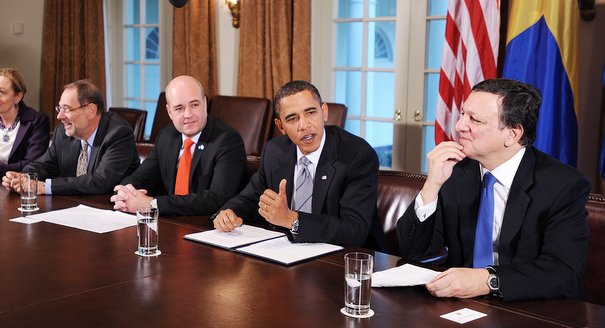
Source: Getty
Energy security is critical to a whole range of public policy objectives, but it cannot be successfully addressed in isolation from other policy aims.
Source: Heinrich Boell Stiftung
On both sides of the Atlantic, energy continues to be a complex, multifaceted issue that is relevant for a whole range of public policy objectives. Energy security is one of the most important aspects, but it cannot be successfully addressed in isolation from other public policy aims. The aim of this paper is to shed light on how three policy communities – those dealing with security, foreign policy, and energy issues – can come together to discuss and find solutions to the transatlantic energy agenda in light of transforming energy security realities on both sides of the Atlantic. Its findings are based on a transatlantic workshop series held in Washington D.C., Brussels and Warsaw in 2015.
This report demonstrates the interconnectivity of the different dimensions of energy policy. The report breaks down the policy silos, providing a comprehensive overview of some of the myriad of issues that any 21st century energy order faces. With workshops in Brussels, Warsaw and Washington D.C., this report has escaped the traditional energy security echo chamber by including in its considerations climate milestones, such as the COP21 Paris Climate Agreement, trade developments such as the transatlantic trade and investment partnership (TTIP), global governance as well as regional co-operation such as the link-up of regional carbon-markets and the creation of sustainable low-carbon energy partnerships....
This report was originally published by Heinich Boell Stiftung.
Former Associate Fellow, Energy and Climate Program
Livingston was an associate fellow in Carnegie’s Energy and Climate Program, where his research focuses on emerging markets, technologies, and risks.
Jeffrey Feldman
Former Junior Fellow, Energy and Climate Program
Carnegie does not take institutional positions on public policy issues; the views represented herein are those of the author(s) and do not necessarily reflect the views of Carnegie, its staff, or its trustees.

As we close out another season of Strategic Europe, it is worth taking stock of the deep shifts underway.

Rym Momtaz

The hybrid warfare landscape is evolving rapidly, leaving policymakers without clear strategies. To better inform their work in addressing emerging challenges, governments must dig deeper into the underlying dynamics at play.


Raluca Csernatoni, Alicia Wanless

Trump is distracted and Ukraine wants Europe to step up. The continent’s leaders must find their voice and assert it in talks with Russia.

Alissa de Carbonnel

Mounting economic strain and battlefield losses will not necessarily make the Kremlin less dangerous. They could instead push Moscow toward a more aggressive hybrid campaign designed to test NATO’s Eastern flank, exploit allied hesitation, and fracture European resolve.

Maksym Beznosiuk

Over the past ten years, NATO has held almost as many summits as it did during the entirety of the Cold War. Are they still useful, or is it time to stop holding annual meetings?
Rym Momtaz, ed.