

Article
C. Raja Mohan, Darshana M. Baruah
{
  "authors": [
    "C. Raja Mohan"
  ],
  "type": "legacyinthemedia",
  "centerAffiliationAll": "dc",
  "centers": [
    "Carnegie Endowment for International Peace",
    "Carnegie India"
  ],
  "collections": [],
  "englishNewsletterAll": "ctw",
  "nonEnglishNewsletterAll": "",
  "primaryCenter": "Carnegie India",
  "programAffiliation": "SAP",
  "programs": [
    "South Asia"
  ],
  "projects": [],
  "regions": [
    "United States",
    "South Asia",
    "India"
  ],
  "topics": [
    "Foreign Policy",
    "Political Reform"
  ]
}
Source: Getty
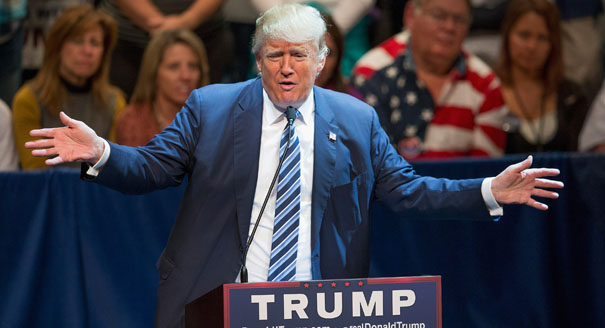
India must begin to take Trump seriously and assess the sources and consequences of America’s changing worldview.
Source: Indian Express
As he overcomes the residual resistance among the Republicans to his nomination as the party’s presidential candidate, Donald Trump has begun to develop a foreign policy framework that challenges much of the conventional wisdom in Washington. In a speech delivered in Washington last week, Trump chose to avoid abrasive off-the-cuff comments and read from a teleprompter. The attempt at sounding more responsible did not mean Trump was giving up on his controversial foreign policy ideas. He was expressing them politely.
Trump’s detractors, both Republican and Democrat, are right in pointing out the multiple contradictions in his worldview. But then, Trump is not at graduate school. He is simply channelling the widespread American wariness about Washington’s expansive and expensive international engagement in recent decades.Trump’s objective is to hammer away at the failings of the post-Cold War American foreign policy rather than offer an immaculate alternative. He has effortlessly distanced himself from the blunders of the Republican establishment and begun to demonise his Democratic rival Hillary Clinton as the personification of America’s foreign policy problems. That certainly looks a smart political move.
Trump argued that “after the Cold War our foreign policy veered badly off course. We failed to develop a new vision for a new time. In fact, as time went on, our foreign policy began to make less and less sense. Logic was replaced with foolishness and arrogance, which led to one foreign policy disaster after another.”
As the first lady in the White House, a Senator and secretary of state during the last quarter of a century, Clinton is deeply associated with America’s post-Cold War international relations. Although there was a debate between the Republicans and Democrats over many international issues, the contest between Trump and Clinton will reveal a much wider chasm.
This new divergence, in which Trump is denouncing his own party’s “arrogance and foolishness” in the Middle East, also reveals the many significant alternative possibilities for America’s foreign policy. It’s this prospect for potential discontinu-ity in America’s external relations that New Delhi must prepare itself for in the coming months.
Starting from then-President Bill Clinton’s visit to India in March 2000, India has slowly but certainly resolved or minimised many of the outstanding disputes with the US, including those on nuclear proliferation and Kashmir. Prime Minister Narendra Modi’s visit to Washington early next month will consolidate and celebrate the expansion of the strategic partnership between the two countries.
The significance of Trump for Delhi’s diplomacy may not necessarily lie in the few stray comments he has made about India. Nor do his occasional remarks on Pakistan’s nuclear weapons suggest a definitive shift. Although Trump’s overall attitude towards India has been positive, it’s his larger worldview that will have a great bearing on India’s strategic choices.
Trump now insists he “will no longer surrender this country or its people to the false song of globalism”. Trump’s emphasis on the primacy of the nation-state and deal-making on the basis of self-interest opens up very interesting opportunities for India if Delhi is prepared to adapt. If Delhi thinks the past is a guide to America’s future foreign policy, it might find itself in some trouble.
A core element of Trump’s proclaimed “America First” foreign policy is the focus on reducing the US trade deficit and limiting the insourcing and outsourcing of American jobs. If Delhi has had great difficulty dealing with American liberalism on trade issues, it’s utterly unprepared to cope with even a mild shift in Washington towards protectionism. If Delhi doesn’t get its trade act together, it’s in for a real rough ride in the coming years.
Trump’s political approach will have elements that benefit India as well as create complications. Consider, for example, Trump’s emphasis on improving ties with Russia. Deteriorating ties between Washington and Moscow in recent years had complicated India’s own strategic calculus. A new compact between them would be very welcome in Delhi.
Delhi would be wary, in contrast, of Trump’s talk about doing a deal with China. Some in the US are concerned that Trump might cede more political space in Asia to China in return for economic concessions from Beijing.
Trump’s continuing insistence that US allies should share more of America’s defence burden and his threat to pull out if they don’t has the potential to alter the geopolitical landscape in Asia. At the same time, it also opens the door for India to take on larger leadership responsibilities in the region.
Like many in Washington, Delhi has sniggered at Trump all these days. India must begin to take Trump seriously and assess the sources and consequences of America’s changing worldview. Delhi is quite familiar with the Clinton establishment. It now needs to engage those shaping the enormously successful campaign that has turned Trump from a political joke into a serious contender for the White House.
This article was originally published in the Indian Express.
Former Nonresident Senior Fellow, Carnegie India
A leading analyst of India’s foreign policy, Mohan is also an expert on South Asian security, great-power relations in Asia, and arms control.
Recent Work

C. Raja Mohan, Darshana M. Baruah


Alexander Gabuev, Paul Haenle, C. Raja Mohan, …
Carnegie does not take institutional positions on public policy issues; the views represented herein are those of the author(s) and do not necessarily reflect the views of Carnegie, its staff, or its trustees.

With its public finances in shambles, the far right polling at 35 percent ahead of the 2027 presidential election, and a growing protest movement, is France’s crisis a threat to the EU’s geopolitical awakening?

Rym Momtaz, ed.

Ahead of a tough winter for Ukraine, Donald Trump’s swing back toward Russia bodes ill. But instead of panicking, Kyiv’s European allies are focusing on action.
Rym Momtaz

Funding Ukraine remains a priority for European leaders. As Russia’s war of aggression heads into another winter, two feasible options to mobilize support for Kyiv should be fast-tracked.


Vladyslav Rashkovan, Gregory P. Wilson

While the EU and European governments are embracing the much-lauded middle-power moment, this entails three difficult conundrums.

Richard Youngs

Europe is facing rising populism internally as well as external pressures from Russia, China, Turkey, and the United States.

Dimitar Bechev