

Research
- +6
Yasmine Farouk, Nathan J. Brown, Maysaa Shuja Al-Deen, …
{
  "authors": [
    "Anouar Boukhars"
  ],
  "type": "other",
  "centerAffiliationAll": "dc",
  "centers": [
    "Carnegie Endowment for International Peace",
    "Malcolm H. Kerr Carnegie Middle East Center"
  ],
  "collections": [
    "Arab Awakening"
  ],
  "englishNewsletterAll": "menaTransitions",
  "nonEnglishNewsletterAll": "",
  "primaryCenter": "Carnegie Endowment for International Peace",
  "programAffiliation": "MEP",
  "programs": [
    "Middle East"
  ],
  "projects": [],
  "regions": [
    "North Africa",
    "Egypt",
    "Libya",
    "Algeria",
    "Tunisia",
    "Maghreb"
  ],
  "topics": [
    "Political Reform",
    "Security",
    "Military"
  ]
}
Source: Getty
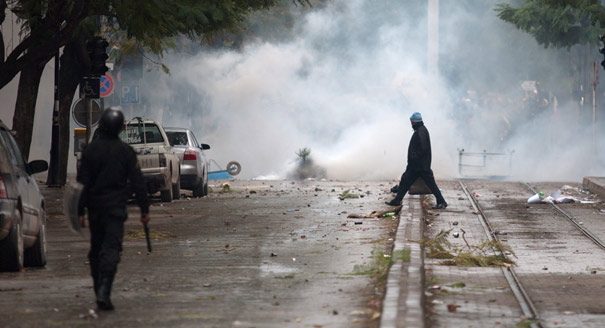
While Tunisia is often and rightly lauded for its progress, social inequality and regional asymmetries are undermining the country’s democratic transition.
Source: World Politics Review
Tunisia is often and rightly lauded for the progress it has made since the popular uprising that toppled longtime strongman Zine el-Abidine Ben Ali in January 2011. But social inequality and regional asymmetries are undermining Tunisia’s democratic transition and deepening the chasm between a restless and rebellious periphery and an eastern Mediterranean coast that fears and misunderstands the bitter resentment of border communities.
These unaddressed challenges are also making it harder to secure the country from internal upheaval and terrorism. Aggrieved youths increasingly express their anger in fiery protests and street violence. This radical projection of grievances risks feeding a dangerous spiral of violent extremism. Already, thousands of disgruntled young Tunisians from the hinterlands have joined the so-called Islamic State in Syria and Libya, making Tunisia one of the largest sources of recruits for the group.
The Islamic State’s deepening presence just across the Libyan border further compounds this growing terror threat, as was amply underlined by the March 2016 dramatic terror assault on security forces in the border town of Ben Guerdane. The brazen attempt by dozens of Islamic State-trained sleeper cells to seize the town and inflame a rebellious populace into open revolt illustrates the group’s destabilizing potential to tap into the pervasive discontent in Tunisia’s border regions.
The stakes are high and the threats are real. There are no anchors of regional stability Tunisia can cling to. Its neighbors are either coming undone or ruthlessly defending a creaky authoritarian status quo. The European Union has provided Tunisia with significant aid since 2011, but is engulfed in its own crises and cannot devote the necessary resources to helping Tunisia consolidate democracy and pursue economic reforms. The United States has extended more than $700 million in financial assistance and rounds of loan guarantees exceeding $1 billion since the start of the revolution. But this represents only a fraction of the support that Jordan and increasingly authoritarian Egypt get...
Former Nonresident Fellow, Middle East Program
Boukhars was a nonresident fellow in Carnegie’s Middle East Program. He is a professor of countering violent extremism and counter-terrorism at the Africa Center for Strategic Studies, National Defense University.
Recent Work



Yasmine Farouk, Nathan J. Brown, Maysaa Shuja Al-Deen, …

Frederic Wehrey, Nathan J. Brown, Bader Al-Saif, …
Carnegie does not take institutional positions on public policy issues; the views represented herein are those of the author(s) and do not necessarily reflect the views of Carnegie, its staff, or its trustees.

With its public finances in shambles, the far right polling at 35 percent ahead of the 2027 presidential election, and a growing protest movement, is France’s crisis a threat to the EU’s geopolitical awakening?

Rym Momtaz, ed.

Ahead of a tough winter for Ukraine, Donald Trump’s swing back toward Russia bodes ill. But instead of panicking, Kyiv’s European allies are focusing on action.
Rym Momtaz

Europe is facing rising populism internally as well as external pressures from Russia, China, Turkey, and the United States.

Dimitar Bechev

A notable degree of participative democracy has firmly arrived in Europe. But to have more far-reaching impact, democratic deliberation needs to move into a radically new phase.

Richard Youngs

Before the next wave of EU enlargement takes place, the union needs to grapple with thorny questions of how power is distributed among its members.


Emil Sondaj Hansen, Ditte Brasso Sørensen