

Article
Paul Stronski
{
  "authors": [
    "Paul Stronski"
  ],
  "type": "legacyinthemedia",
  "centerAffiliationAll": "dc",
  "centers": [
    "Carnegie Endowment for International Peace"
  ],
  "collections": [],
  "englishNewsletterAll": "ctw",
  "nonEnglishNewsletterAll": "",
  "primaryCenter": "Carnegie Endowment for International Peace",
  "programAffiliation": "russia",
  "programs": [
    "Russia and Eurasia"
  ],
  "projects": [],
  "regions": [
    "Caucasus",
    "Azerbaijan",
    "Armenia"
  ],
  "topics": [
    "Political Reform",
    "Economy",
    "Civil Society"
  ]
}
Source: Getty
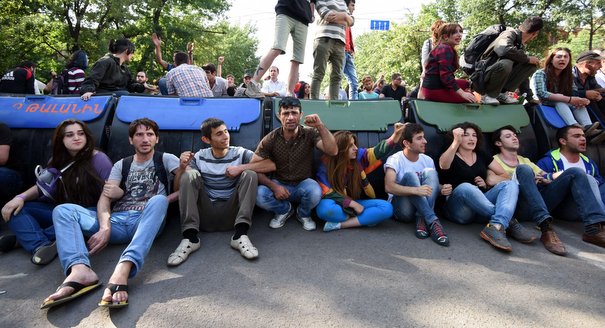
Recent protests in Armenia are the latest example of a growing gap between the Armenian government and society at large.
Source: Polish Institute of International Affairs
The recent instability in Armenia is just the latest example of a growing gap between the Armenian government and society at large. Armenians have become ever more tired of the political intrigues of the leaders who have dominated the landscape since independence. As the economy declines and the security situation worsens, many now question the benefits of the country’s longstanding orientation towards Russia. As a result, Armenia has seen frequent protests since 2013, each sparked by an event—a flawed election, a real or perceived Russian slight, unpopular pension reforms, or hikes to electricity or transportation prices. There are three underlining themes to these social protests; the first is popular anger at the oligarchic system of governance that has taken root in the country; the second is dissatisfaction with pervasive corruption across all aspects of political and economic life. The third is a perception that the country’s political institutions and its leaders (both government officials and increasingly the formal opposition) pursue their own narrow interests at the expense of the people and the nation.
In recent months, two events reinforced frustration with the status quo. The first was the disputed December 2015 constitutional referendum that its critics claim is intended to preserve the power of the ruling party indefinitely. The second was the April 2016 “four-day war” with Azerbaijan that saw heavy casualties and the first losses of Armenian-held territory since the 1994 Nagorno-Karabakh ceasefire. These events tarnished the image of the government in the eyes of many. The war also opened public discussion of the corrosive impact of corruption on Armenian combat readiness.
The events in Armenia are worrying because they were born out of political violence and ultimately met with violence on July 29. The storming of a police station and killing of police officers by a militant opposition group was an illegal act geared to change the country’s politics. That group enjoyed little support before it took government officials hostage, demanded the resignation of the president, and called to reject any concessions to Azerbaijan. The demands of the militants – many heroes of the Karabakh war –resonated with a vocal sector of the population angry about the losses in April, concerned about Russian and international pressure on Yerevan to reach a compromise with Baku, and convinced the only way to influence politics is through the street.
What happened in Armenia is not unique, but a form of the populist and nationalist backlash that is upending politics across the globe. What is troubling for Armenia, however, is the country’s political fragility, its history of political violence, the constant machinations and shifting alliances of its politicians, and the ever-widening gap between the government and the governed. Combined with increased tensions with Azerbaijan, political uncertainty in Turkey, and the regional economic downturn, the country is entering unchartered waters. With all these problems brewing, it is time for the international community to remind Armenia and Armenians to respect constitutional procedures – even if they are flawed – and to refrain from using force.
This article originally appeared in the Polish Institute of International Affairs.

Former Senior Fellow, Russia and Eurasia Program
Paul Stronski was a senior fellow in Carnegie’s Russia and Eurasia Program, where his research focuses on the relationship between Russia and neighboring countries in Central Asia and the South Caucasus.
Recent Work
Paul Stronski
Paul Stronski
Carnegie does not take institutional positions on public policy issues; the views represented herein are those of the author(s) and do not necessarily reflect the views of Carnegie, its staff, or its trustees.

With its public finances in shambles, the far right polling at 35 percent ahead of the 2027 presidential election, and a growing protest movement, is France’s crisis a threat to the EU’s geopolitical awakening?

Rym Momtaz, ed.

A notable degree of participative democracy has firmly arrived in Europe. But to have more far-reaching impact, democratic deliberation needs to move into a radically new phase.

Richard Youngs

The European Commissioner for Trade is headed to China. But after President Xi’s bridge-building visit to Washington, can a more isolated EU overcome Beijing’s stranglehold on critical raw materials? Who will blink first?
Rym Momtaz, ed.

The domestic impacts of how long it is taking to end the war in Ukraine have pushed the French electorate to the political extremes and compromised the country’s diplomatic capacity.
Rym Momtaz

Before the next wave of EU enlargement takes place, the union needs to grapple with thorny questions of how power is distributed among its members.


Emil Sondaj Hansen, Ditte Brasso Sørensen