

Commentary
Andrei Kolesnikov
{
  "authors": [
    "Andrei Kolesnikov"
  ],
  "type": "legacyinthemedia",
  "centerAffiliationAll": "",
  "centers": [
    "Carnegie Endowment for International Peace",
    "Carnegie Russia Eurasia Center"
  ],
  "collections": [],
  "englishNewsletterAll": "",
  "nonEnglishNewsletterAll": "",
  "primaryCenter": "Carnegie Endowment for International Peace",
  "programAffiliation": "",
  "programs": [],
  "projects": [],
  "regions": [
    "Russia"
  ],
  "topics": []
}
Source: Getty
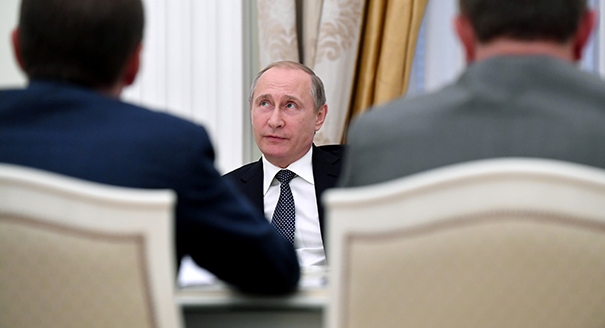
The presidency is the only institution in Russia today that has not been hollowed out, so it is the president who will make all major political decisions. Everyone else is just a liaison officer.
Source: Project Syndicate
Russian President Vladimir Putin has been methodically purging his closest and longest-serving advisers. The latest – but surely not the last – victim is Sergei Ivanov, a former KGB operative (like Putin himself) and defense minister who has just been forced out as Kremlin chief of staff.
Ivanov, a relatively substantive policymaker, is being replaced by a toothless factotum: the former head of the Protocol Schedule Directorate, Anton Vaino. Likewise, the reform-minded education and science minister, Dmitry Livanov, has been fired and replaced with the faceless apparatchik Olga Vasilyeva, a rare woman appointee known only for her Stalinist views (imagine the French president handing an important cabinet position to a mid-level official from the far-right National Front).
As usual, Putin is offering no real explanation for these changes, leaving Kremlinologists – who have gained a new lease on life under Putin – little to work with other than a clear pattern: those who could speak to the president as equals are being replaced by those whom he has created, and who owe their careers to him.Why now? According to a member of Putin’s inner circle during the early years of his regime, the latest purge simply reflects the president’s idea of effective management. Years ago, during a meeting between Putin and his regional plenipotentiaries – whose job was essentially to keep an eye on regional governors – someone in attendance asked the president how he would describe the envoys’ role. He replied that, “Well, they are supposed to be sort of…liaison officers.”
In other words, Putin expects members of his team to be loyal, follow orders like soldiers, and efficiently relay the will of the sovereign down the chain of command. This explains the composition of the new guard – technocrats and officers from the military and security establishment, known as siloviki – that Putin is grooming to serve as the new Russian elite after the 2018 presidential election.
And make no mistake: the relative youth of Putin’s new elite does not mean they will be more liberal. Not one of his new appointees espouses anything like a liberal viewpoint; in fact, they show no ideological commitments or aspirations whatsoever. They are merely what the Chechen warlord and Kremlin loyalist Ramzan Kadyrov calls “Putin’s soldiers.”
The old associates are being removed under different pretexts and by different means. For example, Ivanov – whom many viewed ten years ago as a potential successor to Putin – was given a new job: “Special Presidential Representative for Environmental Protection, Ecology, and Transport.” The head of the Federal Customs Service, Andrey Belyaninov, left office in disgrace after police raided his opulent private residence and emerged with shoeboxes full of cash.
Putin knows that his old cronies are tired, ineffective, often excessively wealthy, and comfortably corrupt, which is not what he needs for a new presidential term. What he does need are his slightly younger “liaison officers,” who will carry out his orders without asking questions. Members of Putin’s new guard already see themselves as loyal subordinates, and, unlike the old guard, they don’t expect the president to be their friend.
It’s hard to say what will become of the old guard’s remaining members. Some – such as Sergey Chemezov, the CEO of the hi-tech and defense state corporation Rostec, and the Kremlin’s “grey cardinal,” Igor Sechin, the executive chairman of the state-owned oil company Rosneft – still hold powerful positions and show little inclination to resign on their own.
But Putin has a lot of time to work his will – the 18 months until the presidential election, and then another six-year term. In the meantime, by appointing an archconservative as his education minister, he is supplementing his military-laden new guard with mid-level officials who hold rabidly isolationist and imperialist views. This will not only jeopardize whatever liberalizing achievements remain from his predecessor Boris Yeltsin’s era, but also the limited social improvements made during his own rule.
Putin’s canny instinct for self-preservation seems to be the only thing preventing him from eliminating the few loyal liberals who still hold key economic positions in his government. These include the Economic Development Minister Alexey Ulyukayev, Finance Minister Anton Siluanov, and the head of the Central Bank of Russia, Elvira Nabiullina.
Even if these officials remain in place for Putin’s next presidential term, we can safely assume that he will not appoint a prominent liberal, such as former finance minister Alexey Kudrin, to replace Dmitry Medvedev as prime minister. His current personnel strategy suggests he’ll choose a bloodless satrap – someone like Vaino.
One thing we know for sure is that Russian foreign and domestic policy is not about to change, and that it will continue to be determined solely by Putin. The presidency is the only institution in Russia today that has not been hollowed out, so it is the president who will make all major political decisions. Everyone else is just a liaison officer.
Former Senior Fellow, Carnegie Russia Eurasia Center
Kolesnikov was a senior fellow at the Carnegie Russia Eurasia Center.
Recent Work
Andrei Kolesnikov
Andrei Kolesnikov
Carnegie does not take institutional positions on public policy issues; the views represented herein are those of the author(s) and do not necessarily reflect the views of Carnegie, its staff, or its trustees.

European Commission President Ursula von der Leyen is about to give her annual address on the state of the EU. Here’s what she won’t—but should—say.

Rym Momtaz

The EU’s responses to two recent incidents expose the gulf between European perceptions and capabilities. Unless the union can bridge that gap, it will never become a real geostrategic power.
Rym Momtaz

European states control several Overseas Countries and Territories around the world that carry strategic, economic, and environmental weight. As great powers challenge the rules-based order, defending them is a geopolitical imperative for Europe.

Marc Pierini

In supporting Europe’s far-right, MAGA and Russia both want the same thing: a weaker EU. Europe must defend itself without abandoning the openness these forces exploit.

Armida van Rij

As we close out another season of Strategic Europe, it is worth taking stock of the deep shifts underway.
Rym Momtaz