

Other
Michael D. Swaine
{
  "authors": [
    "Michael D. Swaine"
  ],
  "type": "legacyinthemedia",
  "centerAffiliationAll": "dc",
  "centers": [
    "Carnegie Endowment for International Peace",
    "Carnegie China"
  ],
  "collections": [
    "China’s Foreign Relations",
    "U.S.-China Relations"
  ],
  "englishNewsletterAll": "asia",
  "nonEnglishNewsletterAll": "",
  "primaryCenter": "Carnegie Endowment for International Peace",
  "programAffiliation": "AP",
  "programs": [
    "Asia"
  ],
  "projects": [],
  "regions": [
    "North America",
    "United States",
    "East Asia",
    "China"
  ],
  "topics": [
    "Political Reform",
    "Foreign Policy"
  ]
}
Source: Getty
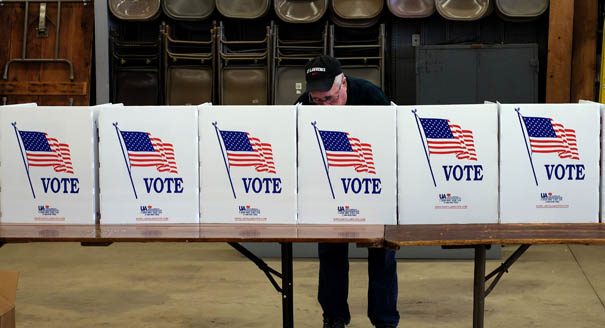
While some Chinese observers praise Trump’s directness, others perceive him as a threat. For such observers, Clinton’s predictability is seen positively, yet some of her positions are expected to increase tensions.
Source: China Leadership Monitor
This year (2016) is a presidential election year, and as always, views toward China and U.S.-China relations play a role in the presidential campaigns of both the Republican and Democratic Party candidates.
In many past campaign years, while stressing the growing importance of the U.S.-China relationship, presidential candidates have generally highlighted the points of contention between Beijing and Washington, especially in the economic, human rights, and (to a lesser extent) national security arenas. These statements and policy platforms have often criticized China (sometimes very sharply) for its alleged transgressions, and proposed various supposedly new or more energetic policy moves designed to elicit more favorable Chinese behavior.
The China issue has frequently been a campaign point for past presidential candidates of both parties. In his 1992 campaign, Bill Clinton used the China issue to criticize the foreign policies of the incumbent George H. W. Bush Republican administration. Clinton used the 1989 government actions in Tiananmen Square to accuse Reagan and Bush of sending “secret emissaries to raise a toast with those who crushed democracy.”1 Similarly, in 2000, part of Al Gore’s foreign policy agenda was to strongly support normalized trade relations with China because “it is right for America’s economy and right for the cause of reform in China.” This gave George W. Bush a point on which to attack Gore.2 Again, in the 2012 election, Barack Obama took a shot at China by complaining to the WTO about Beijing’s imposition of more than $3 billion in duties on U.S. automobile exports, which the Obama administration regarded as an abuse of trade laws. Other than being a counterargument to Mitt Romney’s claim that Obama had not been tough enough on China’s trade policies, this was also a way to remind voters that Romney’s role as a private equity executive was linked to the outsourcing of American jobs to China.3
This year is no exception to the general pattern of a China focus in the foreign policy arena. Both of the presumptive presidential candidates, Democrat Hillary Rodham Clinton and Republican Donald J. Trump, have addressed China, U.S.-China relations, and U.S. policy toward China at various times in their campaigns, often stressing the problems Beijing poses while offering various supposed new or improved policy solutions. That said, the 2016 presidential campaign arguably provides a particularly interesting example of the China views of presidential candidates. Given her long history as First Lady, U.S. senator, and public political figure, Clinton has an extensive track record of views on China and has in the past generated considerable controversy within that country over her stances. Chinese views on her during the current campaign to some extent reflect that history. In contrast, Trump is a relative newcomer to the national political arena, and has made far fewer comments on China. However he has arguably made up for that deficiency in recent months as an extremely provocative and energetic candidate, offering a variety of controversial statements on China or China-related aspects of U.S. foreign policy...
This article was originally published in China Leadership Monitor.
1 Paul Haenle, “The China Factor in the U.S. Presidential Election: Separating Rhetoric from Action,” Carnegie-Tsinghua, October 17, 2012,
http://carnegietsinghua.org/publications/?fa=49700#3.
2 “Gore Tries to Sway Union on China Trade,” Associated Press, May 23, 2000,
http://articles.latimes.com/2000/may/23/news/mn-33119.
3 Jeff Mason, “Obama knocks China trade policy, Romney on campaign tour,” Reuters, July 5, 2012, http://www.reuters.com/article/us-usa-campaign-obamaidUSBRE8640WM20120705;
see also Tom Cohen, “Obama, Romney duel over China, immigration,” CNN Politics (website), September 18, 2012, http://www.cnn.com/2012/09/17/politics/campaign-wrap/.
I am indebted to Wenyan Deng for her critical assistance in the preparation of this article.

Former Senior Fellow, Asia Program
Swaine was a senior fellow at the Carnegie Endowment for International Peace and one of the most prominent American analysts in Chinese security studies.
Recent Work
Michael D. Swaine
Michael D. Swaine
Carnegie does not take institutional positions on public policy issues; the views represented herein are those of the author(s) and do not necessarily reflect the views of Carnegie, its staff, or its trustees.

Ahead of a tough winter for Ukraine, Donald Trump’s swing back toward Russia bodes ill. But instead of panicking, Kyiv’s European allies are focusing on action.

Rym Momtaz

Funding Ukraine remains a priority for European leaders. As Russia’s war of aggression heads into another winter, two feasible options to mobilize support for Kyiv should be fast-tracked.


Vladyslav Rashkovan, Gregory P. Wilson

While the EU and European governments are embracing the much-lauded middle-power moment, this entails three difficult conundrums.

Richard Youngs

Europe is facing rising populism internally as well as external pressures from Russia, China, Turkey, and the United States.

Dimitar Bechev

A notable degree of participative democracy has firmly arrived in Europe. But to have more far-reaching impact, democratic deliberation needs to move into a radically new phase.
Richard Youngs