

Commentary
Evan A. Feigenbaum
{
  "authors": [
    "Evan A. Feigenbaum"
  ],
  "type": "other",
  "centerAffiliationAll": "dc",
  "centers": [
    "Carnegie Endowment for International Peace"
  ],
  "collections": [],
  "englishNewsletterAll": "asia",
  "nonEnglishNewsletterAll": "",
  "primaryCenter": "Carnegie Endowment for International Peace",
  "programAffiliation": "AP",
  "programs": [
    "Asia"
  ],
  "projects": [],
  "regions": [
    "East Asia",
    "China"
  ],
  "topics": [
    "Economy",
    "Foreign Policy"
  ]
}
Source: Getty
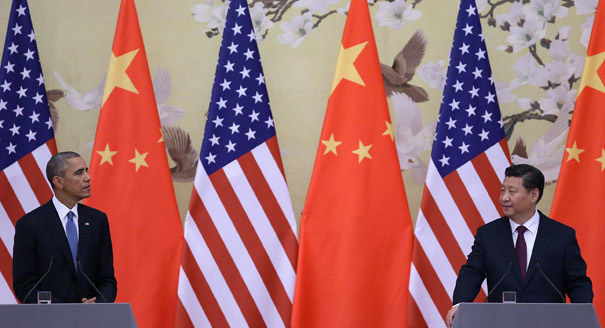
China has not necessarily been successful at leveraging its economic might to promote its interests.
Source: Center for Strategic and International Studies
At the Center for Strategic and International Studies’ “China’s Power: Up for Debate” conference, Carnegie’s Evan Feigenbaum debated with SAIS’s David M. Lampton the question of whether China can successfully leverage its economic weight in support of its broader strategic interests. Feigenbaum was asked by the organizers to advocate for the “no” position. He acknowledged the undeniable increase in China’s economic weight over the past decade, adding that it is simply intuitive that more trade, more investment, and a bigger economy give any country greater leverage than less trade, less investment, and a smaller economy. But, he argued, that is not the end of the story of Chinese economic power overseas.
Feigenbaum noted several constraints on Beijing: First, he noted the collision between economic integration in Asia, which has enabled a larger Chinese role, and security fragmentation, with many countries reacting to Beijing with fear, suspicion, or counter-balancing actions. Specifically, Feigenbaum argued, there have been notable backlashes against China’s exercise of economic power, including a nationalist backlash (he cited land and labor protests in Kazakhstan and Kyrgyzstan as examples) a security backlash (for instance, the prospective tightening of investment rules in Australia and the United States), and a backlash related to economic competition (he noted some examples from India). These, he concluded, place constraints on China’s ability to straightforwardly translate economic weight into political leverage.
Second, Feigenbaum pushed back against the notion that pan-Asian initiatives automatically demonstrate that China is “writing the rules” in Asia. Feigenbaum argued that other regional states, such as Japan, India, and Southeast Asian countries have long been involved in developing pan-Asian institutions, pacts, and bargains. China will not simply be dictating new rules to countries like Japan. Instead, he said, these will likely result from pan-Asian bargains.
Third, Feigenbaum addressed the concept of “connectivity” in Asia, a major focus of recent Chinese economic diplomacy. This, he said, did not start in 2013 with President Xi Jinping’s “One Belt, One Road” initiative, but has considerable history in Asia, involving choices and action by many countries, both on the demand side and as infrastructure, capital, and trade providers. In conclusion, Feigenbaum noted again that China’s economic weight is a fact but suggested that the strategic situation in Asia is vastly more complex than the current debate.
The debate was originally broadcast live by the Center for Strategic and International Studies.

Vice President for Studies
Evan A. Feigenbaum is vice president for studies at the Carnegie Endowment for International Peace, where he oversees work at its offices in Washington, New Delhi, and Singapore on a dynamic region encompassing both East Asia and South Asia. He served twice as Deputy Assistant Secretary of State and advised two Secretaries of State and a former Treasury Secretary on Asia.
Recent Work
Evan A. Feigenbaum
Evan A. Feigenbaum
Carnegie does not take institutional positions on public policy issues; the views represented herein are those of the author(s) and do not necessarily reflect the views of Carnegie, its staff, or its trustees.

Are Germany’s economic, industrial, and political struggles becoming a liability for the EU’s ability to rise to the geopolitical moment?

Rym Momtaz, ed.

European Commission President Ursula von der Leyen is about to give her annual address on the state of the EU. Here’s what she won’t—but should—say.
Rym Momtaz

The aftermath of the Ceuta crisis shows Europe has drawn the wrong lessons. Rather than doubling down on failed migration policies, the EU needs to address the underlying roots of such episodes.

Richard Youngs

Canadian Prime Minister Mark Carney has twice inspired praise for standing up to U.S. President Donald Trump: at the 2026 World Economic Forum in Davos and on Canada-U.S. trade negotiations. Is Carney showing a third way better than the EU has in dealing with the Trump administration?
Rym Momtaz, ed.

The EU’s responses to two recent incidents expose the gulf between European perceptions and capabilities. Unless the union can bridge that gap, it will never become a real geostrategic power.
Rym Momtaz