

Q&A
- +1
Amr Hamzawy, Andrew Leber, Eric Lob, …
{
  "authors": [
    "Marwan Muasher"
  ],
  "type": "legacyinthemedia",
  "centerAffiliationAll": "dc",
  "centers": [
    "Carnegie Endowment for International Peace",
    "Malcolm H. Kerr Carnegie Middle East Center"
  ],
  "collections": [
    "Arab Awakening"
  ],
  "englishNewsletterAll": "menaTransitions",
  "nonEnglishNewsletterAll": "",
  "primaryCenter": "Carnegie Endowment for International Peace",
  "programAffiliation": "MEP",
  "programs": [
    "Middle East"
  ],
  "projects": [],
  "regions": [
    "Middle East",
    "North Africa"
  ],
  "topics": [
    "Political Reform",
    "Democracy"
  ]
}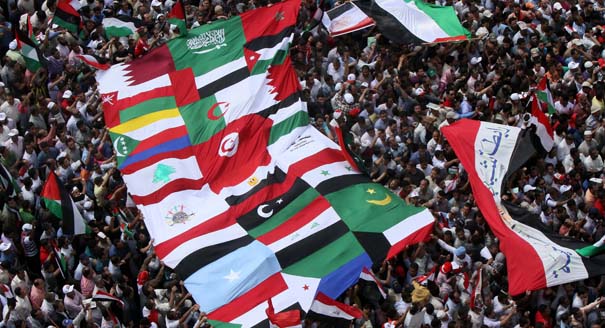
Source: Getty
The Middle East is facing what a new study calls a collapsing regional order.
Source: NPR’s All Things Considered
AUDIE CORNISH, HOST:
The Middle East is facing what a new study calls a collapsing regional order. The Arab Spring may have swept away authoritarian regimes, but they weren't replaced with what a new report from the Carnegie Endowment for International Peace says the region needs - pluralistic societies with minority rights. The study's called "Arab Fractures." Marwan Muasher is a co-author, also a former deputy prime minister of Jordan. It came out just as the Trump administration announced a ban on travel from several Middle Eastern countries - a ban Muasher says affected his colleagues.
MARWAN MUASHER: It really has. We have a number of colleagues who have dual citizenships from part of the countries that have a travel ban. All of them are calling for a pluralistic and moderate future for their countries. If these voices are not heard here, this is basically a favor to ISIS, who wants to argue that there is a clash of civilization between the West and the Muslim countries. And a travel ban like this probably adds to this argument.
CORNISH: You know, what does a Trump presidency, with its declaration of an aggressive war against radical Islamic terrorism that - they're very specific about saying those words - what does that mean for the prospects of stability there?
MUASHER: I'm afraid that's going to make things worse if the Trump presidency only focuses on military force alone. We all remember in 2007 when the United States was able to defeat al-Qaida in Iraq, only for us to see that al-Qaida's successor was even more radical, worse organization with ISIS. The point being that unless you follow up military force with a inclusionist policy, defeating a military organization like al-Qaida, in itself, is not going to solve the problem. This is the lesson that I hope the Trump administration will get to understand very quickly.
CORNISH: You talk about the shift that authoritarian regimes of Arab countries are going through with their people - with people saying, like, the old way of doing things does not work because you're corrupt. You're not making good on the economic promises you gave us, and we want a say in how the country's run. Do you see the voices that are calling for a pluralistic society really breaking through?
MUASHER: There are already some breakthroughs. Tunisia has been able to - despite the considerable differences between the secular and religious forces in the country, has been able to arrive at a negotiated social contract that basically protects the rights of each component of society, including full women rights and the right to believe or not to believe.
So policies of exclusion are - I'm saying 20th century politics (unintelligible) - they don't work anymore. And the sooner Arab governments understand that from now on, if they want to keep their power, they have to share it, the quicker we can transition to better systems.
CORNISH: But is it naive for people in the U.S. or other places who say, look, maybe democracy isn't going to take, so to speak, in the way that we recognize it?
MUASHER: Of course, it is naive. Look at a place like Latin America, which is close to home here. You know, the United States has not exactly been impartial in intervening in many of Latin America's countries. Almost all of Latin America were governed by dictators 30 or 40 years ago. Today, Latin America - the overwhelming majority of countries in Latin America is democratic today. So it is not impossible to move from authoritarian regimes to democratic ones, but it's also not an easy or a quick process. This is a process that I'm afraid will take decades at best.
CORNISH: Marwan Muasher is director of the Middle East program for the Carnegie Endowment for International Peace. Thank you so much for speaking with us.
MUASHER: Thank you.
This interview originally aired on NPR's All Things Considered.

Vice President for Studies
Marwan Muasher is vice president for studies at Carnegie, where he oversees research in Washington and Beirut on the Middle East. Muasher served as foreign minister (2002–2004) and deputy prime minister (2004–2005) of Jordan, and his career has spanned the areas of diplomacy, development, civil society, and communications.
Recent Work



Amr Hamzawy, Andrew Leber, Eric Lob, …
Marwan Muasher
Carnegie does not take institutional positions on public policy issues; the views represented herein are those of the author(s) and do not necessarily reflect the views of Carnegie, its staff, or its trustees.

An overwhelming victory by a far-right-wing party in a small state in eastern Germany will have major repercussions for Chancellor Friedrich Merz’s coalition.

Judy Dempsey

In supporting Europe’s far-right, MAGA and Russia both want the same thing: a weaker EU. Europe must defend itself without abandoning the openness these forces exploit.

Armida van Rij

The hybrid warfare landscape is evolving rapidly, leaving policymakers without clear strategies. To better inform their work in addressing emerging challenges, governments must dig deeper into the underlying dynamics at play.


Raluca Csernatoni, Alicia Wanless

As the EU confronts profound challenges, several leaders have called for fundamental reform to the union’s model—but only modest, superficial changes have resulted. What if Europe really could be reimagined from zero today: What should such a redesigned European order look like?

Richard Youngs, ed.

Far-right leader Marine Le Pen can—and will—run in France’s next presidential election. What does the outcome of her appeal against a 2025 embezzlement conviction mean for the country’s political future?
Catherine Fieschi