

Q&A
Eugene Rumer
{
  "authors": [
    "Eugene Rumer"
  ],
  "type": "legacyinthemedia",
  "centerAffiliationAll": "dc",
  "centers": [
    "Carnegie Endowment for International Peace"
  ],
  "collections": [],
  "englishNewsletterAll": "ctw",
  "nonEnglishNewsletterAll": "",
  "primaryCenter": "Carnegie Endowment for International Peace",
  "programAffiliation": "russia",
  "programs": [
    "Russia and Eurasia"
  ],
  "projects": [],
  "regions": [
    "North America",
    "United States",
    "Russia"
  ],
  "topics": [
    "Foreign Policy"
  ]
}
Source: Getty
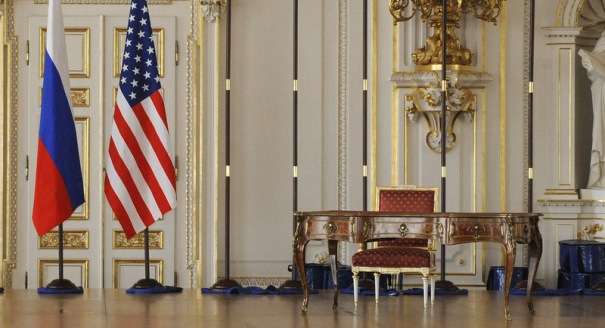
The United States should strike a “middle path” in its policy toward Russia: standing up for core U.S. principles and values but also cooperating with Russia where necessary.
Source: C-SPAN’s Washington Journal
The Trump administration faces both challenges and opportunities in its relations with Russia. In a recent joint task force report, Eugene Rumer, Andrew S. Weiss, and Richard Sokolsky argued that the United States must “skillfully manage, rather than permanently resolve, tension with Moscow,” striking a middle path in its policy toward Russia.
Eugene Rumer, director of the Russia and Eurasia Program at the Carnegie Endowment, expanded on the concept of a middle path in an interview with Steve Scully on C-SPAN’s Washington Journal:
“The middle path is the path of standing up for our core principles and core values that have been guiding our foreign policy for a long time, but also cooperating with Russia where necessary and working to diffuse the situation in a number of very tense global hot spots; one of course being in Syria... and the other in Europe, where we see a military confrontation standoff between Russia and NATO in a way we haven’t seen since the end of the Cold War.”
This interview was originally broadcast on C-SPAN’s Washington Journal.
Director and Senior Fellow, Russia and Eurasia Program
Rumer, a former national intelligence officer for Russia and Eurasia at the U.S. National Intelligence Council, is a senior fellow and the director of Carnegie’s Russia and Eurasia Program.
Recent Work
Eugene Rumer
Eugene Rumer
Carnegie does not take institutional positions on public policy issues; the views represented herein are those of the author(s) and do not necessarily reflect the views of Carnegie, its staff, or its trustees.

European Commission President Ursula von der Leyen is about to give her annual address on the state of the EU. Here’s what she won’t—but should—say.

Rym Momtaz

Radical-right parties are expected to do well in upcoming elections in four of the EU's biggest member states. If successful, they could prevent the union from addressing key challenges ahead.

Stefan Lehne

The aftermath of the Ceuta crisis shows Europe has drawn the wrong lessons. Rather than doubling down on failed migration policies, the EU needs to address the underlying roots of such episodes.

Richard Youngs

Canadian Prime Minister Mark Carney has twice inspired praise for standing up to U.S. President Donald Trump: at the 2026 World Economic Forum in Davos and on Canada-U.S. trade negotiations. Is Carney showing a third way better than the EU has in dealing with the Trump administration?
Rym Momtaz, ed.

The EU’s responses to two recent incidents expose the gulf between European perceptions and capabilities. Unless the union can bridge that gap, it will never become a real geostrategic power.
Rym Momtaz