• Research
  • Strategic Europe
  • About
  • Experts
Carnegie Europe logoCarnegie lettermark logo
EUUkraine
  • Donate
{
  "authors": [
    "Bruce Jones",
    "Tamara Cofman Wittes",
    "Sarah Yerkes"
  ],
  "type": "other",
  "centerAffiliationAll": "dc",
  "centers": [
    "Carnegie Endowment for International Peace"
  ],
  "collections": [],
  "englishNewsletterAll": "menaTransitions",
  "nonEnglishNewsletterAll": "",
  "primaryCenter": "Carnegie Endowment for International Peace",
  "programAffiliation": "MEP",
  "programs": [
    "Middle East"
  ],
  "projects": [],
  "regions": [
    "Middle East",
    "Syria"
  ],
  "topics": [
    "Security",
    "Foreign Policy"
  ]
}
Source: Getty

Other

Stabilization Planning in Syria

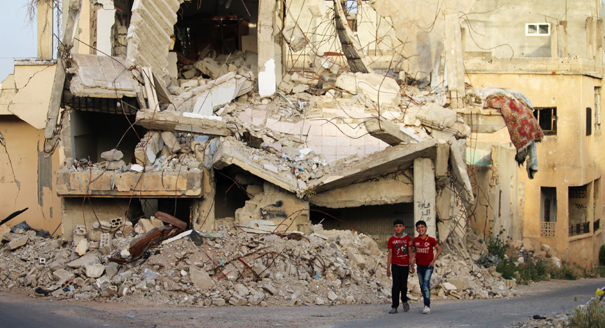
Policymakers examining the real options for bringing Syria’s civil war to an end, or mitigating its destructive violence, must start with a number of realities.

Link Copied
By Bruce Jones, Tamara Cofman Wittes, Sarah Yerkes
Published on Mar 14, 2017

Source: Brookings Institution

Introduction

Syria is entering its sixth year of debilitating violence at a moment of geopolitical flux. It has been and remains a crucible in the geopolitics of the Middle East; a flash point in great power politics; a source of extraregional instability; and a devastating human tragedy. Sadly, the international response to Syria has dealt with those aspects in that order, rather than prioritizing the human suffering.

Most analysts of civil wars believe that the approach to the Syrian civil war most likely to result in a sustained end to bloodshed would have the following elements: increased scale and coherence of Western engagement, in order to enhance Western leverage in negotiations with Russia and Iran; political negotiations that link international, regional, and local actors; the forging of an interim political deal—either a deal that sees President Bashar Assad leave power eventually, or at least one that limits Assad’s ability to execute violence against his opponents; and the installation of transitional institutions that can oversee interim security arrangements (including the disposition of Syria’s armed forces and intelligence agencies) and the beginnings of social reconciliation and economic reconstruction. These will be mammoth tasks, given the scale of devastation, destruction, and distrust.

The prospects for such an approach, however, remain dim. Indeed, given the current geopolitical dynamics, we do not believe an equitable negotiated settlement that removes Assad from power is possible. However, when Assad does eventually leave power, either through a pacted transition, an election, or eventual retirement or death, the international community may have an opportunity to guide Syria through a new negotiated political framework, allowing for a different set of stability measures and a robust reconciliation process.

In the shorter term, however, policymakers examining the real options for bringing Syria’s civil war to an end, or mitigating its destructive violence, must start with the following realities.

  • Geopolitical factors. Unlike much of the experience of response to civil wars during the post-Cold War period, decisionmaking in Syria is heavily shaped by great power tensions and geopolitics—both within the Middle East and externally. That is to say, relations between regional powers and between Russia, Iran, the United States, and Europe are a decisive factor in shaping options for conflict mitigation or management. After a long period of deterioration, in part over debates about Syria, those relations are now in flux. The new U.S. president creates an opportunity for realignment with Russia over Syria, but the extent of that realignment, or its sustainability, is unclear. Particularly unclear is how President Trump might align his administration’s desire for de-escalation and closer ties with Russia with its rising antagonism with Iran, which has been one of Russia’s key allies in the Syrian conflict.
  • Ground realities. The balance of forces and influence between outside actors and on-the-ground fighters always tilts in favor of local actors, but that is true in spades in Syria. Because the West’s involvement has been patchy and limited, its influence with various opposition actors is also limited. The involvement of Turkish, Gulf, and other actors further fractures opposition loyalties. (This has waxed and waned; but as we note in the annexed paper on reconstruction, it is likely to grow under conditions of settlement.) Russia has a more direct tie to Assad and his armed forces but even there, influence is far from total; indeed, much of it is tied to Iran’s presence, which arguably wields the greatest degree of external influence in Syria. All of this means that whatever agreements can be forged at the geopolitical level are unlikely to translate directly into changing conditions on the ground. Trust is non-existent, national institutions are shattered or profoundly weakened, and even under conditions of a so-called “victory” or a negotiated settlement, continuing violence (perhaps at a low level, localized) is likely to be a long-term reality for Syria.
  • Intrusive regional politics. Regional actors have major stakes in the shape of Syria’s postwar politics and security arrangements, as well as economic interests, and are likely to continue to provide support to their partners even if there is a political deal among major external actors. An international arrangement that fails to account for the politics of these actors is likely to run into substantial headwinds. Two major issues structure regional actors’ views of the Syrian conflict. The first is a disagreement over the role that Iran will play in post-conflict Syria; the second is a disagreement over the primacy of preserving Syria as a unitary state with a strong central government, currently headed by Assad. Positioning on these two issues generates divergent priorities amongst governments who are all partners to the United States and Europe in both the Syrian negotiations and the anti-ISIS fight. These differences have frustrated the Vienna negotiating process, hampered cooperation in the fight against ISIS, and threaten to escalate the Syrian war further. It is thus imperative that any stabilization effort recognizes these disagreements and how they shape emerging coalitions within the region.
  • Reconciliation matters. Even well organized, substantial, and savvy external support to political negotiations and physical security will falter if not accompanied, from the outset, by a scaled and sustained effort to foster local and national reconciliation. Building this into planning from the outset will be an important determinant of likely success. Furthermore, it is essential that reconciliation not be treated as a side pillar to economic reconstruction, political negotiations, or international security measures. Rather, reconciliation should be central to the design of those measures. Regardless of whatever outcome is achieved, it is worthwhile for the international donor community to invest now in Syrian actors and organizations who can support future reconciliation, particularly at the community level.

The net result of all of these factors is that what are often depicted as alternate scenarios for the eventual reconstruction of Syria, are in fact points along a spectrum. And whereas the common scenarios examined for Syria refer primarily to the disposition of military forces on the ground, we believe it is necessary to construct scenarios by tying geopolitical and ground realities together.

Read Full Text

This piece was originally published by the Brookings Institution.
About the Authors

Bruce Jones

Bruce Jones

Senior Fellow, The Brookings Institution

Bruce Jones is a senior fellow with the Strobe Talbott Center for Security, Strategy, and Technology in the Foreign Policy program at the Brookings Institution; he also works with the Center for Asia Policy Studies. He is also a consulting professor at the Freeman Spogli Institute at Stanford University. From 2015 to 2020, Jones previously served as the vice president and director for the Foreign Policy program. 

Tamara Cofman Wittes

Tamara Cofman Wittes is a senior fellow in the Center for Middle East Policy at Brookings, where she focuses on U.S. policy in the Middle East.

Sarah Yerkes
Sarah Yerkes

Senior Fellow, Middle East Program

Sarah Yerkes is a senior fellow in Carnegie’s Middle East Program, where her research focuses on Tunisia’s political, economic, and security developments as well as state-society relations in the Middle East and North Africa.

Authors

Bruce Jones
Senior Fellow, The Brookings Institution
Bruce Jones
Tamara Cofman Wittes

Tamara Cofman Wittes is a senior fellow in the Center for Middle East Policy at Brookings, where she focuses on U.S. policy in the Middle East.

Tamara Cofman Wittes
Sarah Yerkes
Senior Fellow, Middle East Program
Sarah Yerkes
SecurityForeign PolicyMiddle EastSyria

Carnegie does not take institutional positions on public policy issues; the views represented herein are those of the author(s) and do not necessarily reflect the views of Carnegie, its staff, or its trustees.

More Work from Carnegie Europe

  • Commentary
    Strategic Europe
    Russia’s Imperial Retreat Is Europe’s Strategic Opportunity

    The war in Ukraine is costing Russia its leverage overseas. Across the South Caucasus and Middle East, this presents an opportunity for Europe to pick up the pieces and claim its own sphere of influence.

      William Dixon, Maksym Beznosiuk

  • Commentary
    Strategic Europe
    Europe and the Arab Gulf Must Come Together

    The war in Iran proves the United States is now a destabilizing actor for Europe and the Arab Gulf. From protect their economies and energy supplies to safeguarding their territorial integrity, both regions have much to gain from forming a new kind of partnership together.

      • Rym Momtaz

      Rym Momtaz

  • Commentary
    Strategic Europe
    Taking the Pulse: Is France’s New Nuclear Doctrine Ambitious Enough?

    French President Emmanuel Macron has unveiled his country’s new nuclear doctrine. Are the changes he has made enough to reassure France’s European partners in the current geopolitical context?

      • Rym Momtaz

      Rym Momtaz, ed.

  • Commentary
    The Iran War’s Dangerous Fallout for Europe

    The drone strike on the British air base in Akrotiri brings Europe’s proximity to the conflict in Iran into sharp relief. In the fog of war, old tensions in the Eastern Mediterranean risk being reignited, and regional stakeholders must avoid escalation.

      Marc Pierini

  • Trump United Nations multilateralism institutions 2236462680
    Article
    Resetting Cyber Relations with the United States

    For years, the United States anchored global cyber diplomacy. As Washington rethinks its leadership role, the launch of the UN’s Cyber Global Mechanism may test how allies adjust their engagement.

      • Christopher Painter

      Patryk Pawlak, Chris Painter

Get more news and analysis from
Carnegie Europe
Carnegie Europe logo, white
Rue du Congrès, 151000 Brussels, Belgium
  • Research
  • Strategic Europe
  • About
  • Experts
  • Projects
  • Events
  • Contact
  • Careers
  • Privacy
  • For Media
  • Gender Equality Plan
Get more news and analysis from
Carnegie Europe
© 2026 Carnegie Endowment for International Peace. All rights reserved.






