

Commentary
Dmitri Trenin
{
  "authors": [
    "Dmitri Trenin"
  ],
  "type": "legacyinthemedia",
  "centerAffiliationAll": "",
  "centers": [
    "Carnegie Endowment for International Peace",
    "Carnegie Russia Eurasia Center"
  ],
  "collections": [],
  "englishNewsletterAll": "",
  "nonEnglishNewsletterAll": "",
  "primaryCenter": "Carnegie Russia Eurasia Center",
  "programAffiliation": "",
  "programs": [],
  "projects": [],
  "regions": [
    "North America",
    "United States",
    "Russia"
  ],
  "topics": [
    "Foreign Policy"
  ]
}
Source: Getty
The US-Russian relationship under Trump will mainly focus on reducing risks of collision, taking confidence-building measures, and engaging in other forms of war avoidance. Improved relations can only result from a change in the basic attitude of either of the two countries toward the other.
Source: Global Times
Recent developments in US-Russian relations have brought the short truce in their confrontation, which started when Donald Trump was elected as president last November, to an end. The US missile strikes against Syria following the chemical weapons attack blamed on Damascus, and the sharp change of tone in Washington toward the Kremlin again ushered the US-Russian ties into a low ebb, which may even be worse than under the Barack Obama administration. The global community had feared a US-Russian collusion; now, they are afraid of their collision.
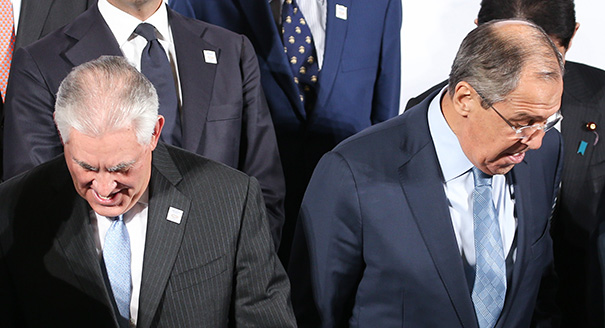
Under these circumstances, Secretary of State Rex Tillerson’s visit to Moscow went reasonably well. He spent seven hours talking to his Russian hosts, including two hours with President Vladimir Putin. At a press conference, Foreign Minister Sergey Lavrov sounded constructive, with many of his criticisms leveled at the policies of the Obama administration. The US secretary of state was more restrained, focusing on the differences between the two countries. But his criticism of Moscow’s actions was also fairly muted.
There are good reasons for both Russia and the US to try to keep the relationship from overheating. The former Cold War adversaries find themselves in a more capricious situation right now than at any time since the 1962 Cuban missile crisis. In Syria, their armed forces risk aggressive collision. Thus, the top priority for the Kremlin and the White House should be to reduce that very real risk, fraught with dire consequences of escalation.
Optimists in Moscow and Washington hope that the US-Russian relationship wouldn’t decline any further. They argue that more deterioration would mean hostilities. However, it is premature to expect Russians and Americans would immediately start cooperating with each other. They will more likely stay where they are, avoiding an open military clash, but hardly improve their relations.
However, they won’t clash with each other everywhere. In Syria, there is still a potential for US-Russian collaboration on a diplomatic settlement to end the country’s six-year-long civil war. In Ukraine, Washington and Moscow could at least make sure that the ceasefire, agreed in 2015, holds. Complete collapse of the arms control regime is not in the interests of either party. Yet, the terms of bilateral engagement are not agreed upon, and it is unlikely that they will be, in the foreseeable future.
The reason for this is clear. Both the US and Russia are exceptional countries, though each in its own way. The US is accustomed to be the leader - indeed, of the world. Russians, historically, reject anyone’s leadership and prefer being their own masters, even when it comes at a huge cost. Also, Russians want to be treated as equals, which Americans see no reason for, given the vast disparities between the two countries.
This makes Russia strive to expedite the transition from a US-dominated world order to one based on an oligarchy of several major players, including itself. Since Moscow cannot hope to prevail in long-term economic competition, it resorts to active political resistance and information campaigns. This makes it a classic meddler in Washington’s eyes. The fundamental conflict over world order weighs in on practical issues, reducing chances of cooperation.
The US and Russia also feature in each other’s domestic politics. In Russia, the US has consistently impacted domestic issues since Soviet times, albeit in the 1990s the country was seen in a largely positive light. In the US, Russia has only entered the spotlight in domestic issues during the 2016 presidential election. In each case, however, references to the other country as an adversary serve to consolidate the ruling elite and much of society. The official investigation into the Trump administration’s links to Moscow continues, despite the apparent falling-out between the Trump’s White House and the Kremlin.
In dealing with Syria, Russia and China, Trump has demonstrated that he can constantly change his course. His decision-making tactics look erratic. He probably has no strategy. Yet, the rise of people like Generals McMaster and Mattis, and Tillerson and the loss of Steve Bannon’s influence suggest that the administration is finally finding its bearings. American globalism is alive and well, with narrow American nationalism lying by the wayside.
This all leads to a near-to-medium term forecast of continued US-Russian confrontation. In essence, the relationship under Trump will mainly focus on reducing risks of collision, taking confidence-building measures, and engaging in other forms of war avoidance. Hopefully, this will help prevent open conflict between the two countries or at least its escalation. Improved relations can only result from a change in the basic attitude of either of the two countries toward the other. At this point, such a change is not on the horizon.
Former Director, Carnegie Moscow Center
Trenin was director of the Carnegie Moscow Center from 2008 to early 2022.
Recent Work
Dmitri Trenin
Dmitri Trenin
Carnegie does not take institutional positions on public policy issues; the views represented herein are those of the author(s) and do not necessarily reflect the views of Carnegie, its staff, or its trustees.

Funding Ukraine remains a priority for European leaders. As Russia’s war of aggression heads into another winter, two feasible options to mobilize support for Kyiv should be fast-tracked.


Vladyslav Rashkovan, Gregory P. Wilson

While the EU and European governments are embracing the much-lauded middle-power moment, this entails three difficult conundrums.

Richard Youngs

Europe is facing rising populism internally as well as external pressures from Russia, China, Turkey, and the United States.

Dimitar Bechev

Much has been said of the changes Brussels is trying to make to the EU enlargement process. Here’s why gradual integration might—or might not—be the answer.
Dimitar Bechev

The European Commissioner for Trade is headed to China. But after President Xi’s bridge-building visit to Washington, can a more isolated EU overcome Beijing’s stranglehold on critical raw materials? Who will blink first?

Rym Momtaz, ed.