

Research
- +6
Yasmine Farouk, Nathan J. Brown, Maysaa Shuja Al-Deen, …
{
  "authors": [
    "Michele Dunne"
  ],
  "type": "testimony",
  "centerAffiliationAll": "dc",
  "centers": [
    "Carnegie Endowment for International Peace",
    "Malcolm H. Kerr Carnegie Middle East Center"
  ],
  "collections": [
    "Arab Awakening"
  ],
  "englishNewsletterAll": "menaTransitions",
  "nonEnglishNewsletterAll": "",
  "primaryCenter": "Carnegie Endowment for International Peace",
  "programAffiliation": "MEP",
  "programs": [
    "Middle East"
  ],
  "projects": [],
  "regions": [
    "North America",
    "United States",
    "North Africa",
    "Egypt"
  ],
  "topics": [
    "Political Reform",
    "Democracy",
    "Foreign Policy"
  ]
}
Source: Getty
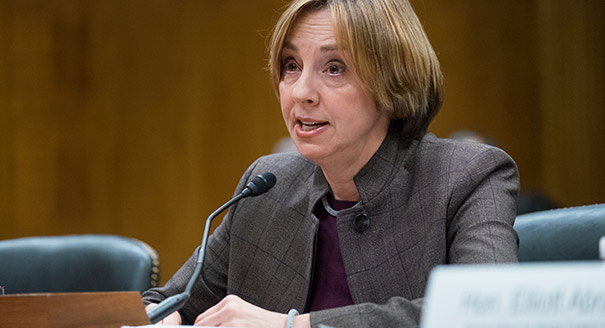
With a new U.S. administration in office that is reexamining foreign assistance priorities overall, there is an opportunity to take assistance to Egypt off auto-pilot and design an approach that better serves the interests of the United States and of Egypt—the nation broadly, not only the military
Source: U.S. Senate Appropriations Subcommittee on State, Foreign Operations, and Related Programs
Chairman Graham, Ranking Member Leahy, Subcommittee members, thank you for this opportunity to address the subcommittee.
The problem for United States’ assistance to Egypt is precisely this: how can the United States best support an important country and longtime regional ally when its government adopts policies that promise chronic instability? The United States has an interest in supporting a stable Egypt, at peace with its neighbors and itself. The Egyptian-Israeli peace is well established on the military and intelligence levels, although lamentably cold on the civilian and citizen level. While the United States will always do what it can to encourage closer and more multifaceted ties, at this point the relationship has its own dynamic. At the same time, there is much to be concerned about regarding what is happening inside Egypt, where security, economic, and political conditions have deteriorated since President Abdel Fattah al-Sisi took control in 2013. With $77 billion in American taxpayer dollars invested since 1948 in security and economic assistance to Egypt,1 it is time for the United States to reconsider its approach.
While President Sisi is fond of presenting Egypt as a bastion of stability in a troubled region, in reality the country is at best limping along and is likely headed for unrest within a few years. There are chronic challenges that date back years or decades, well before Sisi came to power: a rapidly growing population; an economy that generates few jobs; an enormous, obstructionist bureaucracy; and a history of indigenous terrorist groups. But there are also newer problems that Sisi has caused or exacerbated, which have made the overall picture much worse than it was under former presidents Hosni Mubarak or Mohammed Morsi. When Sisi took control in 2013, Egypt did not have a virulent insurgency, thousands dead in extrajudicial killings, tens of thousands of political prisoners, hundreds of enforced disappearances, hundreds killed in terrorists attacks annually including the recent suicide bombings targeting Christians, and a desperate economic situation. Egypt has all of those problems now, along with the strong social polarization and susceptibility to radicalization that result. While regional factors (conflict in Libya and the creation of the self-proclaimed Islamic State) are not helping, Egypt’s problems are in the main homegrown.
In the unhappy context of unprecedented political repression and rights abuses, Egyptians are also beset by an extremely difficult economic situation. In the first few months of 2017, the misery index—the rate of annual inflation plus unemployment—for Egyptians has been about 45 percent. Core inflation in recent months has been between 30 and 33 percent; food prices are rising at an annual rate of 39 percent,2 a serious problem in a country in which a significant number of citizens are poor and spent a large percentage of their income on food. Unemployment according to official statistics is about 12.6 percent;3 many experts believe this underestimates the true unemployment rate, which for young people is estimated at an average 30 percent and for young women nearly 50 percent.4 So for Egyptians under 30—those most likely to cause unrest—the misery rate ranges from 60 to more than 80 percent. Despite harsh anti-protest laws put in place after 2013, public unrest related to the economy (such as protests against shortages of bread, sugar, baby formula) has been on the rise.
The current high inflation is due to a decision President Sisi took in November 2016, for which he has received much praise: he floated the Egyptian currency, after years in which he and his predecessors spent billions supporting the currency at an artificially high rate. That was a necessary step, one of several which Sisi took to secure an IMF standby agreement; he has also instituted a value-added tax and reduced energy subsidies, needed for fiscal stabilization after Gulf States started cutting back their cash aid. But if the currency devaluation is not accompanied by steps to increase investment and generate jobs, it will be pain without gain.
This brings us to the core problem of the Egyptian economy: it does not generate nearly enough jobs for the number of new entrants into the labor force. Egypt has a population of nearly 94 million, increasing by one million every six months. There are more than 600,000 new entrants into the labor market every year,5 a number that will rise sharply in coming years. Yet despite lip service from the government about the need to create new jobs, Sisi’s economic policies are not oriented toward attracting investment in labor-intensive industries or services. They do not encourage the creation or growth of the small and medium enterprises that have the potential to generate most jobs.6 Sisi’s government also has not undertaken serious efforts to develop the Egyptian labor force through education and training; private sector employers complain persistently that graduates of public secondary schools and universities lack the basic skills needed to perform the jobs that are available.
Instead of focusing on creating jobs and improving labor force skills, Sisi’s economic policies are oriented toward helping his most important constituency—the military—to make money. That means undertaking mega construction projects, such as the second Suez Canal passage and new administrative capital in the desert (“Wedian”), with no serious consideration as to whether such projects will generate significant employment, growth, or even revenue for the government. Sisi has also decreed many changes in laws, regulations, and government contracting procedures to allow the military or military-affiliated companies to take a larger-than-ever share of the economic pie.7
The fact that economic decisions in Egypt serve such a narrow range of interests reflects the overall constriction of public institutions as well as civil society. The parliament is open only to coup-supporters, with not only most Islamists but also many secular parties either legally barred or strongly harassed—even including several larger secular parties that have supported Sisi but have tried to preserve some modicum of independence.8 The judiciary, once the branch of the government most respected by citizens, has become highly politicized. Media and journalists have been strongly repressed, and there are very few media outlets that are truly independent. Civil society groups, both secular groups focusing on human rights or civil liberties and social welfare groups suspected of ties to the Muslim Brotherhood, have received harsh treatment unprecedented in Egypt—closed down, assets confiscated, leaders either under prosecution or driven out of the country by death threats.
All of this repression of society and institutions adds up to a situation in which there is minimal input to Sisi on important decisions, which are therefore made in the interests of the few and not the many. This is a more exaggerated version of what has long been the case; during the Mubarak era economic decisions were made to favor crony capitalists as well as the military, whereas now it is just the military.
For the United States, Egyptian government decision-making that works against stability rather than for it has become a bigger problem over time. U.S. assistance increased sharply at the time of the Egyptian-Israeli peace in the late 1970s, and for a while military and economic assistance were each funded at about $1 billion per year. Over time, military assistance stabilized at $1.3 billion annually, while economic assistance began to drop off gradually, until in recent years it has been $150 million per year. Egypt has used much of the military assistance to arm itself with heavy weapons (such as fixed-wing aircraft and tanks) for the sort of ground war it has not fought since 1973 and might not ever fight again, resisting persistent advice from U.S. officials to devote more assistance to training, lighter weapons, and higher technology.
The United States has gradually decreased economic assistance partly due to difficulties in implementing programs with Egyptian government partners as well as persistent disagreements between U.S. and Egyptian officials about needed reforms.9 While some Egyptian officials have welcomed mutually-agreed reform programs, training, and technical assistance, others have stonewalled or frustrated such programs, pressing instead for cash assistance. The more pernicious side of this has been the strong campaign of harassment and retribution against American NGOs carrying out assistance programs, as well as Egyptian organizations or individuals who work with American or European organizations.10 This is hardly the behavior of a partner in development.
With a new U.S. administration in office that is reexamining foreign assistance priorities overall, there is an opportunity to take assistance to Egypt off auto-pilot and design an approach that better serves the interests of the United States and of Egypt—the nation broadly, not only the military. Members of Congress and of this Subcommittee, with their long experience in dealing with assistance to Egypt, have a special responsibility to shape an approach that makes sense and draws on lessons learned.
The new approach should have a tighter focus on the most pressing threats to Egypt’s stability: terrorism, but also inadequate education, unemployment, and the destruction of civil society. Ideally the U.S. and Egyptian governments would agree on assistance programs and the Egyptian government would cease harassment of implementing organizations. If those goals are unrealistic with the current government, the United States can still extend assistance to the Egyptian people with a minimum of government cooperation. At a bare minimum, the U.S. government should ensure that its assistance is neither wasted nor complicit in exacerbating the country’s problems.
1 Jeremy M. Sharp, “Egypt: Background and U.S. Relations,” Congressional Research Service, March 24, 2017, https://fas.org/sgp/crs/mideast/RL33003.pdf .
2 Core inflation for March 2017: 32.35 percent; for February 2017: 33.1 percent. Inflation for fruits and vegetables for March 2017: 39 percent; for February 2017 31.3 percent. Central Bank of Egypt website, http://www.cbe.org.eg/en/EconomicResearch/Statistics/Pages/Inflation.aspx .
3 The World Bank, http://www.worldbank.org/en/country/egypt/overview .
4 Adel Abdel Ghafar, “Educated but Unemployed: The Challenge Facing Egypt’s Youth,” Brookings Doha Center, July 2016, https://www.brookings.edu/wp-content/uploads/2016/07/en_youth_in_egypt-1.pdf .
5 Ghada Barsoum, Mohamed Ramadan, and Mona Mostafa, “Labour market transitions of young women and men in Egypt,” International Labour Organization, June 2014, http://www.ilo.org/wcmsp5/groups/public/@dgreports/@dcomm/documents/publication/wcms_247596.pdf .
6 Decision-making that favored insider privileges over broader job creation policies has been a persistent problem. See “More Jobs, Better Jobs: A Priority for Egypt,” The World Bank, June 2014, http://documents.worldbank.org/curated/en/926831468247461895/pdf/884470EG0repla00Box385343B00PUBLIC0.pdf .
7 See Emily Crane Linn, “The Army and its President,” Foreign Policy, January 28, 2016 http://foreignpolicy.com/2016/01/28/the-army-and-its-president-egypt-sisi/ ; Shana Marshall, “The Egyptian Armed Forces and the Remaking of an Economic Empire,” Carnegie Endowment for International Peace, April 2015, http://carnegie-mec.org/2015/04/15/egyptian-armed-forces-and-remaking-of-economic-empire-pub-59726 .
8 Michele Dunne and Amr Hamzawy, “Egypt’s Secular Political Parties: A Struggle for Identity and Independence,” Carnegie Endowment for International Peace, March 2017, http://carnegieendowment.org/2017/03/31/egypt-s-secular-political-parties-struggle-for-identity-and-independence-pub-68482 .
9 Amy Hawthorne, “Rethinking U.S. Economic Aid to Egypt,” Project on Middle East Democracy, October 2016, http://pomed.org/pomed-publications/new-report-rethinking-u-s-economic-aid-to-egypt/ .
10 “Close Case 173,” Amnesty International, https://www.amnesty.org/en/latest/campaigns/2016/12/close-case-173/ .
11 The author serves on the board of the National Endowment for Democracy.

Former Nonresident Scholar, Middle East Program
Michele Dunne was a nonresident scholar in Carnegie’s Middle East Program, where her research focuses on political and economic change in Arab countries, particularly Egypt, as well as U.S. policy in the Middle East.
Recent Work



Yasmine Farouk, Nathan J. Brown, Maysaa Shuja Al-Deen, …

Robert Springborg, Emile Hokayem, Becca Wasser, …
Carnegie does not take institutional positions on public policy issues; the views represented herein are those of the author(s) and do not necessarily reflect the views of Carnegie, its staff, or its trustees.

The EU can impose sanctions but struggles to enforce them without the United States. With Washington increasingly disinterested in backing European interests, the bloc must now fend for itself.


Nicu Popescu, Tiago Antunes

Russia is testing the waters of NATO’s mutual defense clause. What do strikes in Romanian territorial waters mean for the alliance’s posture toward Moscow?

Dimitar Bechev

With its public finances in shambles, the far right polling at 35 percent ahead of the 2027 presidential election, and a growing protest movement, is France’s crisis a threat to the EU’s geopolitical awakening?

Rym Momtaz, ed.

Ahead of a tough winter for Ukraine, Donald Trump’s swing back toward Russia bodes ill. But instead of panicking, Kyiv’s European allies are focusing on action.
Rym Momtaz

Funding Ukraine remains a priority for European leaders. As Russia’s war of aggression heads into another winter, two feasible options to mobilize support for Kyiv should be fast-tracked.


Vladyslav Rashkovan, Gregory P. Wilson