

Paper
James M. Acton, Ankit Panda
{
  "authors": [
    "James M. Acton"
  ],
  "type": "other",
  "centerAffiliationAll": "dc",
  "centers": [
    "Carnegie Endowment for International Peace"
  ],
  "collections": [],
  "englishNewsletterAll": "ctw",
  "nonEnglishNewsletterAll": "",
  "primaryCenter": "Carnegie Endowment for International Peace",
  "programAffiliation": "NPP",
  "programs": [
    "Nuclear Policy"
  ],
  "projects": [],
  "regions": [
    "Russia"
  ],
  "topics": []
}
Source: Getty
The United States signed the INF Treaty almost 30 years ago in a vastly different geopolitical environment. The treaty's dissolution, whether by abrogation or irrelevance, would by highly undesirable from a U.S. perspective.
Source: Russia Matters
The Intermediate-Range Nuclear Forces (INF) Treaty is, most likely, a dead pact walking. Not only are the prospects of Russia returning to compliance with the treaty extremely bleak, but even serious discussions between Washington and Moscow about the treaty’s implementation seem like a diplomatic bridge too far right now. Without a process that offers at least some hope of a solution, the treaty’s survival is likely to be threatened—probably sooner rather than later—by either abrogation or irrelevance.
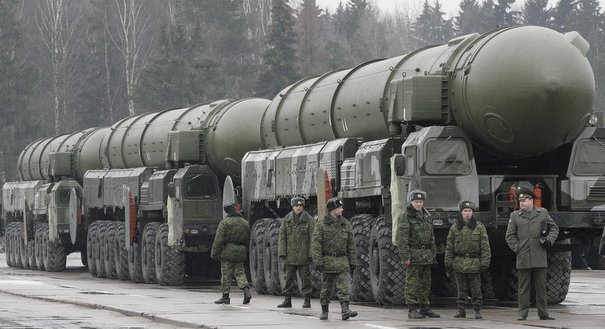
From a U.S. perspective, this outcome would be deeply undesirable. Although the United States signed the INF Treaty almost 30 years ago in a quite different geopolitical context with a state (the Soviet Union) that no longer exists, the agreement still serves the security interests of the United States and its allies. It prohibits the development, testing or possession of ground-launched cruise and ballistic missiles with ranges of between 500km and 5,500km, whether they are armed with nuclear or nonnuclear warheads. Such weapons—including the ground-launched cruise missile that Washington has accused Russia of developing and deploying—would pose a genuine military threat to U.S. allies in both Europe and East Asia.
This threat would probably be most serious in Europe, where the United States’ strategy to defend NATO’s eastern flank in the event of a war with Russia relies on rapidly reinforcing the relatively modest number of alliance troops that are stationed there. By using banned missiles—most likely armed with conventional warheads—to threaten key transport nodes and pre-positioned equipment, Russia could severely undermine this strategy’s viability. It is, therefore, very much in the U.S. national interest to make a concerted (if last minute) effort to preserve the treaty—by inducing Russia to come back into compliance—even if the odds of success are poor.
Recent discussions about how to achieve this aim have, to a large extent, turned into a debate about which weapons the United States should deploy in response to Russia’s violation. Such deployments may well be necessary, but they are unlikely to be sufficient to induce Russia to return to compliance by themselves.
What is needed now is a strategy—comprising diplomatic, economic and military components—to create three realities that Moscow cannot ignore. First, the costs associated with continued noncompliance will outweigh any benefits. Second, these costs will be removed if Russia comes back into compliance. Third, any solution will allow Moscow to save face.
The United States has multiple options to change Moscow’s cost-benefit calculation about the consequences of violating the treaty. The deployment of both offensive and defensive weapons is one approach. For starters, the United States and NATO should make a major investment in cruise missile defense. Defending large areas against cruise missiles is next to impossible. However, to help deny Russia the benefits of deploying a prohibited cruise missile, the United States and NATO need only make discrete targets—such as key transport notes—significantly less vulnerable. This more modest goal could be accomplished—relatively quickly, affordably and without controversy—with the deployment of the existing Patriot Advanced Capability 3.
The United States could also impose costs on Russia by deploying offensive weapons, including heavy bombers and JASSM-ER cruise missiles. Doing so would be more controversial and increase tensions with Russia, but these risks would be worth running precisely because such deployments would create a genuine military problem for Russia, and hence an incentive to rethink the INF Treaty’s value.
At the same time, economic and diplomatic approaches to imposing costs should not be ignored. Moscow has apparently developed a short-range export version of its prohibited cruise missile. The United States and its allies could launch a major diplomatic initiative to dissuade potential buyers from purchasing this missile, as a way of cutting off a source of income for Russia (much as the United States led a global effort to restrict sales of Iranian oil as a way of forcing Tehran to negotiate limits on its nuclear program). While the loss of revenue to Russia might be relatively modest compared to the totality of its arms exports, Moscow might worry that, if it did not return to compliance with the INF Treaty, the United States would attempt to block more sales.
Such efforts would be aided by the United States releasing more information about the Russian violation. Some senior officials within the administration of President Barack Obama wanted to do just that, but were stymied by concerns from the intelligence community about compromising the sources and methods used to collect intelligence. While such concerns are understandable and demand selectivity in any information release, it is high time for the United States to substantiate its claim of Russian noncompliance publicly.
By itself, cost imposition is unlikely to be effective, however. Moscow must also believe that if it does return to compliance, the pain will be alleviated. After all, if Moscow judged that, say, U.S. military deployments nominally intended to counter Russia’s INF violation would not be rolled back under any circumstance, it would have little incentive to return to compliance.
There is no easy solution to this problem, but the United States and NATO can take steps to mitigate it. They should identify, publicly and precisely, which future force deployments are connected to Russia’s INF violation and which are not. They should, publicly and repeatedly, commit to reversing the former if Russia comes back into compliance with the treaty. Such assurances would probably be somewhat more effective if they were conveyed personally to Russian President Vladimir Putin by the leaders of the European states on which the deployments occurred. The development or deployment by the United States of weapons prohibited by the treaty would undermine such efforts and should be avoided.
Finally, Washington should present Moscow with a solution that allows Russia to save face. In this regard, it may be paradoxically helpful that Russia has leveled its own charges of noncompliance with the INF Treaty against the United States.
Although two of these charges have no merit, a third claim cannot be easily dismissed. Under the so-called European Phased Adaptive Approach, the United States is deploying ground-based Standard Missile-3 interceptors in Romania and Poland for missile defense. The launchers for these systems are modified versions of the Mk-41 Vertical Launch System, which is also used for launching cruise missiles from ships. Moscow argues that, because of this capability, the deployment of these launchers on land violates the treaty. The United States counters that the land-based version has been modified in ways that prevent it from launching cruise missiles—but Moscow’s ongoing concern is understandable nonetheless.
Against this background, Washington should offer Moscow a deal: Russia will be permitted to inspect ground-based missile defense launchers in Europe to verify they have been modified to ensure they cannot be used to launch cruise missiles, if the United States is permitted to inspect Russia’s banned cruise missiles to verify that they have been modified to ensure compliance with the treaty’s range limits. Before making this offer, the United States should consult with its NATO allies—Romania and Poland, in particular—to secure their support.
A precedent for such an offer comes from 2007, when the administration of President George W. Bush was planning to deploy a missile-defense radar in the Czech Republic. It offered to permit Russian inspections to confirm that the radar was oriented toward Iran and not Russia. Given the deal suggested here would be based on strict reciprocity, it should be more acceptable to the U.S. body politic than the Bush administration’s offer, which required Russia to do nothing in return.
Russia turned down the 2007 offer and, in the short term, it seems extremely unlikely that it would take the United States up on this one. But Washington should leave the offer on the table. If it is successful, over time, at imposing costs on Russia for its violation, Moscow just might start looking for a way out.

Jessica T. Mathews Chair, Co-director, Nuclear Policy Program
Acton holds the Jessica T. Mathews Chair and is co-director of the Nuclear Policy Program at the Carnegie Endowment for International Peace.
Recent Work

James M. Acton, Ankit Panda
James M. Acton
Carnegie does not take institutional positions on public policy issues; the views represented herein are those of the author(s) and do not necessarily reflect the views of Carnegie, its staff, or its trustees.

The EU can impose sanctions but struggles to enforce them without the United States. With Washington increasingly disinterested in backing European interests, the bloc must now fend for itself.


Nicu Popescu, Tiago Antunes

Russia is testing the waters of NATO’s mutual defense clause. What do strikes in Romanian territorial waters mean for the alliance’s posture toward Moscow?

Dimitar Bechev

Europe is facing rising populism internally as well as external pressures from Russia, China, Turkey, and the United States.
Dimitar Bechev

A summer of escalation in the Black Sea has hurt Ukraine economically and is exacerbating world food security. A truce is needed—as is a broader reframing of Europe’s Ukraine strategy.

Thomas de Waal

European Commission President Ursula von der Leyen is about to give her annual address on the state of the EU. Here’s what she won’t—but should—say.

Rym Momtaz