

Commentary
Andrei Kolesnikov
{
  "authors": [
    "Andrei Kolesnikov"
  ],
  "type": "legacyinthemedia",
  "centerAffiliationAll": "",
  "centers": [
    "Carnegie Endowment for International Peace",
    "Carnegie Russia Eurasia Center"
  ],
  "collections": [
    "Inside Russia"
  ],
  "englishNewsletterAll": "",
  "nonEnglishNewsletterAll": "",
  "primaryCenter": "Carnegie Endowment for International Peace",
  "programAffiliation": "",
  "programs": [],
  "projects": [],
  "regions": [
    "Russia"
  ],
  "topics": [
    "Political Reform"
  ]
}
Source: Getty
Moscow, with its 13 million residents, is Russia’s most progressive city. But its citizens are not homogenous and cohesive. But after the authorities began intruding on their private space, Muscovites started to unite. They are no longer a resource supporting the political regime. The movement to defend private property rights just might give birth to a sense of civic pride.
Source: Moscow Times
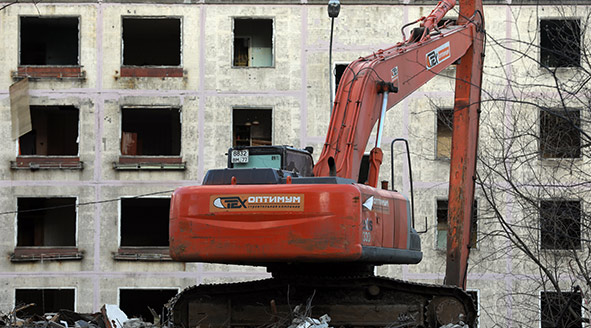
The most important political issue in Moscow this spring is the authorities’ plan to demolish thousands of 50-year-old, five-story buildings.
On one hand, the Khrushchevka apartments—built at the behest of Soviet leader Nikita Krushchev—are increasingly dilapidated and depressing. Who wouldn’t want to move from a crumbling apartment and into a modern replacement on the city’s dime? Moscow Mayor Sergei Sobyanin was certain Muscovites would embrace his proposal.
With the polls in his favor and Putin onboard the plan was sprung into motion just one year before both the presidential and Moscow mayoral elections. But to the authorities’ shock, their plan is encountering stiff resistance. Each building is full of people with feelings, memories, and a sense of ownership. This is what the authorities overlooked.
Moscow authorities have long ignored feedback. This is why opposition to demolishing the city’s historic sites and parks, and the construction of new buildings in the middle of neighborhood commons has recently grown fierce.
These conflicts have already led huge numbers of Muscovites to organize at the local level and to a lesser extent, to their politicization.
Then came the project to demolish old apartment buildings — a measure affecting one in every 10 Muscovites and one that has nearly erupted into a political crisis.
That is why Putin demanded that Moscow authorities respect citizens’ rights during the demolition, and why — after protests — Moscow authorities now promise concessions.
Authorities have not bothered to ask why it is that so many people prefer to stay in their aging, cramped apartments. Historically, the decision to evict people from their apartments is a story about private property rights in a country that has always had vague understanding of the concept.
The Soviet authorities not only offered no protection of ownership rights—the very idea of private ownership was considered shameful and inconsistent with communist values.
Khrushchev clearly broke with that tradition: by moving people out of Stalin-era communal apartments that they had been forced to share with numerous neighbors, he gave them personal space and private territory. Now, an erstwhile builder of communism would come home, slam the door behind him, and thus transform into a private individual free to do as he pleased within the confines of his allotted space.
This sense of ownership was passed on from one generation to the next. It was here, in these cookie-cutter apartment blocks, that the Soviet middle class was born (and from which the Russian bourgeoisie emerged).
In the more prosperous 1970s, when oil prices were high, the mantra of “apartment—car—dacha” occupied a far more central place than any Marxist-Leninist slogan in the average Soviet mind. The Khrushchevka apartment effected a true, Soviet-style bourgeois revolution.
In the “state capitalism” prevailing in modern Russia, the concept of property rights is blurred. Many believe that land and resources belong to everyone—and that influential businesspeople have probably stolen both — though the “apartment—car—dacha” mantra remains as compelling as ever.
By pushing their program of mass demolitions so abruptly and rudely, Moscow authorities have encroached on citizens’ personal space. These few square meters with tiny adjoining rooms, microscopic bathrooms, kitchens too small to turn around in, and a view of a few trees from the window—are the only things that people could call their own. Now, a hostile outside force is about to invade that space and take it away.
Another factor here is a widespread distrust of the state and ruling authorities — and in this case, of Moscow officialdom. Muscovites have no doubt that they will be dealt with treacherously, that their new apartments will not be as good or better, but worse than before, and that they will inevitably come out the losers in any deal initiated by the authorities.
The people are willing to support rulers at the level of symbols — Crimea, the “greatness of the Russian state,” and the memory of the WWII. But they are unwilling to gamble their vested interests against the promises of the authorities.
Moscow, with its 13 million residents, is Russia’s most progressive city. But its citizens are not homogenous and cohesive. But after the authorities began intruding on their private space, Muscovites started to unite. They are no longer a resource supporting the political regime. The movement to defend private property rights just might give birth to a sense of civic pride.
Former Senior Fellow, Carnegie Russia Eurasia Center
Kolesnikov was a senior fellow at the Carnegie Russia Eurasia Center.
Recent Work
Andrei Kolesnikov
Andrei Kolesnikov
Carnegie does not take institutional positions on public policy issues; the views represented herein are those of the author(s) and do not necessarily reflect the views of Carnegie, its staff, or its trustees.

The EU can impose sanctions but struggles to enforce them without the United States. With Washington increasingly disinterested in backing European interests, the bloc must now fend for itself.


Nicu Popescu, Tiago Antunes

Russia is testing the waters of NATO’s mutual defense clause. What do strikes in Romanian territorial waters mean for the alliance’s posture toward Moscow?

Dimitar Bechev

Europe is facing rising populism internally as well as external pressures from Russia, China, Turkey, and the United States.
Dimitar Bechev

A notable degree of participative democracy has firmly arrived in Europe. But to have more far-reaching impact, democratic deliberation needs to move into a radically new phase.

Richard Youngs

Before the next wave of EU enlargement takes place, the union needs to grapple with thorny questions of how power is distributed among its members.


Emil Sondaj Hansen, Ditte Brasso Sørensen