

Article
Dalia Ghanem
{
  "authors": [
    "Dalia Ghanem"
  ],
  "type": "legacyinthemedia",
  "centerAffiliationAll": "dc",
  "centers": [
    "Carnegie Endowment for International Peace",
    "Malcolm H. Kerr Carnegie Middle East Center",
    "Carnegie Russia Eurasia Center"
  ],
  "collections": [],
  "englishNewsletterAll": "menaTransitions",
  "nonEnglishNewsletterAll": "",
  "primaryCenter": "Malcolm H. Kerr Carnegie Middle East Center",
  "programAffiliation": "MEP",
  "programs": [
    "Middle East"
  ],
  "projects": [],
  "regions": [
    "Maghreb",
    "Algeria",
    "North Africa"
  ],
  "topics": [
    "Political Reform"
  ]
}
Source: Getty
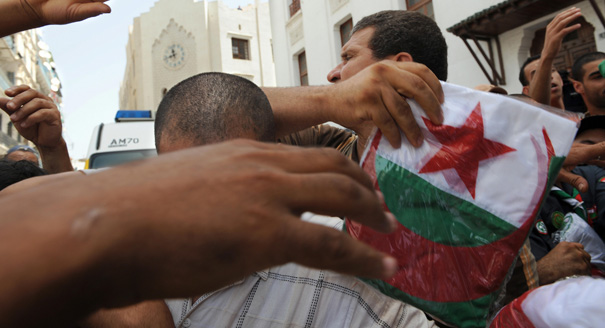
Following the Arab uprisings, the Algerian regime exhibited a remarkable degree of stability and continuity as it adapted to the new local, regional and international realities.
Source: The Italian Institute for International Political Studies
Algeria has recently been at the center of multiple discussions and speculations. Several analysts believe that the country is about to face the second wave of the so-called “Arab Spring”. The regime would collapse and a civil war would follow. Six years after the Arab uprisings, the Algerian regime showed a remarkable degree of stability and continuity. The regime adapted to the new local, regional and international realities. The relative peace and more broadly the regime’s longevity can be explained by the combination of elements from both authoritarianism and democracy. The Algerian regime is in fact a hybrid one. To preserve itself while managing democratization demands, the regime opened up the political arena, allowed for more freedom of association and speech, liberalized (selectively) the economy while continuing to co-opt large and diverse interest groups and personalities and to use coercion to avoid social unrest.
The first mechanism used to maintain the regime while managing democratization demands is liberalization of the political arena. Algeria took the first step towards liberal democracy in the Arab world and that was in 1989. We can argue that the experience was short (1989-1991), messy and untidy, yet the one-party system ended, civil society bloomed and competitive elections were held for the first time in the country. Since the advent of the multi-party system, 15 elections have been held regularly, among them five presidential elections. More recently, in 2012 electoral reforms were initiated to liberalize the party registration process and many parties were allowed to register. There are 23 parties today. The arena is mainly divided between nationalist groups, Berbers, democrats, independents and Islamists who have been integrated into the political game since 1995. More recently, in 2016, electoral reforms were also adopted to enhance individual and collective freedom, improve voting and women’s participation as well as strengthening election oversight with creation of an independent electoral commission. However, these democratic elements are mixed with authoritarian ones such as the oppression of opposition figures, legal obstacles to party formation and financing as well as restrictions of access to both media and funds. Fraud and gerrymandering stratagems make the elections safe for the regime. Hence, the dominant party of power, National Liberation Front (FLN), wins the majority of votes and keeps a tight grip on parliament. Nonetheless, opposition parties remain significant in national politics yet outsized margins are common but they are more “realistic” to avoid people’s derision. Co-optation, clientelism, patronage are embedded political subterfuges used to maintain the regime and reinforce the status quo.
The second mechanism is in the media and the associative arena. Algeria has one of the most vibrant presses on the African continent. There are 269 accredited publications, including 140 daily newspapers (six are believed to be operated by the government), 16 weekly and 31 monthly magazines and several specialized publications. Online news media has boomed with the development of the 3G network. Social media gave youth a virtual space for contestation and platforms such as Facebook became important safety valves to soothe social pressure. Even if the Internet is not restricted, the state monitors Internet activities and electronic communications. Coercion is used when the state judges that limits have been crossed. Journalists, cartoonists, bloggers, publishers, editors and human right activists can be harassed, arrested or jailed, newspapers seized, and news organizations sabotaged by means of taxes and regulations. As for the associative world, there are 1,027 national and 92,627 local associations legally registered in the country. Yet, the regime restricted their influence and eroded their capacities to constitute a significant challenge with a number of legal, financial and political actions.The third instrument is economic liberalization. The Algerian state remains the main economic actor in the country. However, since 2001 it has introduced reforms to boost the private sector and foreign investment. Yet the economic reforms are selective and meant to enrich regime supporters and strengthen alliances between important businessmen and their political allies.
The fourth tool is coercion. The security forces, such as the police and the gendarmerie, receive important material incentives to protect the regime from dissident groups. A crucial player remains the military apparatus that detains the locus of power in Algeria. It is the most professionalized and organized institution in the country. Despite popular criticism, most Algerians see it as the “savior” that prevented the radical Islamic Salvation Front (FIS) from seizing power and was able to ensure the stability of the country. The military apparatus capitalizes on the population’s fear (which is well-founded) of instability and change - especially with the dangerous situation along the borders with neighboring Tunisia, Libya and the Sahel - to justify, locally and internationally, its grip on power, as the country became a pivotal ally for the US and Europe in the fight against terror.
The military apparatus remains the source of decision-making in Algeria with a strong grip on Algerian society and politics. Even if the older generation is disappearing, it had plenty of time to socialize with and educate new recruits to its visions and way of actions. Except in 1989, the military apparatus never went back to their barracks and are unlikely to do so anytime soon. For the aforementioned reasons, the regime is not likely to crumble even if it faces a fragile situation with the succession problem. The succession of Bouteflika is a delicate issue and might introduce a moment of instability, yet the Algerian regime has resources to deal with it, and the emergence of weak spots (if any!) will make its old reflexes reappear. The military “young” Generals who do not want to antagonize the civil society as they did in the 1990s, seem likely to accept a slow but steady transition that would put a more representative and consensual government and president in place. It is possible that the political-military elite is currently trying to organize a consensus around a figure who will preferably be a civilian, a “présidentiable”, someone with historical legitimacy and an acceptable level of public support. But again, one cannot be certain about Algeria’s political-military apparatus’ next step, nor about the durability of Algeria’s civil society and political parties’ consensus on the need for a peaceful transition.
Former Senior Resident Scholar, Malcolm H. Kerr Carnegie Middle East Center
Dalia Ghanem was a senior resident scholar at the Malcolm H. Kerr Carnegie Middle East Center in Beirut, where her research focuses on Algeria’s political, economic, social, and security developments. Her research also examines political violence, radicalization, civil-military relationships, transborder dynamics, and gender.
Recent Work
Dalia Ghanem


Frances Z. Brown, Judy Dempsey, Dalia Ghanem, …
Carnegie does not take institutional positions on public policy issues; the views represented herein are those of the author(s) and do not necessarily reflect the views of Carnegie, its staff, or its trustees.

A notable degree of participative democracy has firmly arrived in Europe. But to have more far-reaching impact, democratic deliberation needs to move into a radically new phase.

Richard Youngs

Before the next wave of EU enlargement takes place, the union needs to grapple with thorny questions of how power is distributed among its members.


Emil Sondaj Hansen, Ditte Brasso Sørensen

As the EU confronts profound challenges, several leaders have called for fundamental reform to the union’s model—but only modest, superficial changes have resulted. What if Europe really could be reimagined from zero today: What should such a redesigned European order look like?
Richard Youngs, ed.

The EU’s new migration policy is not suited to today’s realities. With climate change increasingly becoming a driver of displacement, Europe needs to rethink its deterrence-focused approach.

Shana Tabak
Preparing candidate countries for EU membership is no longer enough. As the enlargement process becomes a reality, the union must also prepare its own societies.

Iliriana Gjoni