

Commentary
Dmitri Trenin
{
  "authors": [
    "Dmitri Trenin"
  ],
  "type": "legacyinthemedia",
  "centerAffiliationAll": "",
  "centers": [
    "Carnegie Endowment for International Peace",
    "Carnegie Russia Eurasia Center"
  ],
  "collections": [],
  "englishNewsletterAll": "",
  "nonEnglishNewsletterAll": "",
  "primaryCenter": "Carnegie Russia Eurasia Center",
  "programAffiliation": "",
  "programs": [],
  "projects": [],
  "regions": [
    "North America",
    "United States",
    "East Asia",
    "China",
    "Russia",
    "North Korea"
  ],
  "topics": [
    "Foreign Policy"
  ]
}
Source: Getty
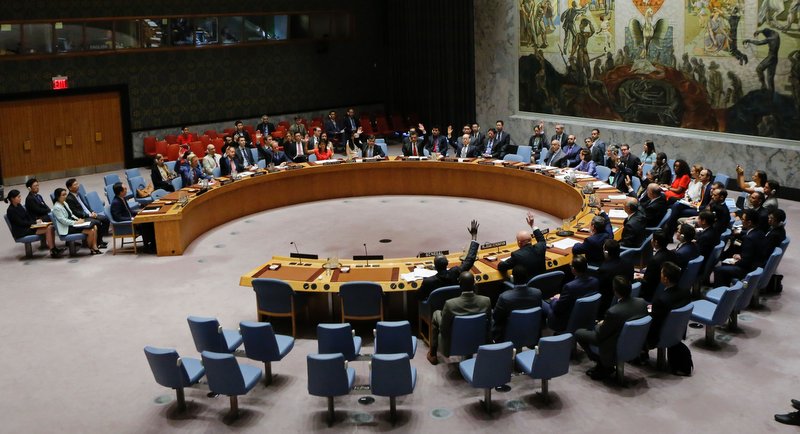
Recent US sanctions against China and Russia are signs of the Trump administration’s toughening approach to North Korea. Ironically, these sanctions come on the heels of a UN Security Council resolution imposing new measures against North Korea that the US, China and Russia voted in favor of.
Source: Global Times
Recent US sanctions against China and Russia are signs of the Trump administration’s toughening approach to North Korea. Ironically, these sanctions come on the heels of a UN Security Council resolution imposing new measures against North Korea that the US, China and Russia voted in favor of.
The idea behind the US-ordered sanctions is to get Beijing to do what Washington itself has been unable to achieve, namely to make Pyongyang give up its plans of developing and testing long-range missiles capable of delivering a nuclear weapon to US territory. In the US’ thinking, China is the only outside player capable of coercing North Korea by cutting off economic links to it. As for Russia, it is viewed by most in Washington as an openly hostile power. Another recent piece of US legislation puts Moscow in the same category as Tehran and Pyongyang.
From the beginning of his presidency, Donald Trump tried to persuade Chinese President Xi Jinping to take a much harsher stance on North Korea. Initially "encouraged" by his Chinese counterpart’s attitude, he is now “disappointed” with Beijing’s failure to “deliver” North Korea to Washington. Displeasure leads to pressure.
The sanctions now being imposed on various Chinese entities are just one instrument in Trump’s toolbox. More consequential will be deployments of US Terminal High Altitude Area Defense and Aegis Ashore missile defense systems in South Korea and Japan, which are aimed at protecting against North Korean launches, but have a serious capability against China’s nuclear arsenal.
These deployments would probably be there anyway, but North Korea’s recent tests undermine whatever opposition there has been in South Korea to them.
Moreover, heightened tensions around North Korea could lead to the US’ alliances with both Japan and South Korea becoming stronger, thus reducing Beijing’s influence in Seoul, a major economic partner. Should President Trump decide that the 1987 INF Treaty with Moscow must be abandoned, in view of alleged Russian violations and the growth of North Korea’s — and China’s — medium-range missile fleet, Washington could proceed with developing and deploying relevant US systems, creating a situation in Northeast Asia similar to that in Europe during the early-to-mid 1980s, when the Soviet Union faced the prospect of a US strike against its command and control centers from a close distance.
As a result, China may be put at a strategic disadvantage, but this will hardly make North Korea abandon its goal. The China connection is a lifeline to North Korea, but Pyongyang is largely impervious to outside pressure on issues which it considers top national security priority. Gaining a security policy in the form of a guaranteed delivery of a nuclear warhead to US territory is such a priority. The North Korean leadership calculates that only the risk of losing a US city can safely deter Washington from attacking North Korea.
The Trump administration will no doubt seek to deny North Korea such a capability. In principle, it can use various methods, from destabilizing the Pyongyang regime to taking out Kim Jong-un in some sort of a decapitating strike, to trying to eliminate North Korea’s nuclear and missile assets. In 1962, former US president John F. Kennedy walked right to the brink to get Nikita Khrushchev to withdraw Soviet missiles from Cuba. Although the two situations are hardly similar, there is no more tolerance now for Kim than there was then for Khrushchev.
That said, China and Russia must take the US refusal to be deterred by North Korea seriously, and draw practical conclusions from this. Beijing and Moscow need to be realistic about the chances of their own joint proposal of mutual restraint between Washington and Pyongyang. Trump will not want to display weakness and be seen as Kim Jong-un’s appeaser. As for Kim, his willingness to negotiate seriously will logically follow North Korea’s attainment of a deterrence capability, not precede it.
In these circumstances, China and Russia should continue to seek diplomatic means of reducing the risk of confrontation so close to their borders. They need to stay busy with their channels of communication with both Koreas. Yet, they also have to work through scenarios involving a major crisis, military incidents, even a war, breaking out on the Korean Peninsula in the next couple of years, and coordinate their actions if one of these scenarios becomes a reality.
Former Director, Carnegie Moscow Center
Trenin was director of the Carnegie Moscow Center from 2008 to early 2022.
Recent Work
Dmitri Trenin
Dmitri Trenin
Carnegie does not take institutional positions on public policy issues; the views represented herein are those of the author(s) and do not necessarily reflect the views of Carnegie, its staff, or its trustees.

The new U.S.–Denmark–Greenland agreement will help Washington exert political, economic, and financial dominance under the guise of security. Yet, it acknowledged Copenhagen’s and Nuuk’s sovereignty on the island.

Marc Pierini

A summer of escalation in the Black Sea has hurt Ukraine economically and is exacerbating world food security. A truce is needed—as is a broader reframing of Europe’s Ukraine strategy.

Thomas de Waal

Are Germany’s economic, industrial, and political struggles becoming a liability for the EU’s ability to rise to the geopolitical moment?

Rym Momtaz, ed.

European Commission President Ursula von der Leyen is about to give her annual address on the state of the EU. Here’s what she won’t—but should—say.
Rym Momtaz

Radical-right parties are expected to do well in upcoming elections in four of the EU's biggest member states. If successful, they could prevent the union from addressing key challenges ahead.

Stefan Lehne