During the G20 summit in Hamburg in July, Beijing unexpectedly opened a new frontier of Internet censorship: users of the social network Weibo were prevented from sharing and commenting on posts mentioning Vladimir Putin. As Weibo users quickly noticed, the content of the post was unimportant; only the popularity of its author mattered. All posts and comments about Putin were impossible to engage with if the poster had more than a thousand friends.
The Financial Times first reported on the story on July 10, concluding that the censorship signaled a golden age of Sino-Russian relations. As Chinese journalist Cai Shenkun told the FT, Putin is the first foreign leader to have the privilege of being shielded from criticism on the Chinese Internet. Usually, such protection is reserved for China’s top leaders.
This explanation was refuted quickly, however. By the time the article came out, the ban on all Putin-related content had been lifted, its removal as unexpected as its introduction. It is noteworthy that articles about Putin were not, in fact, prohibited (only their dissemination was), and it remains unclear what criticism of the Russian president the Chinese censors were expecting.
Indeed, the logic and mechanics of Chinese Internet regulation are not as simple as they appear. The list of prohibited words and topics is always changing, and censorship can be constant or momentary, implemented in connection with international and domestic developments or to mark important dates.
One way or another, after the conclusion of the G20 summit, new articles mentioning Putin’s name could again be freely commented on and widely shared. As such, if some kind of logic informed the ban, it did not concern Sino-Russian relations or even the president himself.
Articles that were fairly critical of relations with Russia were not censored whatsoever before, during, or after the “special period” of the July 7–8 G20 summit. The FT’s July 3 Chinese-language essay on Beijing’s foreign policy, for example, written by the famous Chinese political scientist Deng Yuwen, remained uncensored on social networks, blogs, and some information portals in China itself—despite the fact that the article went as far as to call on China to completely avoid close ties with Moscow.
The FT shared a link to its Deng Yuwen article on its Weibo account three times. Not one of these posts was censored, and users were able to freely repost and comment on them. It is unlikely that Weibo’s administrators and state censors simply missed this, given that FT’s Weibo account is not only foreign but also influential, with 1.5 million subscribers. By contrast, posts about Putin were frozen from July 7 to July 8 if their authors had a mere thousand subscribers.
The Chinese experts I surveyed were not certain of the logic behind the censors’ actions during the G20 summit meeting. One authoritative international affairs expert told me that the logic of the Chinese bureaucratic machine was not worth speculating about: “First, it appeared to them that undesirable Putin-related content posed some kind of danger. Later, they saw that nothing was going on, and lifted the ban on comments and reposts.”
Some experts agreed that the ban on undesirable comments speaks to the state of Sino-Russian relations and the unique character of the two countries’ partnership, and that it showed Beijing’s desire not to damage bilateral relations. That said, they could not explain why interest in censoring information about Putin was so short-lived and coincided perfectly with the G20 summit.
Several sources familiar with Internet censorship explained that Chinese news websites had received instructions to block personal attacks on the Russian president. But this doesn’t explain everything: July 7–8 saw censorship not just of attacks but of the dissemination of any and all information about Putin.
Here, the story starts to unravel. A survey of topics published by the party’s main newspaper, the People’s Daily, shows that during the Hamburg summit, Putin was mentioned in the newspaper’s pages only once, in a report about an informal BRICS meeting that took place on the sidelines of the G20 and was chaired by Xi Jinping.
Completely missing from the pages of the People’s Daily was a topic that was at the center of the Russian and international press attention in early July: the first meeting between Vladimir Putin and Donald Trump.
With this in mind, the Putin censorship appears to have been an attempt to draw the Chinese people’s attention away from Russian-American talks. It’s no mystery why this was done. In the year of a party conference, commentary on any domestic and international developments must focus on Xi Jinping. Preparing a media strategy for the G20 summit, Chinese propaganda organs did all that they could to ensure that talks between Putin and Trump did not eclipse China’s participation in the G20 summit meeting.
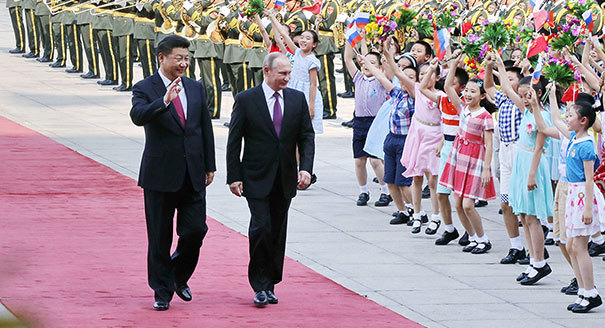
The censors’ sensitivity to anything related to the “core” of the Chinese political machine, Xi Jinping, has multiplied in recent months. When China’s delegation arrived slightly late to a meeting between Xi and Putin at the Shanghai Cooperation Organization’s June summit, Putin joked to Xi, who was sitting across from him: “A lone warrior!” The quote, which spread quickly in the Russian press, terrified Chinese censors. They did everything to stop the video clip’s dissemination online and deleted written transcripts of the episode, as well as memes and popular comments discussing it.
The image of a leader abandoned by his allies at a crucial moment, after all, is not befitting of a strong ruler like Xi.