

Commentary
The new U.S.–Denmark–Greenland agreement will help Washington exert political, economic, and financial dominance under the guise of security. Yet, it acknowledged Copenhagen’s and Nuuk’s sovereignty on the island.
Marc Pierini
{
  "authors": [
    "Jen Psaki"
  ],
  "type": "legacyinthemedia",
  "centerAffiliationAll": "",
  "centers": [
    "Carnegie Endowment for International Peace"
  ],
  "collections": [],
  "englishNewsletterAll": "",
  "nonEnglishNewsletterAll": "",
  "primaryCenter": "Carnegie Endowment for International Peace",
  "programAffiliation": "",
  "programs": [],
  "projects": [],
  "regions": [
    "North America",
    "United States"
  ],
  "topics": [
    "Foreign Policy"
  ]
}
Source: Getty
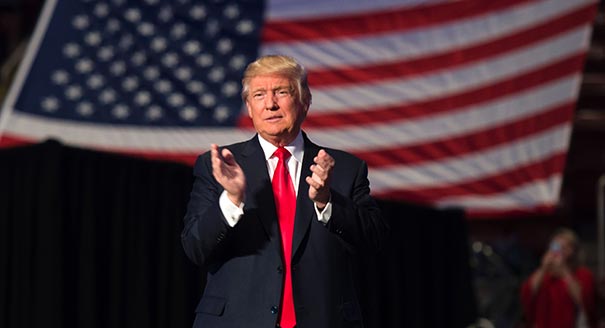
On international issues, Trump’s bark has often been stronger than his bite.
Source: CNN
In any year, the UN General Assembly meetings are part "Model UN," with nearly every country in the world sending representatives to a small radius of New York City hotels, and part diplomatic speed dating, where the President of the United States is the hot date.
This last purpose intensifies in a year when there is a new president: The two-week meeting becomes a first chance to get up close and personal with the new leader of the free world.
In 2009, President Barack Obama's presence was met with the same high expectation, and he used his speech in front of the General Assembly to urge the world to come together to address the global threat of climate change. This speech set the stage for the diplomatic work that happened behind the scenes in the years leading up to the Paris climate accord in 2016.
And -- again, behind the scenes -- the United States has used the UNGA as a backdrop for significant diplomatic actions. We did in 2013, when President Obama and President Hassan Rouhani spoke for the first time on the phone, as the Iranian President headed to the airport, and in 2014, when the United States announced the support of a 60-member coalition and the first round of air strikes against ISIS.
But this year, it is clear that at the leader level we simply don't have the capacity or the interest in being the drivers of the global agenda we once were. We are no longer in the territory of 2016, when President Obama focused his speech on the role of the United States as a force for good.
World leaders, we need you this week. Before I continue, it is important to reiterate that even through this period of our history, America hopes that you do maintain the kind of give-and-take relationship you have had with the American president and his team for decades, through ups and downs in history.
As Americans, we know it is hard to understand the thinking and the strategy of the American president. But you shouldn't spend too much time trying to figure it out. The dirty little secret is sometimes it does not appear there is a strategy.
But it is important to remember that President Trump responds to two things. The first is strength and the second is deal-making. You need to speak to President Trump about how decision-making will affect him, his popularity and his strength.
He has also shown that he respects and values the recommendations of the military. He has shown deference to Defense Secretary Jim Mattis and the recommendations of his team.
Secretary of State Rex Tillerson has not shown an interest in spending as much time as his predecessors actively negotiating or engaging with the world. But he has shown himself to be a voice of reason on some key issues, including the Paris climate agreement and the need for a diplomatic approach to North Korea.
It is hard to tell from the outside how much influence he wields internally, but in him, world leaders, you may find a helpful sounding board.
And there are a few issues where you should focus your attention-- because they are present in our debates in the United States.
First, North Korea. There is no question that this will be a central topic of President Trump's speech Tuesday --and on his mind during private meetings. Unfortunately, North Korea has provided the best opportunity for Trump and his team to exhibit what they perceive as strength by using fiery rhetoric.
As you well know, military action has never been off the table, but it has also never been the preferred option. We are at the point where we need to know exactly what the Trump administration's plan is behind the scenes. And we could use your help extracting that information. What diplomatic path is the military threat leveraging? Does President Trump understand that China has different objectives from the United States? And what is his "day after" plan if he were to take military action?
Finally, I would recommend reiterating to the President that you know the American military is the best in the world, but that the consequences and fallout of military action could affect the perception of his leadership and his ability to get things done.
Second, the Iran deal. While President Trump made the decision last week to continue the sanctions waivers as part of the 2015 nuclear deal, his team may refuse to certify compliance next month, throwing the matter back into the hands of Congress.
He needs to hear that this passive move may sound good on the surface, but the international community is on to him. He will be blamed when the sanctions regime falls apart and Iran is in a position where it is, once again, taking steps toward acquiring a nuclear weapon, out of sight from the global community.
World leaders can and should acknowledge that the deal is not perfect, but also reiterate, having been through the years of negotiations, that there is no better deal to be had. The consequences of this falling apart could amount to a major crisis for the remainder of his presidency.
Third, Paris climate accord. As you know, there are plenty of advocates for the agreement within the administration and, given that it is not a binding agreement, President Trump's announcement that he would withdraw the US from it has not toppled the deal. But it is worth explaining to him that his decision has given an opening to China to form a closer partnership with the European Union, something China has wanted to pursue for some time.
And instead of a position of strength, the decision to back out of the climate accord has removed Trump and his team from the negotiating table, making the United States more of an outlier than a powerful global force led by a powerful agenda-setting president.
If time: Human rights: Raising human rights and media freedom around the world will, sadly, not be at the top of many of your lists during your visit, but there is an opening to speak out about them -- particularly with a receptive American media -- given the virtual silence of this administration. Becoming a voice on these issues at a time when the United States' President is silent could help position your own voice on the global stage.
In conclusion, take heart. On international issues, Trump's bark has often been stronger than his bite.
UNGA also comes at a critical time for decision-making on North Korea and Iran, specifically. There are a number of officials from both political parties who do not want to see the Iran deal unravel or a war develop with North Korea. We appreciate your help in advocating for sensible approaches with the administration.

Jen Psaki
Former Nonresident Scholar
Jen Psaki was a nonresident scholar at the Carnegie Endowment for International Peace.
Carnegie does not take institutional positions on public policy issues; the views represented herein are those of the author(s) and do not necessarily reflect the views of Carnegie, its staff, or its trustees.

The new U.S.–Denmark–Greenland agreement will help Washington exert political, economic, and financial dominance under the guise of security. Yet, it acknowledged Copenhagen’s and Nuuk’s sovereignty on the island.

Marc Pierini

A summer of escalation in the Black Sea has hurt Ukraine economically and is exacerbating world food security. A truce is needed—as is a broader reframing of Europe’s Ukraine strategy.

Thomas de Waal

Are Germany’s economic, industrial, and political struggles becoming a liability for the EU’s ability to rise to the geopolitical moment?

Rym Momtaz, ed.

European Commission President Ursula von der Leyen is about to give her annual address on the state of the EU. Here’s what she won’t—but should—say.
Rym Momtaz

Radical-right parties are expected to do well in upcoming elections in four of the EU's biggest member states. If successful, they could prevent the union from addressing key challenges ahead.

Stefan Lehne