

Paper
Constantino Xavier
{
  "authors": [
    "Constantino Xavier"
  ],
  "type": "legacyinthemedia",
  "centerAffiliationAll": "dc",
  "centers": [
    "Carnegie Endowment for International Peace",
    "Carnegie India"
  ],
  "collections": [],
  "englishNewsletterAll": "ctw",
  "nonEnglishNewsletterAll": "",
  "primaryCenter": "Carnegie India",
  "programAffiliation": "SAP",
  "programs": [
    "South Asia"
  ],
  "projects": [],
  "regions": [
    "South Asia",
    "India",
    "Eastern Europe",
    "Western Europe"
  ],
  "topics": [
    "Economy",
    "Trade",
    "Global Governance"
  ]
}
Source: Getty
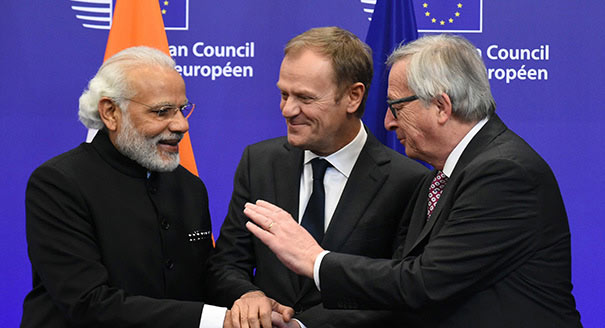
To counter the rise of isolationist, unilateral, and authoritarian forces, India and the Europe must strengthen their relationship beyond mere economic and transactional arrangements.
Source: Hindu
As India and the European Union (EU) meet at their 14th summit today in New Delhi, they must go beyond business as usual. Trade and investment, science and technology, and innovation and education will remain on the Indo-European partnership platter, but such tactical cooperation will prove meaningless unless it is given a strategic and democratic direction to navigate an increasingly hostile global environment.
With the U.S. reducing its global footprint and China moving in to fill the vacuum, this is the right time for New Delhi and Brussels to join hands in defence of the liberal order. Taking such a lead entails not merely protecting the international principles and institutions that have underpinned the development, security and stability of both India and Europe, but also reforming the multilateral architecture to prevent the rise of isolationist, unilateral and authoritarian forces.
For inspiration on how to steer their relationship ahead, European and Indian officials will have to look no further than the landmark resolution passed last month by the European Parliament. On September 13, 751 parliamentarians from 28 states resolved that the EU-India partnership “has not yet reached its full potential,” and called on Brussels and New Delhi to “strengthen their efforts in promoting effective, rule-based multilateralism” and address security challenges with “respect for international law and cooperation among democratic states.”
How can India and Europe further deepen their partnership? Delhi has also accelerated outreach efforts in the Baltic and Central and Eastern Europe region, where China’s formidable Belt and Road Initiative (BRI) is changing the balance of power and threatening European unity. But if India is serious about engaging the EU and presenting itself as an alternative to China, it will have to open its market to European goods, services and investments. India will also have to invest in greater coordination security cooperation with Europe in overlapping spheres of influence. For example, it is puzzling that India continues to stay away from the EU-coordinated naval escort missions for the UN World Food Programme in the Indian Ocean, when China has already participated 11 times.
For the EU, the challenge is to openly recognise that beyond mere economic and transactional interests, democratic India makes for a much more attractive and sustainable partner than China. Rooted in its democratic institutions and open societies, the Indian and European world views are far more similar than usually assumed. This is increasingly manifested in their converging interests to ensure Eurasian connectivity plans that are truly multilateral, and also financially and environmentally sustainable; the protection of international legal principles such as the freedom of navigation; or the development of regulatory frameworks that foster scientific and technological innovation under the rule of law.
As the world’s two largest democracies, it is now time for Europe and India to infuse their relationship with a liberal vision for a transformed global order.
Former Fellow, Carnegie India
Constantino Xavier was a fellow at Carnegie India, based in New Delhi. His research focus is on India’s foreign policy, with emphasis on relations with its neighboring countries and South Asian regional security.
Recent Work
Constantino Xavier
Constantino Xavier
Carnegie does not take institutional positions on public policy issues; the views represented herein are those of the author(s) and do not necessarily reflect the views of Carnegie, its staff, or its trustees.

With its public finances in shambles, the far right polling at 35 percent ahead of the 2027 presidential election, and a growing protest movement, is France’s crisis a threat to the EU’s geopolitical awakening?

Rym Momtaz, ed.

While the EU and European governments are embracing the much-lauded middle-power moment, this entails three difficult conundrums.

Richard Youngs

Europe is facing rising populism internally as well as external pressures from Russia, China, Turkey, and the United States.

Dimitar Bechev

A notable degree of participative democracy has firmly arrived in Europe. But to have more far-reaching impact, democratic deliberation needs to move into a radically new phase.
Richard Youngs

Much has been said of the changes Brussels is trying to make to the EU enlargement process. Here’s why gradual integration might—or might not—be the answer.
Dimitar Bechev