

Commentary
Joseph Bahout
{
  "authors": [
    "Joseph Bahout"
  ],
  "type": "legacyinthemedia",
  "centerAffiliationAll": "dc",
  "centers": [
    "Carnegie Endowment for International Peace",
    "Malcolm H. Kerr Carnegie Middle East Center"
  ],
  "collections": [],
  "englishNewsletterAll": "menaTransitions",
  "nonEnglishNewsletterAll": "",
  "primaryCenter": "Carnegie Endowment for International Peace",
  "programAffiliation": "MEP",
  "programs": [
    "Middle East"
  ],
  "projects": [],
  "regions": [
    "Middle East",
    "Lebanon",
    "Levant"
  ],
  "topics": [
    "Political Reform"
  ]
}
Source: Getty
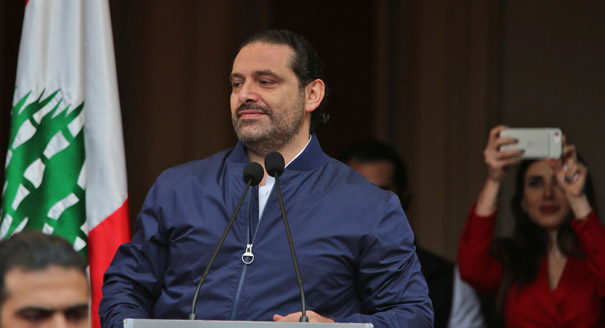
Two months after the political turmoil in Lebanon, which placed its prime minister under the world’s scrutiny, Lebanese politics seem to have resumed.
Source: Institut Montaigne
Two months after the political turmoil in Lebanon, which placed its Prime Minister under the world’s scrutiny, Lebanese politics seem to have resumed. What lies behind this apparent return to normality, and what will be the next steps for the country? Joseph Bahout, visiting scholar in Carnegie's Middle-East Program and associate researcher at the Crown Center for Middle East Studies at the University of Brandeis, shares his analysis.
The situation is as follows: right now, Saudi Arabia has somewhat lost its bet. The kingdom wanted to force the Lebanese government to resign in order to overthrow the current alliances, thus reshaping the country’s political state of affairs, which has been the same for over a year. This bet, which is aligned with Saudi Arabia’s regional policy of escalation against Iran, aimed to target Hezbollah and isolate the party until it would have been withdrawn from the governmental structure.
This strategy failed for several reasons, though not all of them have yet been clearly revealed:
Saudi Arabia was forced to release Hariri so that Lebanon could return to the status quo that had prevailed until then, despite the kingdom’s difficulty to concede defeat.
However, everything seems to suggest, and I strongly believe, that the current situation in Lebanon can only be temporary. It is a truce, a moment suspended in time before Saudi Arabia’s "return match" on the Lebanese stage, most likely planned for the upcoming elections in Spring. What will happen then? The question remains open.
As a consequence, the relationship between Hariri and Saudi Arabia, which was strong and organic at first, is now so damaged that it is probably broken for good.
Hariri has undoubtedly benefited from a renewed popularity, especially amongst the Sunnis. The biggest flaw in the Saudis’ strategy was probably that they did not understand the psychology of the Sunni people, who felt humiliated by this event and rallied around their leader. Although some disapprove of Hariri’s policy, they did not tolerate the way he was treated. Saudi Arabia’s influence has thus declined among the Lebanese population.
In the meantime however, Hariri has lost Saudi Arabia’s support, his most significant and faithful regional ally. Consequently, he may have lost their financial support as well, yet a necessity to survive in Lebanese politics. The way Hariri will approach the next elections will be decisive for the rest of his political career: a situation worth following closely in the coming months. Especially since paradoxically, those who “saved” him were his political rivals, namely Hezbollah and President Aoun. He now finds himself entangled in an alliance he has somehow been forced to join. His position is far from easy and makes one wonder whether he will politically survive the legislative elections.
I do not think that the Israeli-Lebanese tension, which is structurally ingrained into the region’s dynamics, will be affected by such a phenomenon, which nonetheless remains below the threshold of explosion. These are mostly words and speeches.
I rather believe that a potential deflagration could be provoked by the dynamics that will emerge from the Syrian conflict, the rise of Iran's role in Syria and the global tensions between Iran, Israel, and the Gulf countries. This is where I think the main triggers of a possible confrontation lie. Of course, the Palestinian issue, Jerusalem’s liberation and the calls for rebellion all remain very powerful mobilizing elements for Hezbollah, but they are certainly not detonators of a future conflict.
The Sunni/Shiite division in Lebanon is ancient and precedes the current Sunni/Shiite regional tension. It began after the end of the Lebanese civil war, which started in 1975 and ended with the Taif agreements in 1989. It indirectly explains the assassination of Rafik Hariri back in 2005 and the eruption of the crisis between the two Lebanese Muslim communities. It is also anterior to the 2010/2011 turning point, when the region’s Sunni/Shiite division effectively burst into a conflict - although it is true it had already been sharpened by the Iraq war of 2003.
Paradoxically, the tension is currently partially deflating. Part of the Sunni street resents the Saudis for Saad Hariri’s treatment, even though the majority of non-Shiite Lebanese remains very suspicious, if not bitter, about the rise of Hezbollah in the region. Nonetheless, most Lebanese are altogether satisfied of living in their country’s relative stability, which comes as a relief after years of insecurity and fear that the Syrian cauldron might pour into their country.
Therefore, the explicit animosity between the two Muslim communities contradicts the fact that none of them wants to actually confront each other, and both seek ways of conciliation instead. That is why Hariri’s current policy, despite some criticism, surprisingly finds a lot of support among Sunnis.
This article was originally published by the Institut Montaigne.
Former Nonresident Fellow, Middle East Program
Joseph Bahout was a nonresident fellow in Carnegie’s Middle East Program. His research focuses on political developments in Lebanon and Syria, regional spillover from the Syrian crisis, and identity politics across the region.
Recent Work
Joseph Bahout
Joseph Bahout
Carnegie does not take institutional positions on public policy issues; the views represented herein are those of the author(s) and do not necessarily reflect the views of Carnegie, its staff, or its trustees.

A notable degree of participative democracy has firmly arrived in Europe. But to have more far-reaching impact, democratic deliberation needs to move into a radically new phase.

Richard Youngs

Before the next wave of EU enlargement takes place, the union needs to grapple with thorny questions of how power is distributed among its members.


Emil Sondaj Hansen, Ditte Brasso Sørensen

As the EU confronts profound challenges, several leaders have called for fundamental reform to the union’s model—but only modest, superficial changes have resulted. What if Europe really could be reimagined from zero today: What should such a redesigned European order look like?
Richard Youngs, ed.
The EU’s new migration policy is not suited to today’s realities. With climate change increasingly becoming a driver of displacement, Europe needs to rethink its deterrence-focused approach.

Shana Tabak
Europe seems to have accepted its sidelining in the Middle East. The EU must reassert its support for the international rules-based order and step up engagement.

Rym Momtaz