

Research
- +4
Milan Vaishnav, Rahul Verma, Rukmini S., …
{
  "authors": [
    "Christophe Jaffrelot"
  ],
  "type": "legacyinthemedia",
  "centerAffiliationAll": "dc",
  "centers": [
    "Carnegie Endowment for International Peace"
  ],
  "collections": [],
  "englishNewsletterAll": "ctw",
  "nonEnglishNewsletterAll": "",
  "primaryCenter": "Carnegie Endowment for International Peace",
  "programAffiliation": "SAP",
  "programs": [
    "South Asia"
  ],
  "projects": [],
  "regions": [],
  "topics": [
    "Political Reform",
    "Democracy"
  ]
}
Source: Getty
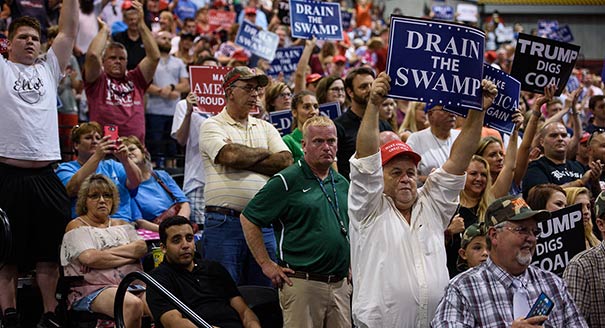
Populism is by nature extremely personalized. It tends to short-circuit political parties and institutions in general by talking to their people directly and personally. This phenomenon is unlikely to disappear anytime soon.
Source: Indian Express
We are living in an era of populism, but populism is not easy to define. It is not an ideology. It is not, for instance, either right or left wing. But it is not simply demagoguery either. In that sense, the notion of a “populist budget” is misleading: A populist leader does not only promise good things to everybody — even though to be a merchant of dreams is an important part of his politics — he also articulates a political style.
Populists claim to represent the people. This pretension places them above any institution, including the judiciary, because they identify with the people’s sentiments, sense of justice and morality. One of the most successful populists of South Asia, Zulfikar Ali Bhutto, used to tell the crowds at his meetings: “There are two Zulfikar Ali Bhuttos, me and the one who is in each of you!” The populist claims he represents everybody as if the whole nation had voted for him. He’s the people’s voice, be they 200 million or 1.2 billion. Hence formulas such as “India is Indira and Indira is India”.
Populists repudiate pluralism, for the people can only be one and they are the people. This explains their tendency to disqualify their rivals, and even reject the multiparty system of democracy. For them, adversaries are enemies and elections like wars that are aimed at eliminating the others — hence formulas like “Congress-mukt Bharat”. Even the party of the populist, usually named as if it epitomised the nation, like Silvio Berlusconi’s Forza Italia, does not matter much. In fact, its candidates to parliament or chief ministership are nominated by the supremo according to a vertical chain of command.
Populism implies a strong concentration of power, as it is by nature extremely personalised: The populist leader relates directly to “his” people, short-circuiting his own political party and all institutions in general. Communication is possibly his most important weapon. He does not take the risk of debate (with whom could he have a debate?) or proper press conferences, but talks to his people directly, on a regular basis somewhat personally (on radio, for instance) and saturates the public sphere to show that nobody can compete with him — exist even. Today, social media and holograms contribute to this ubiquity — that is rather costly. In fact, populist leaders need a lot of money for their political communication, and in particular for paying the PR firms which market them.
But they cannot appear in public with the crony capitalists who pay for their expenditures because they are supposed to be anti-establishment. Their combat against the elites is an integral part of their repertoire, even when they are in no way plebeians but simply belong to a sector of the elite that is different from the political set, like Donald Trump.
That is enough to make them “outsiders”, even after years at the head of some multinational company or state government. Even then the populist claims that he’s not a politician. Indeed, he sometimes is a manager, like Thaksin Shinawatra in Thailand. When he’s not, he may present himself as the CEO of his country because of the aura of effectiveness of the private firms among the middle class, the core electoral base of the populists that is particularly exposed to his discourse. However, populists have to prove that they are with the people against the establishment. For that they have to use the rights words — not only simple words, but harsh words — and denounce the ruling elite that is usually closed on itself (if not dynastic) and corrupt.
The role of speech is all the more important as the populist must convince his audience that he embodies the people above class divisions, which are presented as secondary, if not mere illusions. The populist thus constantly makes use of what a theorist of populism, Ernesto Laclau, has called “empty signifiers”, such as “America first” or “New India”.
Many populists have seized power through a military coup. In fact, quite a few of them were army men, especially in Latin America (Juan Peron and Hugo Chavez are cases in point). But populism generally develops within democracies, because this political style flourishes more easily in a public space offering freedom of expression. Once in office, however, it makes democracy shrink. Democratic regimes are based on a demotic pillar that implies regularly held and fairly contested elections as well as on a liberal pillar upheld by the rule of law guaranteed by an independent judiciary — without which elections do not remain free and fair for long.
The populist hypertrophies the demotic aspect of democracy at the expense of the liberal aspect: Since he represents the people, other institutions cannot compete with him; legality cannot compete with legitimacy. As a result, Viktor Orban, the Hungarian strongman, is not shy of advocating “illiberal democracy” and Mahinda Rajapaksa dared to clip the wings of Sri Lanka’s Supreme Court.
Populists generally rise to power in the wake of a social or moral crisis connected with an economic crisis and/or corruption scandals. In such a context, his targets can either be “the big bad guys” (among them, the political rulers, even politicians in general) or “the others,” meaning “foreigners” or “non-sons of the soil”.
Such a sequence gives rise to what Gino Germani named “national populism”, an “ism” with obvious affinities with the nationalist right or even the extreme right. For, while populism can be rightwing or leftwing, national populism calls up a clearly identifiable ideological repertoire. In fact, this brand of populism has been the most successful one in history: It took over power in several European countries in the inter-war period. It is back in a different form today. Anti-semitism has been replaced by a pervasive hostility to migrants and even, sometimes, by Islamophobia.
Indeed, the Muslim is the new Other across the globe. And this Other is easily projected as posing a threat to vulnerable-nations-in-quest-of-strong-men-to-protect-them because of the terrorist activities of jihadists in almost all the countries where populists are in the fray. The populists exploit such antagonism in order to polarise their society: Paradoxically, those who claim that they are the incarnation of the people divide this people along religious, racial or linguistic lines to win elections through majoritarian tactics.
But the societies affected by populism suffer from one more pathology, socio-economic frustrations due to joblessness or rising inequalities and unmet expectations. The issue is not as acute everywhere but it helps almost systematically the populists who can make promises to the frustrated aspiring sections, use idle vigilantes at the time of canvassing and designate scapegoats that the same young men are (trigger) happy to lynch on the altar of their anger.
Populists are here to stay, not only to take revenge over soft targets, but also to make people dream. In that regard, they are demagogues in the sense the first Greek democrats gave the word, in other words, expert manipulators, not only by skillfully pandering to the people and playing on their affects, but also by promising to address their concerns. The populists do not explain public policies, they are always campaigning, even when they are in office, as if they were still in the opposition, not accountable. They keep promising happy days to come.
This article was originally published in the Indian Express.
Former Nonresident Scholar, South Asia Program
Jaffrelot’s core research focuses on theories of nationalism and democracy, mobilization of the lower castes and Dalits (ex-untouchables) in India, the Hindu nationalist movement, and ethnic conflicts in Pakistan.
Recent Work

Milan Vaishnav, Rahul Verma, Rukmini S., …
Christophe Jaffrelot
Carnegie does not take institutional positions on public policy issues; the views represented herein are those of the author(s) and do not necessarily reflect the views of Carnegie, its staff, or its trustees.

A notable degree of participative democracy has firmly arrived in Europe. But to have more far-reaching impact, democratic deliberation needs to move into a radically new phase.

Richard Youngs

The domestic impacts of how long it is taking to end the war in Ukraine have pushed the French electorate to the political extremes and compromised the country’s diplomatic capacity.

Rym Momtaz

Before the next wave of EU enlargement takes place, the union needs to grapple with thorny questions of how power is distributed among its members.


Emil Sondaj Hansen, Ditte Brasso Sørensen

Radical-right parties are expected to do well in upcoming elections in four of the EU's biggest member states. If successful, they could prevent the union from addressing key challenges ahead.

Stefan Lehne
An overwhelming victory by a far-right-wing party in a small state in eastern Germany will have major repercussions for Chancellor Friedrich Merz’s coalition.

Judy Dempsey