

Commentary
Funding Ukraine remains a priority for European leaders. As Russia’s war of aggression heads into another winter, two feasible options to mobilize support for Kyiv should be fast-tracked.
Vladyslav Rashkovan, Gregory P. Wilson
{
  "authors": [
    "François Godement",
    "Abigaël Vasselier"
  ],
  "type": "legacyinthemedia",
  "centerAffiliationAll": "dc",
  "centers": [
    "Carnegie Endowment for International Peace",
    "Carnegie China",
    "Carnegie Russia Eurasia Center"
  ],
  "collections": [
    "Belt and Road Initiative"
  ],
  "englishNewsletterAll": "asia",
  "nonEnglishNewsletterAll": "",
  "primaryCenter": "Carnegie Endowment for International Peace",
  "programAffiliation": "AP",
  "programs": [
    "Asia"
  ],
  "projects": [],
  "regions": [
    "East Asia",
    "China",
    "Western Europe"
  ],
  "topics": [
    "Economy",
    "Foreign Policy"
  ]
}
Source: Getty
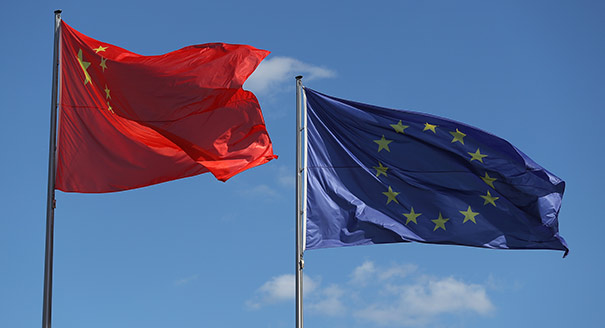
As China’s influence grows, Europe starts to have an increasing quest for reciprocity and is turning to realist engagement with China.
Source: European Council on Foreign Relations
Since 2009, the time of the European Council on Foreign Relations’ first Power Audit, China has become more present and influential within Europe. This is no longer only about a massive trade surplus; it is also about investment, lending, and financial power which serves China’s public diplomacy. What has not changed is the asymmetry claimed by China as a developing economy, even as it reaches the first rank among global economies. And it explains the increasing quest for reciprocity by Europeans.
China practises “pick and choose” in its relations with the European Union, focusing on its direct interests, and often ignoring EU norms in its proposals. It has vastly increased efforts to strengthen bilateral relations with member states, putting special emphasis on Europe’s periphery. China holds its own summit with central and eastern European nations, the so-called 16+1, and it seized the opportunity of the euro crisis for massive takeovers in southern Europe. Fascinatingly, its offers and their packaging are not very different from those offered to African and other developing nations: a flurry of projects creating competition among recipients, loans at commercial rates, and a strong insistence on identical statements and agreements.
China is now inside Europe. Its soft power diplomacy relies on repetitive and positive messages. There is a gold rush by some European figures, while many companies, media groups, and universities seek to protect their access to the Chinese market.
The EU has been learning from the experience of difficult–or sometimes inexistent–relations. New agreements are missing, even on trade and economic issues which are at the core of the interest for Europe. The agreed Agenda 2020 for political and security cooperation with China is fulfilled only minimally–with human rights and humanitarian aid as the most disappointing areas. This gap is also explained by the opportunistic behaviour of many–but not all–member states. Climate and environment issues seem more promising, but at the 2017 EU-China summit, China held a joint statement on climate hostage to its dispute on market economy status. Europe does not link together different issues. It seeks engagement with China on peacekeeping and support for fragile states, but at best these actions happen only side by side and not jointly.
Europe is turning to realist engagement with China, getting over the mirage of cash from China. China is strengthening its command economy, turning to full state-led industry and technology policies, including their military applications. In Europe, this means acquisition of critical technologies, scientific cooperation agreements mirroring China 2025 goals, and other massive plans to lead the fourth industrial revolution.
A requirement for reciprocal opening has entered European policy statements on China. The European Commission has proposed new trade defence instruments and has expanded an initiative by three core member states on investment screening. This is not a turn to protectionism. Europe seeks engagement rather than confrontation, but must also gear up for a China that is presently unresponsive to its requests.
To do this, this Power Audit of EU-China relations proposes the following priorities:
This report was originally published by European Council on Foreign Relations.

Former Nonresident Senior Fellow, Asia Program
Godement, an expert on Chinese and East Asian strategic and international affairs, was a nonresident senior fellow in the Asia Program at the Carnegie Endowment for International Peace.

Abigaël Vasselier
Director, Policy and European Affairs, MERICS
Abigaël Vasselier is director for policy and European affairs at MERICS.
Carnegie does not take institutional positions on public policy issues; the views represented herein are those of the author(s) and do not necessarily reflect the views of Carnegie, its staff, or its trustees.

Funding Ukraine remains a priority for European leaders. As Russia’s war of aggression heads into another winter, two feasible options to mobilize support for Kyiv should be fast-tracked.


Vladyslav Rashkovan, Gregory P. Wilson

While the EU and European governments are embracing the much-lauded middle-power moment, this entails three difficult conundrums.

Richard Youngs

Europe is facing rising populism internally as well as external pressures from Russia, China, Turkey, and the United States.

Dimitar Bechev

A notable degree of participative democracy has firmly arrived in Europe. But to have more far-reaching impact, democratic deliberation needs to move into a radically new phase.
Richard Youngs

Much has been said of the changes Brussels is trying to make to the EU enlargement process. Here’s why gradual integration might—or might not—be the answer.
Dimitar Bechev