Russia is traditionally viewed as an unpredictable country whose motivations can seldom be understood rationally. But May 7, 2018, will be remembered as an exception to the rule: Dmitry Medvedev—the new/old prime minister nominated by the recently reelected president Vladimir Putin—announced a truly new government. And that was entirely predictable.
The newly nominated officials perfectly fit the country’s current internal political moment and represent the conclusion of a long transition to authoritarian governance.
And Putin’s new term—his fourth—already stands out for the total clarity of its domestic policies. They will be based upon the quiet rejection of development and change amid enormous successes in “creative accounting” and reporting the country’s achievements and propaganda.
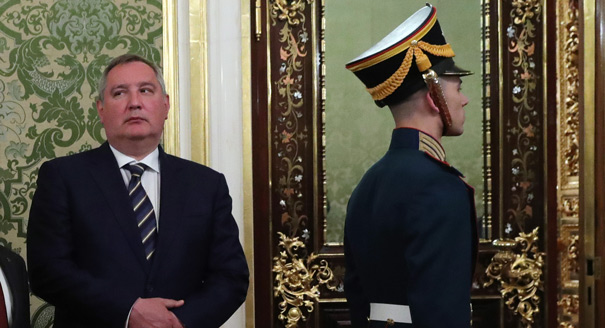
The new Russian government is particularly interesting because of who is absent. There is not a single new face from among the country’s political and economic heavyweights. There won’t be a single old one of that caliber, either. Deputy prime ministers Arkady Dvorkovich and Igor Shuvalov are out. If their counterpart, defense hawk Dmitry Rogozin, were staying, it would look like a victory for the “security clan.” But he is not, and the dismissals are evenly spread across the political spectrum.
It is hardly surprising that important politicians have lost interest in government work. Why be a bureaucrat with a small salary living in eternal fear of a public flogging or an anti-corruption investigation, when you can head a state corporation for an astronomical salary, start your own business and receive generous state contracts, or simply make money as a consultant or lobbyist? But, surprisingly, the president did not insist that any heavyweight join the government.
We can draw only one conclusion from this: like the State Duma, the government will cease to be a place for discussion, formulating strategies, and implementing policies. Instead, the Kremlin will assume those responsibilities, and the presidential administration will function as the true government and congress.
The presidential administration, de facto led by a long-trusted ally of former Russian president Boris Yeltsin, Sergey Kiriyenko, famous for bringing fire upon himself in 1998 by declaring a default on the Russian internal debt, has now done what even the president’s biggest apologists would not expect: it has organized decorative, manipulative, but quite honest elections, and the president has won them with a margin and turnout exceeding even the bravest expectations. Predictably, Putin’s trust in the presidential administration is at the highest level, and its significance has only grown as a result.
The future government will feature notably more deputy prime ministers with significantly narrower and more unusual areas of responsibility. Why, for example, should there be a deputy prime minister for construction—especially one who, as minister of sport, presided over a doping scandal that led to Russia’s shameful ejection from the Olympics?
And despite the country’s catastrophic international predicament, not a single international relations specialist will serve as a deputy prime minister. In fact, foreign policy will remain completely outside the deputy prime ministers’ purview. But an ephemeral “digital economy”—a fetish of our era and the main “cargo cult” of contemporary Russia—will be supervised by a deputy PM.
By all appearances, the government will become a classic Soviet ispolkom (a purely Soviet-type “executive committee” whose goal had always been to convey and supervise the execution of the decisions of the party committees)—a place neither for the “siloviki” clan, nor for the technocrats, but for technicians and qualified executives preoccupied with the technicalities of the moment. These will be obedient officials who quickly and accurately forward documents, create orders on the basis of presidential decrees and instructions, and write reports that meet expectations.
There is one more important detail: the decision to appoint Finance Minister Anton Siluanov to the office of first deputy prime minister and retain Elvira Nabiullina as central bank governor. This tells us that the president does not consider the catastrophic situation in the private banking sector or the de facto nationalization of the financial sector to be a problem, but even more it speaks to the high quality of Russia’s macroeconomic monetary policy over the last few years. This appointment is an eloquent rejoinder to all the critics of strict monetarism, both left and right. There will be no uncontrolled monetary emission, concessional loans, or other types of loose monetary policies for the economy à la Venezuela. This is likely the only good news.
This technical government has received completely technical orders that mix vague strategic goals and minor practical tasks. Luckily, the strategic goals can be completely ignored, as their phrasing invites exceedingly broad interpretation—including that they have already been achieved. And the government can easily report that the minor tasks are completed, regardless of reality, thanks to the developed technology of “window dressing” the Russian authorities have always been famous for.
For example, what does Putin’s promise to make Russia one of the five largest economies on Earth mean? If it refers to nominal GDP, Great Britain is the fifth with its GDP 80 percent larger than Russia’s and growing at 2 percent per year. Meanwhile, in 2018, Russian GDP will likely demonstrate 1 percent growth in the best-case scenario.
If Russia’s GDP were to grow at 3.5 percent a year and Britain’s were to continue growing at 2 percent, Russia would need forty years to catch up to the UK. To catch up with Britain in twelve years, Russia would need 7 percent annual GDP growth. But even if Russia overtook the UK, it wouldn’t be fifth. India, now seventh, would be ahead—it is growing at 7 percent a year and its GDP is 60 percent larger than Russia’s.
Of course, there are other ways to achieve this goal—on paper. If we measure GDP by purchasing power parity—a tool popular among poorer economies for its artificial increase of their size—then Russia lags behind fifth place (held by Germany) by only 4.5 percent. Of course, Germany today is growing faster than Russia, but that is irrelevant. All Russia’s statistical agency must do is lower purchasing power parity by a further 10 percent. Then, the president’s task will be complete, and Russia will have overtaken Germany.
Or how, for example, shall we treat the task of ensuring a “total fertility coefficient of 1.7,” if it is already above 1.7 in Russia? Maybe the president meant a similar coefficient, representing a number of births per 100 citizens per year? Then, for Russia it is 1.2, but the 1.7 level is much higher than the European average, and more likely to appear in Arab countries and places like Iran, Costa Rica, Guyana, and Argentina. Russia already has a fertility rate higher than any European country while having a population with a fairly European lifestyle and social behavioral patterns. In global conditions where quality-of-life improvements lead by default to decreased fertility, this goal appears unachievable. But there is likely some flexibility here. For example, the coefficient may be treated as only applicable to Russians of child-bearing age.
Addressing the goal set in the president’s decree for the death rate in the employable population is probably also not difficult. Currently, that mortality in Russia is falling slowly (at approximately 2 percent a year). It now stands at a level of 530 deaths per 100,000 working-age citizens. In six years, it should naturally fall to 470 people per 100,000. The president has set the goal at 450. So, nothing must be done except, perhaps, an alternation of the methodology for calculating the employable population. Even lowering the official head count by 1–2 percent would yield the needed result. Of course, this complicates the question of whether to increase the pension age. If that goes up, the mortality index will also rise sharply.
Many tasks can also be accomplished simply by allocating funds and choosing an oligarch who will pocket most of the money. Russia can easily build many rural medical centers (regardless of the provision of necessary equipment and/or adequate staffing, as has happened many times in recent history in other fields) or pour money into state corporations and declare them and their subsidiaries “inventive” companies.
And, of course, in most cases the authorities can simply change the methodology for calculating whether a task has been completed. For example, it is easy to compose a rating by which Russia would become one of the “top ten leading countries by quality of general education”—even if that ranking is not recognized by anyone but the Kremlin.
Speaking metaphorically, the content of President Putin’s new term is clear: Russia has recognized that it is stuck in the middle of the ford between socialism and capitalism. Luckily, the stream dividing them is full of oil. Its fate in the coming decades is life without movement, sunken into the stream. We will hear constant assurances that Russia will soon cross over onto the proper shore. Of course, each citizen will be free to decide which one is proper.
And one task will consume Russia’s leaders: how to convincingly declare the river’s muddy bottom to be solid ground and standing half-submerged to be Russia’s successful end destination.