

Research
- +4
Milan Vaishnav, Rahul Verma, Rukmini S., …
{
  "authors": [
    "Christophe Jaffrelot"
  ],
  "type": "legacyinthemedia",
  "centerAffiliationAll": "dc",
  "centers": [
    "Carnegie Endowment for International Peace"
  ],
  "collections": [],
  "englishNewsletterAll": "ctw",
  "nonEnglishNewsletterAll": "",
  "primaryCenter": "Carnegie Endowment for International Peace",
  "programAffiliation": "SAP",
  "programs": [
    "South Asia"
  ],
  "projects": [
    "India Elects 2019"
  ],
  "regions": [
    "South Asia",
    "India"
  ],
  "topics": [
    "Political Reform",
    "Democracy",
    "Religion"
  ]
}
Source: Getty
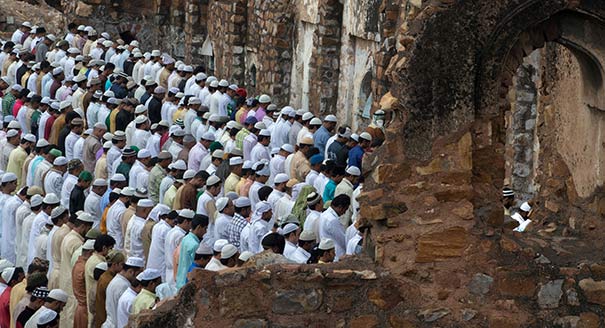
Muslim MPs currently occupy 19 seats of the Lok Sabha (or 3.5 percent of its members), the lowest figure since 1952.
Source: Indian Express
Muslim MPs currently occupy 19 seats of the Lok Sabha (or 3.5 percent of its members), the lowest figure since 1952. Between 1980 and 2014, the representation of Muslim MPs in the lower house of India’s Parliament has diminished by nearly two-third even as the share of Muslims in the population rose during the same period. Consequently, the gap between their proportion of the population (which rose from 11.1 to 14.2 percent between 1981 and 2011) and that of their elected representatives in Lok Sabha (which dropped from 9 per cent in 1980 to 3.5 percent currently) has increased five-fold, jumping from two to 10 percentage points. Responsibility for this trend lies primarily with the BJP, which since 1980 has fielded only 20 Muslim candidates in general elections, of which only three won.
In 2009, the BJP fielded four Muslim candidates, or 0.48 percent of the total, and only one got elected. In 2014, it fielded seven Muslim candidates out of 428 (less than 2 percent) and none were elected. For the first time in India’s history, the winning party in the general elections had no Muslim in its parliamentary group in Lok Sabha. For the first time also, in UP, where Muslims make up over 18 percent of the population and where the BJP won 71 out of 80 seats, not a single Muslim MP got elected (compared to 6 in 2009 and 10 in 2004), until the recent by-election in Kairana.
The BJP’s decision not to field any Muslim candidates aims to liberate the party entirely from the “Muslim vote” that it accuses other parties of wooing for electoral gain at the expense of the Hindu majority. The low representation of Muslims also stems from other parties, who are reluctant to field Muslim candidates in constituencies other than those with a high concentration of Muslim voters. This tactic was especially clear in the Congress’ case, which the BJP accused of cultivating a Muslim vote bank by showing concern for their social and economic condition — a false concern if one goes by the impoverishment of Muslims in the UPA regime.
The BJP’s accusation of minority favouritism falls flat when one considers that the Congress hasn’t fielded more than 7 percent Muslim candidates since the early 1990s, when its decline accelerated. In 2009, the Congress, unwilling to embrace its traditional secularism, only endorsed 29 Muslim candidates (or 7 per cent of the total), of whom only 10 won seats. In 2014, only 7 of the 31 Congress Muslim candidates won. The Congress is hardly a “Muslim party” if one goes by factual evidence.
In recent years, most Muslim MPs come from regional parties, mostly in the Hindi belt and in West Bengal. Among non-Muslim regional parties, only the RJD, SP, TMC and CPI(M) have fielded a percentage of Muslim candidates higher than the share of Muslims in their respective states. That said, Muslims represented only 10 percent of all mainstream political parties’ candidates, out of which only 20 got elected (3.7 percent).
The situation is not significantly different at the state level. Among the 14 major states (barring Punjab) that went to polls since 2014, Muslims represent 9.3 percent of the total candidates and 7.1 percent of the MLAs. As of January 2018, out of 1,418 BJP MLAs, only four were Muslim and only two members of the BJP state governments (excluding the BJP’s coalition partners) were Muslim. This situation holds true as much in states where the BJP has been governing for a long time (such as Gujarat, where the party did not endorse a single Muslim candidate since 2007) as for those it recently conquered, such as Assam (34 percent Muslim), where out of 61 MLAs, it has only two Muslim elected representatives.
Each time the BJP conquers a new state, the number of Muslim MLAs drops. The most spectacular example is found in UP where, in 2017, their proportion went from 17 to 6 per cent. While the figure of 17 percent, achieved in 2012 mainly thanks to the success of the SP, had brought the share of Muslim MLAs closer to their share of the population in UP, the figure of 6 per cent, associated with the BJP’s landslide victory, reflects an underrepresentation comparable to that of 1991, when the party had already taken control of the state.
This drop in Muslim representation is less stark in bipolar states where the BJP and Congress are opposed to each other, particularly in northern and western India, where the Hindu nationalists traditionally have the greatest influence. In those states, the attempt to form a Hindu vote bank by the BJP has prompted the Congress (and other parties) to nominate few Muslim candidates, for fear of a Hindu backlash.
In Maharashtra, whatever the winning party, the share of Muslims among MLAs has never exceeded 5 percent (that is, half the proportion of Muslims in the state), including when the Congress won, because it never endorsed more than 7 percent of Muslim candidates. In Gujarat, Muslim MLAs already made up no more than 1 percent of the assembly in 1990, prior to when the BJP came to power — and they have remained at this level, as the Congress never fields more than half a dozen Muslim candidates in Vidhan Sabha elections. The situation is comparable in MP and in Karnataka. In Rajasthan, by contrast, the Congress has always fielded the same number of Muslim candidates since the 1990s, despite the rise of Hindu nationalism. More interesting still, this number — between 13 and 14, or at least 8 percent of its candidates — is nearly proportionate to the share of Muslims in the population (9 per cent in 2011).
The dwindling representation of India’s largest minority in elected assemblies matters because in India, substantive representation (of the interests of a group) is linked to descriptive representation (their numerical presence in elected assemblies). An analysis of Lok Sabha parliamentary questions conducted by Saloni Bhogale reveals that the number of questions concerning minorities is linked to their presence in Parliament. In other words, institutions care about minorities as long as their members are represented in them.
This article was originally published in the Indian Express.

Former Nonresident Scholar, South Asia Program
Jaffrelot’s core research focuses on theories of nationalism and democracy, mobilization of the lower castes and Dalits (ex-untouchables) in India, the Hindu nationalist movement, and ethnic conflicts in Pakistan.
Recent Work

Milan Vaishnav, Rahul Verma, Rukmini S., …
Christophe Jaffrelot
Carnegie does not take institutional positions on public policy issues; the views represented herein are those of the author(s) and do not necessarily reflect the views of Carnegie, its staff, or its trustees.

Before the next wave of EU enlargement takes place, the union needs to grapple with thorny questions of how power is distributed among its members.


Emil Sondaj Hansen, Ditte Brasso Sørensen

Radical-right parties are expected to do well in upcoming elections in four of the EU's biggest member states. If successful, they could prevent the union from addressing key challenges ahead.

Stefan Lehne

An overwhelming victory by a far-right-wing party in a small state in eastern Germany will have major repercussions for Chancellor Friedrich Merz’s coalition.

Judy Dempsey

In supporting Europe’s far-right, MAGA and Russia both want the same thing: a weaker EU. Europe must defend itself without abandoning the openness these forces exploit.

Armida van Rij

The hybrid warfare landscape is evolving rapidly, leaving policymakers without clear strategies. To better inform their work in addressing emerging challenges, governments must dig deeper into the underlying dynamics at play.


Raluca Csernatoni, Alicia Wanless